This post is actually just the Japanese debuts in May, because this was an unusually quiet month that only had three new games. That means it coincidentally had about the same number of new releases in each of the three regions. Japan had an even quieter June after this, which you might attribute to the bubble, but releases were more normal from July onward.
As always, ratings are out of 5 and reflect only how much I’d want to play them today. The ratings are heavily skewed towards 1.

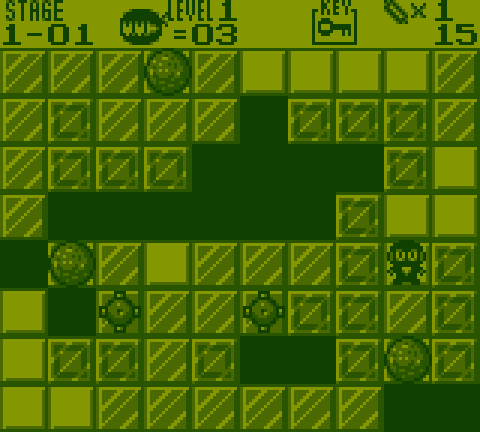
Panel no Ninja Kesamaru (SAS Sakata/Epoch) (May 2nd)
An unusual little puzzle game played on a grid of panels. The shaded panels are impassable and the black panels are voids that kill you if entered, but you can press A to flip the panels directly in front of and behind you from shaded to unshaded. Panels with anything on them can’t be flipped, and some have hidden items on them you need to collect to progress. the boulders can also be pushed into void spaces to create bridges. I could see it being fun for puzzle fans. The music was good, but also the sort of thing that you’d probably end up muting after a few levels.
I didn’t find any professional reviews of it. There are a surprising number of Japanese blogs covering it, however. Most are reasonably positive on the game, although it did take some criticism for the later boss fights. Replay value was also frequently questioned since the puzzles don’t change. That said, quite a few of my search results were playthrough writeups that one guy has done on a site called Playlog, so clearly the replay value was fine for at least some people.
Rating: 2. Not my kind of game, but it is at least unique

Spy vs. Spy (Kotobuki Systems/Kemco) (May 2nd)
Coverage of this game is a mess online. Wikipedia links to the wrong game, as this is its own thing and not a port of the 1984 Commodore 64 game. It also goes by quite a few different titles in its English version, with various sources disagreeing over the inclusion of both “Mad Magazine” and “Operaton Boobytrap” in the title. The Japanese title is at least consistently shown as Trapper’s Tengoku: Spy vs. Spy, but I decided to just go with the part shared across all versions here. At any rate, the game is a really boring race to find items scattered across a simple map before the other spy. You can set traps to trick them, and they could be a friend in multiplayer, but running out of health just resets your progress.
Reviews were poor, with the four MobyGames has averaging out to 61%. In Japan, it got a 23/40 from Famitsu and a 19.0/30 from Family Computer. It has a lot of user-created pages on the Japanese internet, but they’re mostly stubs for some reason, and the GameFAQs listing seems similarly incomplete. It did get a 2/10 user review from someone there.
Rating: 1

X (Argonaut/Nintendo) (May 29th)
A game often described as a 3D space combat sim. It is 3D and does feature combat, but you’re locked into a 2D plane, so in practice it might as well be a land combat game. It apparently features quite a lot of mission variety in later levels despite that. It also has a long tutorial that would feel more at home in a game released decades later than on Game Boy, where the expectation was to be dumped into gameplay with no explanation. It’s certainly a stunning technical accomplishment on Game Boy, but I didn’t find it very fun to play.
Wikipedia describes the contemporary critical response as mixed, although it seems like it may only ever have received reviews from the usual two Japanese sources. Those were indeed mixed, with Famitsu awarding a solid 27/40 but Family Computer a poor 18.7/30. The lead designer went on to make Star Fox, so the game has received a lot of retrospective praise for historical significance.
It never released outside of Japan. Wikipedia cites a number of interviews with the designer in which he says Nintendo felt the game was too complicated and wordy for US audiences, which is honestly probably a fair concern considering what the rest of the market looked like back then. It did nonetheless have a translation completed and that was leaked in the Nintendo hack.
Rating: 3. It’s worth a look for the graphics.


Leave a Reply