October 1-10, 1990 was a surprisingly busy period for Game Boy games. We had three Japanese launches, one North American release with a known day for once, and two more October NA releases that I’m choosing to include here.

Godzilla (Compile/Toho) (Unknown October)
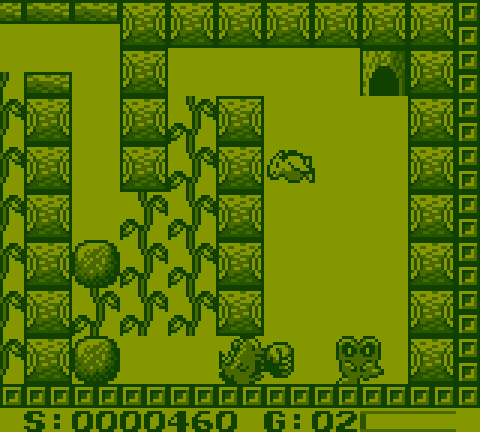
If it seems insane that a Godzilla game from a Japanese dev debuted in North America, it’s likely because this is a port of a 1985 MSX game that was exclusive to Japan. What is insane is that this Godzilla game is a puzzle platformer in which you climb vines and smash rocks while being chased by a bunch of monsters, who you have to punch to death. It makes no sense for the theme, but a few reviews from the time suggest it may have been okay as a puzzle game. It’s an appalling use of the license, though, and also features bizarre happy-go-lucky music in the main game and ear torture on the main screen.

That said, everything makes a little more sense if you play the Japanese version, called Gojira-kun. This version, fittingly, features a kid Godzilla fighting cutesy monsters, which explains the music and odd theming. It appears that Compile felt that this wouldn’t sell in the US and attempted a lazy retrofit to make it be a regular monster game. Western reviews were mostly mixed-to-negative, and the Japanese version is absent from the internet. I found a couple uploads of the manual and one person who explained the controls and then took a screenshot indicating they played even less than I did. There was multiplayer, at least.
Rating: 1.

Mr. Chin’s Gourmet Paradise (Romstar) (Unknown)
Romstar was originally the US subsidiary of SNK, but was independent from 1985 until being bought by Capcom in 1994. A lot of what they made was arcade games, but this game merely plays like one. You’re a guy who needs to eat robotic peaches by first trapping them in laser bowls to make them safe. It has decent music, but is otherwise pretty dull. Reviews were the definition of mixed, ranging from an extraordinary 8% all the way to 100% despite only 6 being available.
The Japanese release was canceled. I don’t know if that was down to poor sales or it being questioned whether a US company releasing this stereotypical of a character in Asia was a good idea. An aside, the name of the game is presented as 食通天国, which looks like an awkward Japanese title for some reason (it’s more like Gourmand Heaven). As far as I can tell, 食通 is not a word in Chinese. I assume they looked up both words in a Japanese dictionary, grabbed the first result, and then hoped that smashing them together would produce the right title. Alas.
Rating: 1

Balloon Kid (Nintendo) (Unknown)
Wikipedia’s List of Game Boy games has this one coming out on October 5th, but now that I’m doing the writeup for it, I can’t find anything supporting that specific day. I can, however, confirm that it really did release everywhere except Japan despite being a Nintendo game. It’s essentially a single player Balloon Fight where the game scrolls endlessly left and you try to make it to the end without dying. There was also a multiplayer mode with more familiar battles. Critic reviews covered just about every number between 40% and 80%, but player scores seem more positive.
Oddly, Japan got several exclusive versions. Sanrio rethemed it as a Hello Kitty game for the NES, Nintendo made an exclusive Game Boy Color update in 2000, and then the GBC version was made available on the 3DS. The original game returned to North America as part of NSO, which that also being the first time the GB game was available in Japan.
Rating: 2.

Fish Dude (Salio/Towa Chiki) (October 5)
It’s basically that Feeding Frenzy flash game. You’re a fish who needs to get bigger by eating smaller fish and not being eaten by even bigger fish. That’s really all there is to it. You can jump out of the water at the risk of being eaten by seagulls, and you get three lives. The eating animation takes longer than I would like.
Critic reviews were surprisingly positive, but there weren’t many. I found a couple brief atwiki posts about it, but the total number of search results for the Japanese title is misleading. It was called “Uoozu” there, and that ends up being a substring of a few other games that were more notable.
Rating: 1

SD Gundam Gaiden: Lacroan Heroes (Human Entertainment/Bandai) (October 6)
This was a Japan-only reimagining of a Dragon Quest-like JRPG to feature Gundams. It never released anywhere else, unsurprisingly, but it earned a 28/40 from Famitsu and a 22.34/30 from Family Computer, which is on the higher end of what both publications were giving Game Boy games around now. There are a lot of guides and other high-level information still available on the Japanese internet, but the only detailed review I could find was this atwiki post. It praises the game for having a dash button, allowing a high degree of player freedom, and for some QoL features like save points in the last dungeon and recovery options at camp. The negatives section is much longer, however, and complains about high encounter rates, poor balancing of enemies and status effects, unclear direction in some quests, and numerous typos.
Rating: 2. It gets a point for being a crazy idea, but it sounds like you’d have to be pretty determined to stick with it.

Nobunaga’s Ambition (Koei) (October 10th)
Nobunaga’s Ambition is one of the most famous and long-running strategy series in Japan. It’s a simulation of the Sengoku period that lets you play as any of the major daimyo of the period and try to be the one to unite Japan. MobyGames has this of a port of the 1986 PC-88 edition, but Japanese Wikipedia (and English) indicate that it’s a mix of the 1983 original and the 1988 release, and I’m inclined to trust them. This version received a 25/40 and 20.64/30 from our usual Japanese publications and a mix of very positive and mediocre scores in the West, which makes sense for something so niche.
It’s impressive that they got what appears to be a very fully-featured simulation working on Game Boy, but there’s no tutorial, so good luck playing it without a manual. While there is still some coverage of it available on the Japanese internet, it seems to have been mostly overshadowed by the sequel released for Game Boy Color later in the decade.
Rating: 3. Impressive for what it is, but this probably isn’t the one you want to play.
Previous: Revisiting Every Game Boy Game: Part 24 – September 28, 1990 | Hub: Revisiting Every Game Boy Game | Next: Revisiting Every Game Boy Game: Part 26 – October 12th, 1990