September 28, 1990 was an important day for Game Boy games overall since it marked the arrival of the system in PAL territories at long last. However, while European buyers were treated to seven launch day games, all seven had been out for at least five months in Japan already and most were over a year old even in North American. That leaves the two Japanese releases of the day.

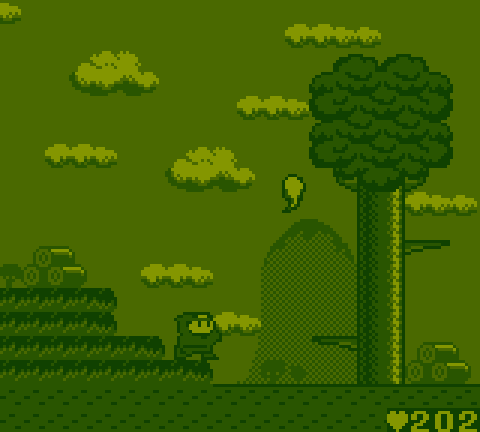
Maru’s Mission (Jaleco)
There are a lot of lists out there of games that have markedly worse box art in one region than another, but I think Maru’s Mission may take the cake. Just take a look at the MobyGames gallery.
Even more interestingly, the quality of the game itself is actually markedly different in each version as well. I played the NA Maru’s Mission first and immediately noticed the bad physics, horrible strobe effects, and constant issues with hitboxes that led to it having such dire scores in Western reviews. Then I looked it up in Japanese and saw that it actually got decent scores from Famitsu and Family Computer. I decided to give Oira Jajakun Sekai Bouken! a go after an atwiki post pointed out that the NA version changed scene to take place in New York City along with many other changes. It turns out that the original game has different sprites for basically every enemy, no physics issues, far more consistent hitboxes, and even a totally different first boss. It’s still not the greatest game ever or anything, but I’d love to know why Jaleco thought it was a good idea to change so much.
Rating: A definite 1 for the NA version. The Japanese game can have a 2 for feeling like a masterpiece in comparison.

F1 Boy (Lenar/ASK Kodansha)
This released as Sunsoft Grand Prix at some point in 1992 in Europe. It’s a surprisingly big racing game, with 16 tracks, 9 different engine/transmission configurations, 3 race types (F1/F3000/Super), multiplayer, and customizable lap and race counts. Unfortunately, the gameplay is pretty much the same regardless of what you pick. It’s hard to make tracks feel very different from this perspective, but the various car types also feel quite similar and there’s minimal sense of speed. The ending screen you get apparently doesn’t change at all no matter what kind or length of race you do, either.
MobyGames has two Western reviews that scored around 60%. I didn’t find any professional Japanese reviews, but there was a broadly negative atwiki post, a lengthy 1/5 score from someone’s blog, and a positive unscored review from another blog that was hard to read because of the tiled anime girl background. Nintendo released F-1 Race about a month later in Japan and before this game in PAL (this never came to NA), which mostly overshadowed it.
Rating: 2. Meh.
Previous: Revisiting Every Game Boy Games: Part 23 – September 21 1990 | Hub: Revisiting Every Game Boy Game | Revisiting Every Game Boy Game: Part 25 – October 1-10, 1990