Namco Classic and Dodge Boy were the only two Game Boy games released from December 3-6, 1991, but I decided to include the last two North American debuts in this post as well. They both released in Japan this month and I’d planned to include them in the posts for those dates, but I didn’t realize the Japanese releases this month were so numerous and so crammed into a few days. Those two games will appear here to avoid some monster posts later.

Namco Classic (TOSE/Namco) (December 3rd)
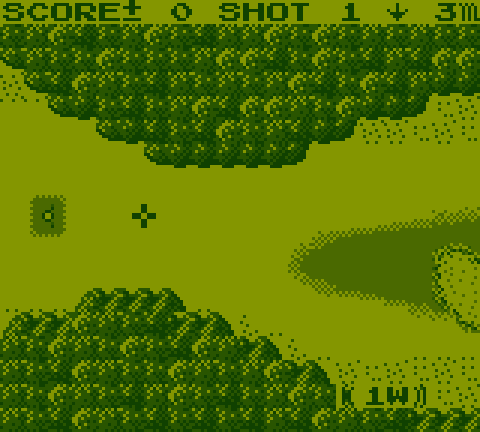
A deeply obscure Japan-only port of a deeply obscure Japan-only Famicom game. By interesting coincidence, it also uses the overhead view that we just saw in Konamic Golf, but this doesn’t let you scroll the camera to see what’s ahead of you. It also doesn’t tell you how far each club can go or the distance to the hole, which are somewhat important pieces of information in a golf game. It looks great, especially when you’re taking a shot, and the music is nice, but it fails at its core task.
There is actually a lot on the Japanese internet about this game, but nearly all of it is for either the original Famicom release or the version later included in the first Namco Classics collection for Game Boy. It was also included in a collection for Switch. Wikipedia did at least preserve the review scores for Game Boy, so we know that Famitsu gave it a 26/40 and Family Computer readers came in at 18.9/30.
Rating: 1.

Dodge Ball (TOSE/Tonkin House) (December 6th)
This version of dodgeball has three players in each half of the court with one player from the other team on each edge of your half. The goal when you have the ball is basically to throw it past the other team’s players to get to one of your own edge players, then pass it between edge players until you have a shot lined up on an opponent. Each player has their own stats, and the game ends when everyone on a team is out of life points. There are apparently special moves and a few different modes as well.
It looks decent and has fun music, but the screen is too zoomed in to really be able to tell what’s happening. The camera constantly jerking around to keep the ball centered can also be a bit uncomfortable. Gamesoft was the only one with any kind of writeup on the game and criticized it for having wildly unbalanced teams. No one else seems to remember it.
Rating: 1.

Ninja Gaiden Shadow (Natsume/Tecmo)
This released in Japan on December 13th and in North America on an unknown day in December. It’s basically a simplified version of the NES Ninja Gaiden games. Movement is more limited and you only get one special attack, plus the enemy density seems to be lower. The backgrounds and music are nice, but enemies are pretty basic-looking. The animation quality varies.
MobyGames has a 71% average from contemporary Western critics, but is missing a number of positive English reviews listed on Wikipedia, so the real average is probably in the mid to high 70s. The similarly named Computer & Video Games and VideoGames & Computer Entertainment both considered it one of the best Ninja Gaiden games so far. In Japan, it got a 25/40 from Famitsu and a 20.3/30 from Family Computer.
Rating: 3

Monopoly (Sculptured Software)
It released on December 20th in Japan and sure is Monopoly. If you wanted to play a digital adaptation of a terrible board game, this was apparently the way to do it in 1991. It had a 78% average from 11 reviews, making it by far the best reviewed version of this particular Monopoly release. The losers stuck playing it on Genesis had to make do with a 57% average! Of course, playing Monopoly is like nuclear war: the only way to win is not to play. Or to start a nuclear war, which would free you from playing Monopoly.
Rating: Friends don’t let friends play Monopoly.
Leave a Reply