August 24-31 1990 was a good week for ambitious Game Boy games, but that doesn’t mean they were any good.

Power Mission (Graphic Research/VAP) (August 24th)
I’d love to see this one remade on a newer system. It’s sort of an extreme upgrade of Battleship. Both navies are playing on the same map instead of in separate seas, there are different terrain types, and enemy units are invisible until you move one of your own close enough to detect it on radar. It’s a really fun concept that reminds me a bit of the board game Captain Sonar, and I’m sure this would be a ton of fun against a human. The Game Boy interface lets the game down a bit, however, and CPU turns take far too long to process. Put this on a modern system to improve the readability and get the CPU turns down to a few seconds and I think you’d really have something.
MobyGames has two contemporary reviews that both came in at about 70%. This seems to have been a very limited release everywhere. None of the usual Japanese resellers have an average price available, there did not seem to be any Japanese reviews available either, and only seven people claim to have a copy on MobyGames. That said, atwiki does have good overview of the game and even a summary of someone’s complete playthrough in 2009, but said summary is completely factual and doesn’t offer an opinion on the game. Alas.
Rating: 3. It’s not the ideal way to experience this idea, but it’s the only way as far as I’m aware.

機動警察パトレイバー 狙われた街1990 (Yutaka) (August 25th)
This gets its header in Japanese because the transliteration is the stupidly long “Kido Keisatsu Patlabor: Nerawareta Machi 1990”, which would have taken up several lines. It’s the second game to use the Mobile Police Patlabor license after a 1989 FDS release, and it is so obscure that Wikipedia’s main Game Boy list has the wrong title and MobyGames doesn’t track it at all. It does seem to have a bit of a reputation as a kusoge in Japan, though, and the wonderful atwiki delivers again with an unscored post detailing every reason it sucks. Such reasons include presenting its text in a way that is highly difficult for even a native speaker to read, numerous typos, mechanics that don’t work or are poorly explained, and more. My favorite is the that they describe their reaction to the final boss’ reveal as (loosely) “who the fuck are you?”. The sole good point listed is that the music is ‘not bad’, which I can agree with.
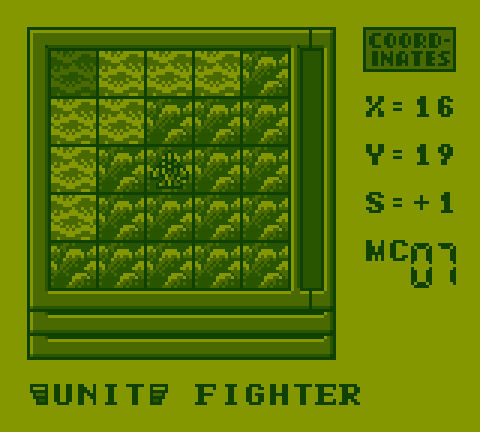
The actual gameplay involves slowly moving around this map to step on the weird sprites in the rectangles, which triggers a battle. You then select five actions from a set of attack and defend commands, all of which are written in bizarre ways, and then you and the enemy both simultaneously execute your 5 commands in order. The battle text goes by stupidly fast and I’m pleased to know that native speakers also found it impossible to follow.
On a final note, used copies of this are incredibly expensive. The average price range seems to be 9,000 to 11,000 yen.
Rating: 1.

Bomber Boy (Hudson) (August 31st)
The Japanese title makes it somewhat clear that this is a Bomberman game, but less so the American Atomic Punk or European Dynablaster. It’s pretty much the standard gameplay for this series with a couple minor variations and a link cable multiplayer mode. Western reviews were largely quite positive and Family Computer and Famitsu both reviewed it at the higher end of their range for GB scores.
Rating: 2. There’s a lot of Bomberman out there.

Battle Pingpong (Quest) (August 31st)
This is indeed the same Quest who would make Ogre Battle three years later. For now, they made a table tennis game that does a better job at simulating a 3D ball than any game I’ve seen so far. It doesn’t have remotely realistic physics, but it does at least animate in an impressively believable way.
That is the only nice thing I can say, unfortunately. Gameplay consists of pressing B when your paddle automatically moves to the ball and it doesn’t seem like you really have any control over where the ball goes. A few Japanese sites with manual uploads suggest that pressing the D-pad does create different hits, though, so it could have been an issue with my game. Single player consists of 10 matches against various countries followed by a secret 11th match against a panda. An atwiki playthrough suggests it gets pretty hard.
Rating: 1.
Previous: Revisiting Every Game Boy Game: Part 20 – August 24-31 1990 | Hub: Revisiting Every Game Boy Game | Next: Revisiting Every Game Boy Game: Part 22 – September 14 1990