There were seven new Game Boy games on December 13th, 1991, but we already covered one of them in the North America post. Another one if them has a plausible claim to inventing a genre.

Battle Of Kingdom (Lenar/Meldac)
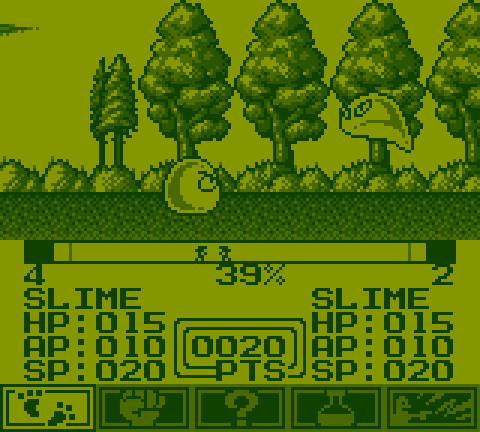
And we’re getting to that mysterious game right away in Battle Of Kingdom. Wikipedia has nothing on it and MobyGames has a long description that somehow never mentions that it’s basically an autobattler. You have 800 points with which to buy monsters at the start, then have to complete a series of battles in which your monsters try to advance to the enemy goal or wipe out all opponents before they can do the same. It’s not quite fully automatic since you can trigger a couple of active abilities and do need to change between walking and fighting modes, but it’s damn close to a genre that was decades away from being widely known. Unfortunately, it’s also incredibly slow paced, so you’re going to want to play with a fast forward function available or every battle will start with 30-60 seconds of literally nothing.
Although the usual suspects don’t have much about it, I did find a few Japanese blogs covering the game, and Gamesoft at least had a post. The consensus seems to be that it’s a decent game that is a little too easy. One thought it would be a good game for working adults who didn’t have the time for longer games, but noted that Meldac titles tend to be expensive. In this case, the issue seems to be more of rarity. One blog said it cost a reasonable 3,000 yen, but no resale sites currently had a copy for sale.
Rating: 3

Final Fantasy Legend III (Square)
The third Final Fantasy Legend moves the plot to a sci-fi setting where you’re tasked with using a time machine to change events in the past and future to prevent a global flood. It somewhat foreshadows Chrono Trigger in that way, but it doesn’t seem like anyone involved in this actually worked on CT. It’s also notable for allowing you to set your characters to Auto to have them play by themselves, although it didn’t seem like you could do that for your whole party.
Contemporary reviews were quite positive. The MobyGames average is 79% and it comes in as the 30th best Game Boy game, but that score includes a few much later reviews and the ‘contemporary’ average would shift around a few points depending on how many years after release you’re willing to include. Famitsu gave it a solid 29/40 and Family Computer a remarkable 24.8/30, which is certainly near their record for a Game Boy game.
Rating: 3. More modern reviews seem to consider it the weakest of the three games on account of relatively generic RPG systems.

Minesweeper (Arc System Works/Pack-in Video)
Yes, that Minesweeper and yes, that Arc System Works. They were just Arc Co. at the time, however, and this is not a port of the Windows version. It’s a vaguely naval-themed edition that features a 70 puzzle campaign, free play on various board sizes, an editor, and even 2 player head-to-head.
Japanese Wikipedia bundles this in with every other version of Minesweeper and doesn’t provide reviews for any of them. The most I could find was the Gamesoft writeup, which doesn’t say much. It’s probably safe to assume that the reception was decently positive since everyone likes Minesweeper, but that it had been largely forgotten by the time the internet came around since it’s one of a billion ways to play the game.
Rating: 2. There are worse ways to play it.

Pachinko Saiyuuki (Marionette/Coconuts)
Coconuts had already made a Momotaro-themed pachinko game in February, but by December they were at it again with a virtually identical game themed after Journey to the West. I suppose if you are so addicted to pachinko that you need to play it for fake money on Game Boy, then having new machines to play is probably a meaningful change to you. They really don’t look that much different to me, however, and everything else about the game is at best a small sprite change.
There is not much out there about the game, as you would expect. Gamesoft’s writeup notes that the mythology-based pachinko games will keep coming.
Rating: 1.

Sagaia (Act/Taito)
Confusingly, Darius II was released in the West as Sagaia, but this Japan-exclusive game is actually a remake of the first Darius. It apparently has some modifications to the stages that I wouldn’t know about since I’ve never played the original. What I can say is that it has great music and impressive boss sprites, but the backgrounds can get repetitive and the scroll speed is a bit slower than I’d like. I don’t have time to play it through right now, but I’ll probably come back to it. Seems promising.
Its 78% score on MobyGames is good enough to be the second highest scoring version of Darius, albeit only from three reviews. Only two of those are contemporary, though, so it really had an 82.5% average from two German scores. I didn’t see any contemporary scores from Japan, but it has been covered positively in a lot of blogs. Atwiki also gave it a ‘good game’ rating.
Rating: 4.

World Beach Volley: 1991 GB Cup (Graphic Research/IGS)
A beach volleyball game. Each country has two male and two female players, and you can make a team out of any combination of them and play another team. Stages seem to be based on iconic settings from each country, which resulted in the unusual sight of playing beach volleyball in front of Mt. Fuji in my game. That is actually possible in the real world, but it’s certainly not one of the views of Fuji I’m used to seeing. It also had good, but very traditional music that would have felt more at home as a remix of Pokemon‘s Ecruteak City theme than in a volleyball game. Still, it’s a better implementation of the sport than the other attempts so far. Movement is fast and you can actually just about tell where the ball is going to go. The only issue is that it goes there quickly, so reacting to it on a Game Boy screen is pretty hard.
It released in PAL a year latter with the title changed to say 1992 instead. I didn’t find much about it from either region. There were a few Japanese Let’s Plays, a vague writeup, and a writeup from a site that posts suspiciously similar and very long reviews of games incredibly quickly. None of that helps me much. It was one of the few Japanese Game Boy games to have a photograph on the box instead of custom art, so my guess is that it wasn’t marketed much and is now a rare game. That said, it’s fairly cheap at resale, so it could just have been forgotten.
Rating: 2. It’s better than the other volleyball games.
Leave a Reply