Three more releases rounded out Japan’s Game Boy games for September 1992. It doesn’t seem like a particularly promising bunch. We’re in a month-long gap between Kaeru and the next Mario release, so publishers likely wanted to avoid the two big Nintendo games.
The usual reminder: Scores are out of 5 and reflect only how worth playing a game is today. Most games get 1s. Exceptionally bad games get 0s.

Vitamina Oukoku Monogatari (Namco) (September 17th)
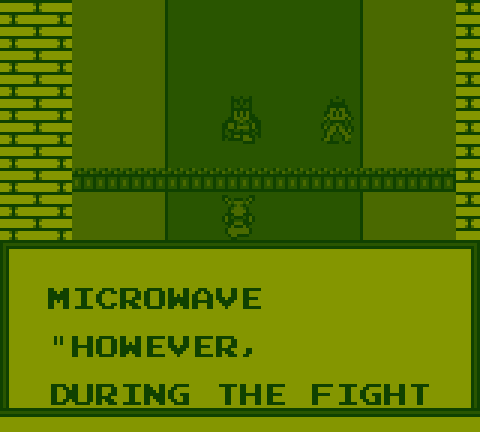
This game with a name meaning “Vitamin Kingdom Story” was released as Great Greed when it launched in the US the following April. The translation is awful. The most obvious problem is that there are bad text breaks everywhere, but it also features meaning changes and grammatical errors in almost every exchange even from the few minutes I played. One major character is named Babaroa in the original, which sounds a little like Barbarossa but is also the word for Bavarian cream. This was changed to “Microwave” for some reason. The assassin became “Hunter”, which is not the same thing, and several sentences have the wrong subject. A reference to pollution was inexplicably changed to acid rain. So it’s certainly one of the worst localization jobs on Game Boy, but if you can get past that, MobyGames suggests that it’s a bit innovative in having autosave after battles and a combat system that blends turns and realtime.
Two German reviewers gave it an 85% and a 71%. In Japan, Famitsu scored 24/40 and Family Computer a dramatically worse 18.6/30. No explanation is provided, but Gesato dinged it for having items that don’t work and unfun status effects while giving it credit for having some innovative content. They particularly call out the story about real world environmental problems. I didn’t find any other scored reviews, but there are lots of Lets Plays. GameFAQs users certainly loved it. It has two 7s, an 8, three 9s, and two 10s in its written reviews section, although all are no more recent than 2005.
Rating: 2. I’m not seeing whatever it is that made this so popular, and the poor translation is hard to get past. Still, it has enough fans to earn a point.

Meruhen Club (Naxat) (September 25th)
This one is romanized in different ways around the internet. The title is probably meant to be the German word for a short fairy tale, Märchen, but I just went with the literal reading of that word. For some reason most databases translate the second half of the title even though it wasn’t a loanword and they never do that for other games. At any rate, it’s a chess-like game where you have a certain number of points to spend on up to 8 units to protect your king. You can place them however you want on the board or choose from some presets, and then you play. Each unit moves according to some chess-like pattern, but battles take the form of a strange game in which you pick one of four face down cards to do an attack. If the attack does enough damage to deplete the other unit’s HP, it is removed from the board. This continues until somebody captures the other player’s king.
I didn’t find much about it anywhere. It has decent scores on some resale sites and one GameFAQs user liked it, but that’s about it. A Japanese comedy group used the same name in 2011 and they’ve taken over the search results. Adding “Game Boy” clears that out, they’ve probably made this game harder for others to find.
Rating: 3. It’s more random than it really should be, but you can’t deny that it’s unique.

Sangokushi Game Boy-hen (Koei) (September 30th)
Another one with odd titling decisions. This is just “Romance of the Three Kingdoms: Game Boy version”, but for some reason the early games seem to be usually left untranslated. Just like with Koei’s earlier port of Nobunaga’s Ambition, it is a blend of the first and second mainline games in the series. Western databases mostly don’t acknowledge it or have it listed as just a port of the first game. I am impressed that they got it to run, but also aware that this is a very complicated game with a lot of Chinese terms, so I don’t feel like there’s any point in me trying to play it in this format.
Famitsu gave it a decent 22/40 score, but they were more impressed with the WonderSwan version that released in 1999, giving that a 24. Family Computer went with a similar 20.2/30. Japanese Wikipedia says that the Famitsu reviewers noted that it had fewer playable nations and simpler mechanics than its big brothers, but were impressed that a campaign was now much shorter and easier to fit into your schedule. There’s not much about it from modern writers, but that’s hardly surprising for a series that has had a million newer console and handheld releases. There’s not much reason for anyone to go back to this.
Rating: 2. A point for being impressive.


Leave a Reply