Nobody’s 2025 Top 100 Games: 100-91
Nobody’s 2025 Top 100 Games: 90-81
Nobody’s 2025 Top 100 Games: 80-71
Nobody’s 2025 Top 100 Games: 70-61
Nobody’s 2025 Top 100 Games: 60-51
Nobody’s 2025 Top 100 Games: 50-41
Nobody’s 2025 Top 100 Games: 40-31
Nobody’s 2025 Top 100 Games: 30-21
Nobody’s 2025 Top 100 Games: 20-11
Nobody’s 2025 Top 100 Games: 10-1
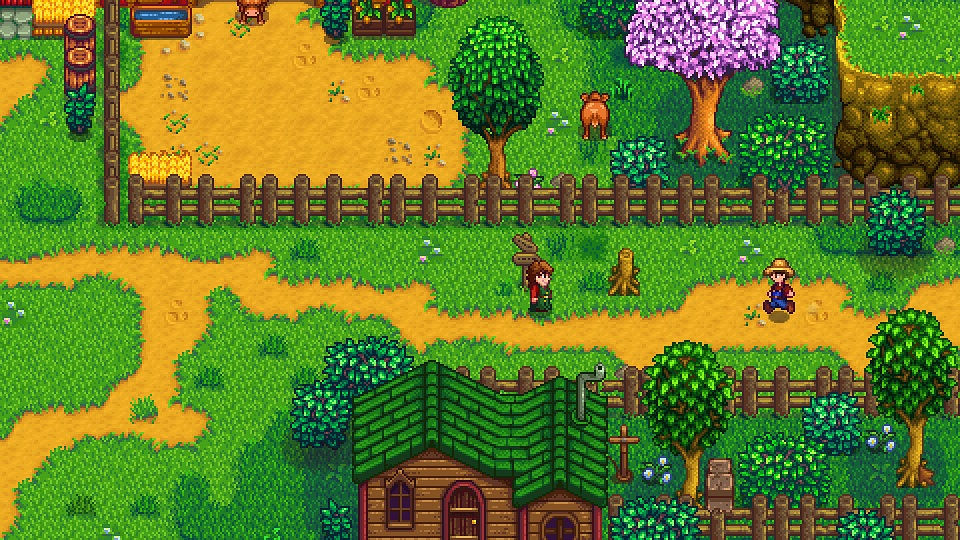
30: Stardew Valley

Stardew Valley is another example of being the entrant in a crowded genre with the most character. Yes, Harvest Moon did it first and yes, Rune Factory had the idea to add combat years earlier, but Stardew Valley is the one with characters you can still name even if you haven’t played since launch. There’s very little new here and, other than the co-op, very little that’s even done much better than other games, but it is brimming with character in a way that other farming sims just haven’t managed. It’s a game that nearly everoyne has played, so I’ll skip writing a long praise of it here and just say: if you haven’t tried out any mods for it, give those a look. Although it’s easy to end up installing an overwhelming amount of content, there are some truly impressive creations out there that add to the experience without feeling out of place or being noticeable lower quality.
Previously: 26
29: Before Your Eyes

I’ve called a lot of games on this list unique, but it’s hard to top Before Your Eyes in that respect. This is a game you control by blinking. The concept is that you’ve died and now have to tell your life’s story to the boatman before you’re judged. Your tale is told entirely through flashbacks, and those flashbacks will last only as long as you can stop yourself from blinking. The game is great about making sure the story context you really need to know happens quickly enough that there’s minimal risk of accidentally blinking past it, but also great about making sure that there’s other content you’d really like to know that’s much harder to see. Many games achieve a feeling to a greater extent than others can manage, but the strain of trying to watch an emotional scene for just a little longer in this game is something that has truly never been done before or after in gaming.
Beyond that, it also has a perspective that’s rarely scene in these games. There are plenty of excellent indie games out there about coming to terms with the loss of someone else. Before Your Eyes is instead told from the perspective of someone who has themselves died and must learn to accept what they did, or did not, do with the life that’s now gone. It’s unforgettable.
Previously: Unreleased
28: Portal 2

And now for the opposite of that. Portal 2 does not have an emotional story to tell. It is here to tell you about adventures that include installing the world’s dumbest AI as chief of a top secret facility, installing another AI on a potato computer, and meeting a third AI who just wants to go to space. With the possible exception of Thank Goodness You’re Here, this is the funniest game ever written, and like the first Portal, a lot of the humor holds up to a second playthrough. Almost everything about it can be described as Portal, but more. It has a credits song that’s even better in “Want you Gone”, a ton of new puzzle types, more varied environments, and tons more characters. Expanding a successful small game like this often results in a diluted experience that can’t compare to the original, but Portal 2 is that rare game that simply manages to be more of a good thing.
Previously: 24
27: Anno 1800

Anno 1800 is either a very simple game or a stupidly complicated one depending on how you look at it. Simple, because technically all you’re doing is building some houses on items, building some buildings to allow those houses to upgrade, and then repeating the loop to upgrade the houses again. Complicated, because doing that means planning out supply chains that can end up involving a half dozen raw resources processed through several steps each that also need to be shipped across islands and supplied with power at various points. On top of that, 1800 complicates the series further by tracking your workforce per-island and per-class, so everything can collapse if you happen to run out of engineers or farmers on one island and suddenly your factories aren’t producing quickly enough. Then there’s the fact that it’s a mutliplayer game and your plans can be ruined by the spot you wanted being taken or, on higher difficulty, hostile actions.
Suffice to say that it’s not a game you can play casually or one that will have particularly wide appeal. It’s going to take quite a while to be at all comfortable playing it, but if you like building complex things, not many games can offer more complexity. If Civ offers one more turn, Anno 1800 offers one more problem.
Previously: Unranked because I hadn’t finished it. The 2021 version may not have made the list anyway. This needed QoL updates and online calculators to really shine.
26: Gunfire Reborn

Before Gunfire, it was pretty common to see the claim that it was impossible to make a good FPS roguelite. Too hard to balance, they said. Rooms would either be too repetitive or too random, they said. Turns out that none of that was really all that hard to solve. Gunfire lifts its weapons system from Borderlands to generate millions of minor variations of a core collection of fun weapons. It pieces its levels together from a set pool of handcrafted rooms while still using random spawns and environmental effects. Best of all, it has a huge cast of playable characters that all have their own unique abilities and playstyles. Some combos are obviously more powerful than others, but everything is more or less viable and there are enough changes with each run that you can play a few times in a row without really feeling like you’ve repeated yourself. And once you start feeling like you’ve got a level down, it’ll surprise you by unlocking a new chapter boss that throws you off balance again. If you’ve beaten the final boss and think you’re unstoppable, there are ascension difficulties and a secret fourth world to prove you wrong. And once even those aren’t enough, you can play any of its seasonal variants or add any combination of buffs and debuffs to a run to create yet more unique experiences. Gunfire didn’t just solve the roguelite FPS problem, it did it while making a game that’s almost infinitely replayable.
Previously: I hadn’t played it yet, but it was available in early access
25: Octopath Traveler 2

Octopath Traveler 2 proves that you don’t always have to make dramatic changes to dramatically improve a game. OT1 was pretty good, but nowhere near making this list. OT2 gets to number 25 by adding bonus stories featuring pairs of its 8 characters and some very small changes like a day/night cycle and boats you can use to cross water. Instead of changing anything wholesale, OT2’s design philosophy is “if it ain’t broke, make it better.” The is pretty much the same game again, just with better characters, a more fleshed out world, more options in combat, and so on. And somewhere in all of those changes, it achieves what the first game sets out to do and really feels like 8 (well, 7) great JRPGs that blend together into one game. Not all of them are necessarily good enough to be number 25 on their own, but what other game can give you 8 quality final boss fights? And after you’re done with those, there’s an excellent epilogue attached that properly wraps all the characters into one story.
Previously: Unreleased
24: Divinity: Original Sin II

This is probably the biggest jump for a game that made the list last time. I did start another playthrough, so that’s part of it, but it’s mostly down to recognizing that an underwhelming last hour to a 50 hour RPG doesn’t ruin an otherwise top notch experience. Yes, it has a trash final boss that’s somehow both frustrating and underwhelming. There’s no getting around that, but there’s also no getting around that the 49 hours before that are a continuous stream of interesting fights and wonderful character moments that all offer more freedom of choice than almost any other game. It could have been even higher except for two things: that crappy final boss, and the fact that Larian outdid themselves with their next game. The 500 pound mindflayer in the room, if you will. That’s coming much later.
Previously: 90
23: To the Moon

I put this in a combined entry with Finding Paradise last time because they’re good for almost exactly the same reasons, but this time I’d rather separate them. To the Moon was the one that started it all, and it tasks you with granting the dying wish of a man who wishes he had gone to the moon. To do that, you’ll use a magic machine that rewrites his memories to give him the life he wanted. And yet, a catch: What if the costs of granting the wish are more than he realized? Any change requires giving up some of the life he actually lived, and when does it all become too much to justify? It works because of the excellent writing that mixes heavy writing and comic relief in a way that doesn’t dilute either. In what is definitely a theme of this list, it also features a great credts song in Laura Shigihara’s “Everything is Alright”.
Previously: 20
22: Final Fantasy VI

I still haven’t quite finished FFVI because I’ve never been able to get through the grind to take on the final dungeon. Despite that issue with the end, though, I’ve seen enough of it to know that this is a truly special game. The story, world, characters, music, and battle system are all either the best this series has ever had or nearly the best. Whether it’s the opera scene or suplexing a train, you’re never far from a moment that has deservedly entered the pantheon of JRPG classics. It doesn’t have the minigames that later FFs would be known for, but it does have a massive cast of characters who all add their own twist to turn based combat, and there’s enough customization that you can develop whatever kind of crazy party you want. If SNES design philosophy isn’t quite for you, the Pixel remaster even brings in a lot of QoL changes and ways to speed up a second playthrough. It isn’t quite the Final Fantasy VI Remake that I’d love to see someday, but this is near the peak of gaming as is.
Previously: 25
21: Helldivers II

There have been quite a few co-op games on this list that pit you and friends against massive hordes of enemies and I’d played any of them any day, but if I have to pick one to rule them all, it’s Helldivers II. Even though it doesn’t have the insanity of Earth Defense Force or the wild terrain deformation of Deep Rock Galactic, it does have massive maps that allow for a relatively small pool of handcrafted locales and objectives to feel different every time. Sure, you’ve blown up this exact Automaton camp a dozen times, but this time it might be in a swamp or being hit by a meteor strike. Maybe a strong patrol inconveniently shows up in the middle of taking it. Also unlike EDF and DRG, there are no explicit character classes, but the weapons and strategems available are so different that there may as well be. You just can’t do better than this for chaotic co-op combat.
Previously: Unreleased
Nobody’s 2025 Top 100 Games: 100-91
Nobody’s 2025 Top 100 Games: 90-81
Nobody’s 2025 Top 100 Games: 80-71
Nobody’s 2025 Top 100 Games: 70-61
Nobody’s 2025 Top 100 Games: 60-51
Nobody’s 2025 Top 100 Games: 50-41
Nobody’s 2025 Top 100 Games: 40-31
Nobody’s 2025 Top 100 Games: 30-21


