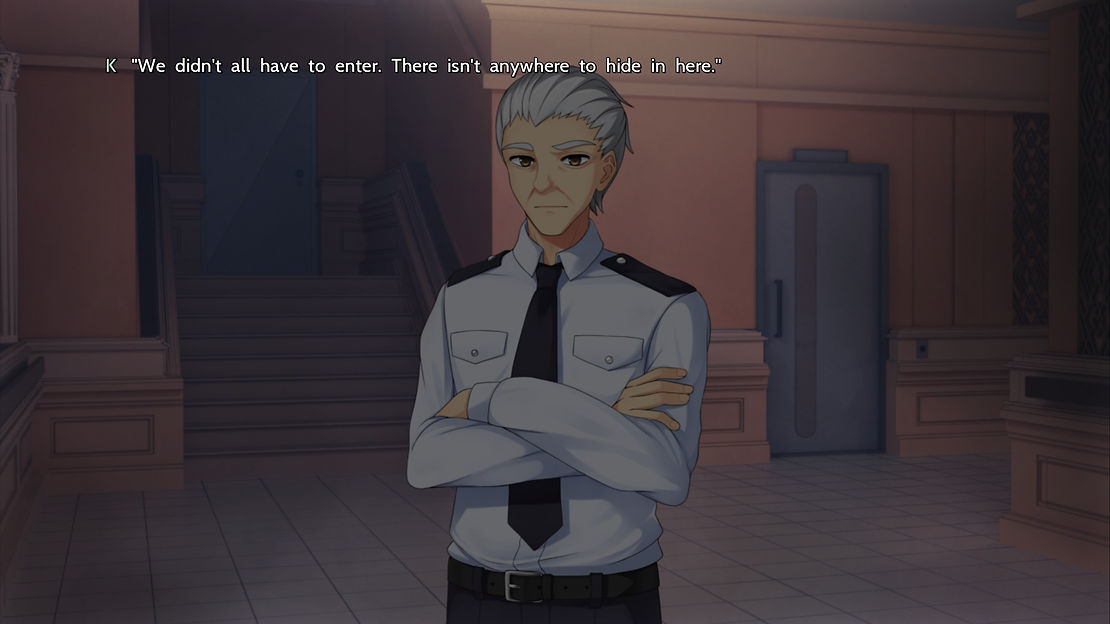
The Sekimeiya: Spun Glass is a difficult game to talk about. It revels in the complexity of its own mysteries and eventually ends up feeling more like a puzzle from a hardcore puzzling competition than a story. It clearly takes inspiration from games like Zero Escape (particularly VLR) and has (presumably) coincidental similarities to the later-released nirvanA Initiative, which makes it even harder to talk about without spoiling any of these games. That said, I would strongly recommend playing those first, both because they’re much better games and because this really feels like it came about as a result of someone deciding ZE’s plot was too easy to follow. This game is a lot.
Speaking of a lot, let’s get the most easily discussed problem out of the way. This game desperately needed an editor. I am not someone who would normally criticize a visual novel for having too much text. That is, after all, the point, and I’m hardly being concise myself in this review. But Sekimeiya takes this truly to the extreme with characters who just never shut up and scenes that absolutely didn’t need to happen. The game is so determined to show you how the devs thought of everything that it’s constantly making you read internal monologues about theories that are immediately rejected and searches that don’t find anything. A game more concerned with actually telling a story would have used this time for establishing characters and their motivations, but Sekimeiya never has time for that among all its obsessive levels of detail. We get pages of text on fruitless searches, but hardly a sentence of backstory for most of the cast. It can be very engaging when it isn’t wasting your time with things that should have either been left to the reader or cut out entirely, though. Chapters 1 and 2 set up a colossal number of strange occurrences to think about and do a truly excellent job with several more tense scenes that don’t leave time for the authors to get into the weeds. If they’d had the same sense of urgency everywhere else in the game, it could have been much better.

Besides just being too wordy, the other major problems with the writing are the characters and worldbuilding. Suffice to say that those are rather important problems for a mystery VN to have. Most other reviews point out that the characters are basically one-note and only exist to drive particular parts of the mystery. This is slightly unfair – three of them, the protagonist pair and Sai, do manage to be interesting in their own ways even if their motivations are not always very clear. Unfortunately, despite the impossible number of words in this game, it never finds time to do much of anything with anyone else. Several characters have no better reason for being there than “because” and when the motivations of the mysterious antagonist group are finally revealed, they’re circular and nonsensical. You’re only going to solve the murder mysteries in this game from circumstantial evidence because motives are so thin that they have more than one character randomly be a sociopath who just wants to kill. They do at least attempt to give the character whose pre-opening death drives the main characters some time, but that mostly just serves to reveal her as being rather unlikable.
As for the worldbuilding, unless this was an attempt to parody localized Ace Attorney‘s ridiculous Japanifornia setting, I can’t begin to fathom what happened here. Sekimeiya is supposedly set in Japan, but the vast majority of characters have names that aren’t even writable in Japanese. The town is full of place names that sound Spanish or French, and the names of most minor characters sound like someone drunkenly trying to read old fashioned English names. The background art shows townscapes that are obviously Western and even have cars on the wrong side of the road, it quotes an inordinate number of ridiculous prices in yen, and so on. I could let all of this go if not for the game spending several hours building this nonsensical setting and then asking if you caught a hint they dropped that relates to the drinking age in Japan. And of course I didn’t – why would I stop to think about that when you have cars driving on the right and think an artisanal loaf of bread costs 200 yen? And the setting isn’t even the only worldbuilding problem. None of the external organizations have motivations that make much sense and even the way everyone gets trapped in the building feels deeply unbelievable. The police can’t find a way past a metal shutter for 12 hours, really? Worldbuilding is often the weakest point of games like this, but usually they at least don’t dwell on it.

That leaves us with the mystery itself, which is the core of Sekimeiya and could theoretically redeem everything else. And I really expected it to pull that off at first. Even though the issues with flat characters and too much blathering on are present from the start, those first two chapters are so engaging that I was fully expecting to give this game a 9/10 or even higher. The mysteries it sets up in those first 15 hours are deeply compelling and beg for a satisfying resolution. Alas, chapters 4 and 5 devolve into a 98 question quiz where the devs show off how clever they are. Since you can see the overall stats for this quiz at the end of the game, I know that I and most other players were hardly more accurate than randomly guessing at the answers. That has three causes: The answers are wildly convoluted to the point that it seems like they set up cool scenarios and then twisted the plot to fit them later, the game doesn’t provide a desperately needed flowchart until you’ve hit the credits and no longer need it, and half the questions are about incredibly minor details. I said “I don’t care!” out loud several times during these chapters, which is both not a good sign for your mystery novel and inevitable when you start asking me who closed a door three chapters and 15 hours ago.
It really is a travesty that this is the game’s payoff. Every other mystery game ends with an exciting reveal scene involving all the major players in the plot because that’s exciting, but Sekimeiya ends with an hours-long quiz and an internal monologue presumably because no one has enough of a motivation for a climactic standoff to take place. And all that to find out that the answers to those amazing mysteries were a chain of coincidences so truly absurd that it makes the actual magical elements of the plot look realistic. If that’s not enough, quite a few of the links in that chain rely on the precise geometry of the game’s world despite it never bothering with measurements or formulae for anything and not even having its map enabled by default. You can get away with one or two incredibly precise setups happening randomly in your story, but there’s a point when you’ve jumped the shark so thoroughly that you’ve reached orbit and begin to jump every shark everywhere forever. This reaches that point.
Conclusion
I hate that I’m leaving a negative review for this. I’ve said it several times, but the first two chapters of Sekimeiya really are amazing. This is the setup for an all-time classic mystery that’s unfortunately been tied to the characters, world, and finale of a very rough draft. It has several exceptionally well done scenes that will stick with me and some great ideas that I hope to see reused in other games, but those can’t make up for everything else. I’d love to know what happened here – was it rushed out to meet a Kickstarter date? Was it only reviewed by people who worked on it? Was the idea to make a hardcore logic puzzle instead of a mystery all along? I don’t know. But for all that, I don’t regret playing and can’t call it a properly bad game. Anything that can be as engaging as this is for as long as it is has done something right even if it completely flubs the ending. Give it a look if you want to play something unique and don’t mind edges rough enough to be sandpaper.
Rating: 65%
Time to beat: About 24 hours
Price: $15
For more reviews, see my Steam curator page: https://store.steampowered.com/curator/43219041


