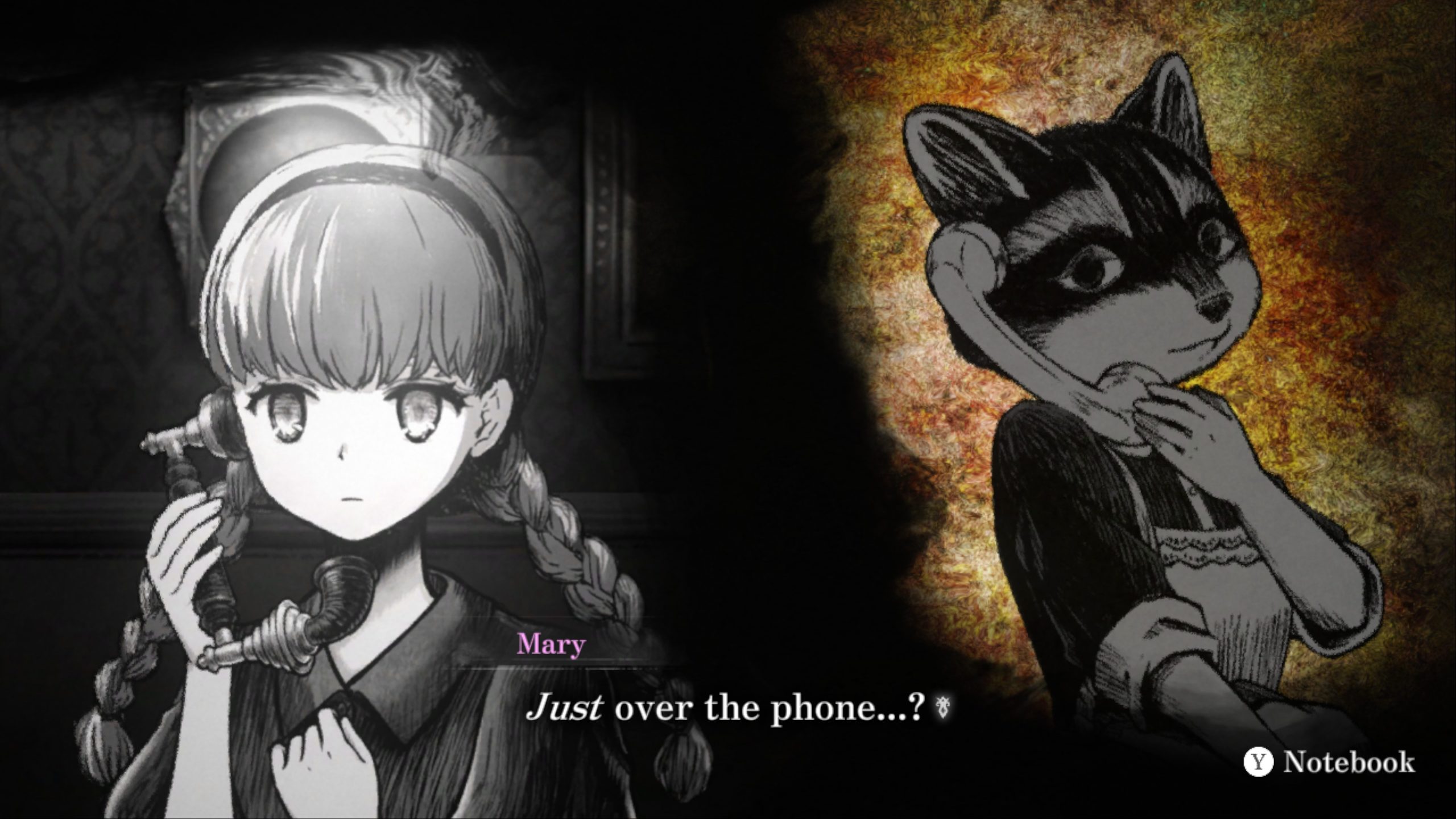
Schrödinger’s Call is a visual novel in which humanity is 21 nanoseconds from being wiped out by the Moon falling from the sky. It hasn’t happened yet, but is unpreventable, so everyone is momentarily in a state of being alive, yet completely doomed. For… reasons, this means that every human is now in a sort of purgatory where they’re alone except for a telephone and are rapidly losing their memories. You play as Mary, who is uniquely able to place and receive calls, and are tasked with helping burdened spirits to accept the end and move on.

Schrödinger’s Call has five chapters that mostly stick to a similar loop. You’ll start with a call to nobody that asks you some questions and ends up introducing that chapter’s characters in a vague, foreshadowing way. Then you’ll have a call with the chapter’s main character, who probably remembers almost nothing at this point, and get to see a partial replay of the important phone call they were having at the moment the Moon fell. The rest of the chapter consists of calls to them or supporting characters and picking highlighted topics out of a notebook to help each person remember more important information. Eventually it builds to a climax in which you put everything together and help that person move on. All of this works well, but you should know going in that the puzzles are almost all incredibly easy and that if this game has fail states, you’re going to have to try pretty hard to reach them. Gameplay is mostly down to choosing the order you explore a list of mandatory topics and occasionally being prompted to correct yourself after making the wrong choice.

That’s hardly unusual in this kind of game, though. Many visual novels with these themes are basically kinetic, so you’re here for the writing more than the gameplay. Luckily, Schrödinger’s Call is very well written. The characters you meet have a wide variety of believable motivations and their stories build to emotionally satisfying resolutions without relying on cheap tricks or trite morals. Thanks to the failing memories gimmick, it’s able to create mysteries that are tense for everyone involved. You’re often presented with characters who know something is wrong with their story, but they can’t remember what, and that tension carries the plot forward until their memories return and it’s time for the resolution. Each chapter’s supporting characters further support that tension with their own mix of fallible memory, conflicting motivations, and sometimes simply personal distance. It’s sort of a blend of the usual “accepting death” indie visual novel and a mystery game.

Still, it’s the presentation that’s really the star here. There are wonderful visual effects and animations to accompany important moments in each conversation, and Mary’s drawings in her notebook add a ton of character to what could have just been a simple menu. Since she can’t see anyone over the phone, she imagines each character as a Beatrix Potter-esque animal, which helps make everyone visually distinct and adds to the dreamlike feel of the whole experience. On top of that, while the soundtrack is largely not something you’re likely to listen to on its own, it is excellent at setting the tone throughout the story and the sound effect work is similarly effective. It’s really on another level from the presentation in a lot of similar games.
Conclusion
Of course, this genre lives and dies on the ending. Schrödinger’s Call builds to a final chapter that successfully connects all the many threads of its previous four stories. The visuals in that last segment are somehow even better than the rest of the game, and it the story’s resolution is a twist that was worth the buildup. It has all the elements of a game I could give a perfect score to, but for reasons I haven’t quite been able to put my finger on, it’s just barely not at that level. It might be that I needed a little more depth from the puzzle sections or that I’d have liked one particular piece of the final chapter to have been expanded a little more. But ultimately, even if it’s not quite a 100% score, Schrödinger’s Call is still an incredible game that may well top my 2026 list at the end of the year.
Rating: 95%
Time to beat: About 9 hours
Price: $18
For a similar game from the same publisher, see Urban Myth Dissolution Center Review – A Bumpy Ride
Feel free to leave a question or comment below!
For more reviews, see my Steam curator page: https://store.steampowered.com/curator/43219041


