Today’s four new Game Boy games are split evenly between sports games and manga licenses. Neither has been particularly fertile ground for quality so far, but maybe we’ll be surprised.
The usual reminder: Scores are out of 5 and reflect only how worth playing a game is today. Most games get 1s. Exceptionally bad games get 0s.

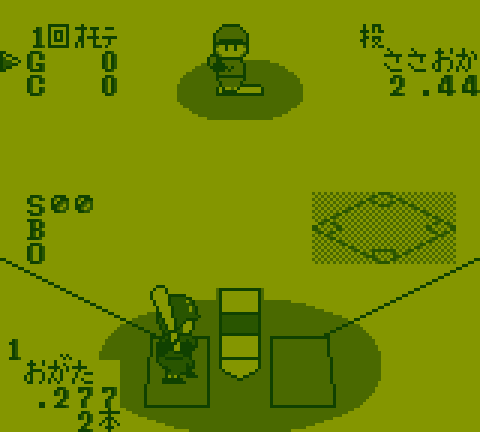
Higashio Osamu Kanshuu Pro Yakyuu Stadium 92 (Tokuma Shoten)
Unsurprisingly for a sports sequel to a game that only released in August, this changes very little from the first entry. The graphics and ridiculously difficult batting are completely identical. I don’t think I tried pitching in 91, but it’s notable for using a power bar of the type usually seen in golf games. The only obvious change is the ability to select which stadium you play in. Presumably team rosters were also updated.
Gamesoft found it disappointing and no one else seems to have really paid attention to it. We will not see this series again. The next entry was for SNES.
Rating: 1.

Ranma ½: Netsuretsu Kakutouhen (Banpresto)
Wikipedia’s one sentence description of this game says that it has “fighting game elements”, although you’d think it’s a beat ’em up from screenshots or from briefly playing it. Based on Gamesoft’s description, I think Wikipedia is right, but the ‘elements’ are few and far between. This is primarily an adventure game where you move around parts of town that look incredibly similar and talk to people to advance the plot. You can do fighting moves at any time, but combat apparently only happens in 1v1 fights that start as part of the story. The long stretches of identical town background before each interactive point feel suspiciously like game padding.
Gamesoft found it disappointing because of how much time you spend aimlessly wandering around. That certainly matches my impression of a very slow game. No one else wrote much of anything about this. Japanese Wikipedia has pages for nearly every Ranma game except this one. I assume it’s because the Japanese market was flooded with this license around now, so this was easy to overlook.
Rating: 1

Track & Field (Konami)
This is incorrectly listed as a port of a 1983 game in a lot of places. It’s actually it’s own version of that long-running series and was an official tie-in to the Barcelona Olympics in the Japanese release. Everywhere else got a generic Olympics-themed game that follows the series’ usual formula of doing a lot of button mashing. This is one of the worst versions I’ve played of the idea. A lot of the games have incredibly specific timing or unintuitive controls that mean you’re basically guaranteed to fail until you’ve played many times. I also found the button mashing to be unusually difficult, although that may just have been my setup. It’s very much a wrist-destroying game. If you’re going to play one of those, the GBC had numerous better versions of this.
Critics were pretty positive on it, which is understandable since the GBC games I’m comparing it to didn’t exist yet. It has a 78% on MobyGames and ranks 40th on the system. All critic scores they track were at least 74%. I didn’t find any contemporary Japanese reviews, but Atwiki has a post on it. Their biggest criticism is that most events only show the player, so it doesn’t feel like you’re really competing in the Olympics. That’s certainly a contrast to later games, which showed your running points tally compared to the other countries.
Rating: 1.

Uchuu Senkan Yamato (Bec)
A strategy game based on the manga known as Space Battleship Yamato in the west. It’s mostly pretty standard stuff. The main notable features are that the sprites all have comically lazy white highlights around them and that you get sucked into this weird faux-3D shmup whenever the Yamato enters battle. It’s all very slow and has particularly awful music. I will give it credit for getting you into the action, though. Where most Game Boy manga games waste your time with 15 minutes of pointless dialogue before starting the game, this has literally two sentences to show you before the battle starts.
It’s yet another game that no one other than Gamesoft remembers. They thought that fans of the original might like it, but questioned the balance. Just like with Ranma, there were quite a few games with this license released around the same time, so people probably paid more attention to those. That said, Japanese Wikipedia doesn’t have articles for any of the 14 games based on it, which is very unusual, so it’s possible that it has a reputation for bad games or something.
Rating: 1


Leave a Reply