Three new Game Boy games released on February 28th, 1992, but it’s a case of quantity over quality.

Heisei Tensai Bakabon (Namco)
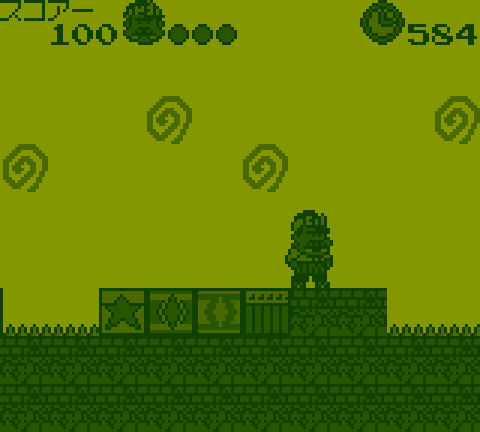
Tensai Bakabon was a manga that debuted in the late 60s and was titled ironically. It was originally about Bakabon, who is a bit stupid rather than being a genius like the title implies. Apparently his even dumber father was a better character, so it eventually changed to focus on him instead. The Heisei part of the title refers to the new Imperial Era that had begun a few years earlier in 1989. All that context brings us to what is probably the slowest platformer ever made. You control a character I assume to be the stupid father as he barely moves across the screen. It’s hard to imagine anyone thought this was fun.
There’s not much out there about the game, but Atwiki classifies the NES original as a bakage and the one review I found for the GB version came to the same conclusion as me: there is no getting past the movement. I didn’t find any professional reviews.
Rating: 1.

Oni II: Innin Densetsu (PandoraBox/Banpresto)
A sequel to Kininkou Maroku Oni. There are two more sequels after this, both of which keep the Oni X name format. It’s another JRPG and very similar to the first in terms of presentation. I didn’t spend long with it since it’s hard to evaluate JRPGs in a series like this, but what I saw had some of the best music on Game Boy paired with painfully simple dialogue and an attack system that’s really big on misses. The story seems to have you playing as basically an exorcist who goes around beating up yokai that have appeared in town. The name means something like “Undercover Ninja Legend”, though, so presumably it changes later on.
As usual with obscure Game Boy RPGs, Gesato has a full walkthrough and review. They credit it with improving on the first game in general, but criticize it for a bad point of no return, regressions in the battle system, and for text boxes that split sentences in a way that’s hard to read. I can’t say that I noticed the last point from what I played, but I can imagine it being an issue if they have long relative clauses in later dialogue. The Retroboy blog, meanwhile, gave it a 5/5 score while comparing it to SaGa 3. Atwiki’s post makes similar points to Gesato’s, but seemed a bit more negative to me. They also note that the whole series is getting a Switch port in 2027.
Rating: 2. I’m a little skeptical that the story can stay interesting for the full 20 hours it apparently takes to beat, but it can have a point for the music and the fact that people still seem to care about it. Reviews suggested that the series might get better from here.


Shinseiki GPX Cyber Formula (Varie)
A “racing” game licensed from an anime. It features what I hope is the hardest to read Japanese text on Game Boy, which is due to the egregious choice of colors rather than the font for once. It doesn’t look that bad blown up into a massive screenshot, but imagine trying to read that on a Game Boy screen. The game itself is actually a roll-and-move board game rather than a typical racing game, and it features basically no animations at all. The game forces you to watch a scroll through of the entire track before you get to start playing. This takes forever and looks even worse than the font because the Game Boy was not made to handle rapid screen shifting, so it’s basically a slide show that has huge screen tearing every time anything moves diagonally. The music is great, though.
Unsurprisingly, it is considered a kusoge. Atwiki justifies this right at the top of their article by pointing out that, in addition to the incomprehensible decision to use dice movement, it features stages that are officially acknowledged as being unbeatable. They say it’s bad enough that it shouldn’t have been sold even if it was bug-free, and further criticize it for taking forever and being boring. The series survived this game and went on to have many more releases that were, I assume, actually beatable.
Rating: 0


Leave a Reply