September 13th, 1991, brought three new Game Boy games.

Chibi Maruko-chan 2: Deluxe Maruko World (KID/Takara)
Despite the first Chibi Maruko-chan‘s terrible reputation, the series got over a dozen more releases all the way through 2016, including three Game Boy sequels. This one has almost nothing to do with the original in terms of gameplay. Instead of being an unfair gambling game, this is mostly a visual novel with fake choices and occasional minigames. It frequently presents four commands like it’s going to be an ADV, but only one of them is actually selectable. Similarly, if you make the wrong choice in a quiz or dialogue, it typically just kicks you back to the start of that scene to try again. I found the story very boring, but I’ve also never heard of this IP. Japanese bloggers mostly thought it would be fun for kids.
Famitsu gave it a 21/40, one point lower than the first game. Japanese blog reviews have criticized it for being too short (you can beat it in under an hour) and for having a painfully slow text speed, but consider it a better use of the license than its predecessor.
Rating: 1.

Jikuu Senki Mu (Hudson)
Surprisingly for a game from such a well-known developer, there’s very little about this in English. I found a few Let’s Plays, but there’s almost nothing in written articles. It’s a JRPG set on the Lost Continent of Mu and is primarily notable for having the first character creator on Game Boy. You were able to name your protagonist, select their gender, and then customize your character portrait for a handful of different styles for hair, nose, face shape, mouth, eyebrows, and eyes. Combat starts relatively simple, but presumably gets more complicated once party members and magic get involved. It seemed pretty advanced for the time.
Famitsu only gave it a 24/40, but Family Computer readers were slightly more positive with a 21.2/30. It does not seem to be well-remembered today. Most of the Japanese articles I found were just pastes of the Wikipedia article or resale sites. Atwiki had the only real review, which praised the game for having a dash button and a large number of characters, but heavily criticized it for poor balance.
Rating: 2

Knight Quest (Lenar/Taito)
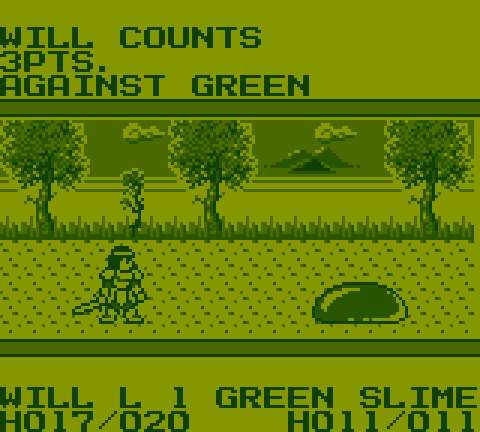
This was the lone game from today’s batch to leave Japan, arriving in North America in July of 1992. It’s a simple RPG that has you playing as a knight who wanders around a relatively open world and fights monsters. Monsters are visible on the overworld and running into them triggers battles like the one in the screenshot. These have excellent animations and unique music, but the animations are so long that they take forever to play out. You also only have four attacks that are more or less effective against different enemy types, but there’s no way to know which ones are good except trial and error. Your first encounter with each enemy is thus inevitably a slapfest until you find the right move.
Japanese blog reviews largely agree with the above, but also criticize the game for having relatively little content and relying on a password system for saves. I did not find any professional Japanese reviews. In the West, it got a 75% from the German ASM and a 58% from EGM. Western user reviews are in the mid-3s on GameFAQs and MobyGames. English carts seem to go for hundreds of dollars, but Japanese carts are pretty cheap.
Rating: 1
Leave a Reply