Four games were brave enough to make their debut right before Mario’s return to the Game Boy on the 21st. They make for strange bedfellows.
The usual reminder: Scores are out of 5 and reflect only how worth playing a game is today. Most games get 1s. Exceptionally bad games get 0s.

Pachinko Kaguya Hime (Marionette/Coconuts) (October 9th)
Another entry in Coconuts’ series of pachinko games loosely tied to Japanese folklore. This one at least has different graphics for the pachinko parlor instead of using the same sprites for the third game in a row. The tables are also different, obviously, but pachinko all feels pretty much the same to me. I don’t see any reason to play it.
I think it’s safe to assume that no one remembers this considering there was hardly anything out there about either of the previous two games.
Rating: 1

3-pun Yosou Umaban Club (Hect) (October 16th)
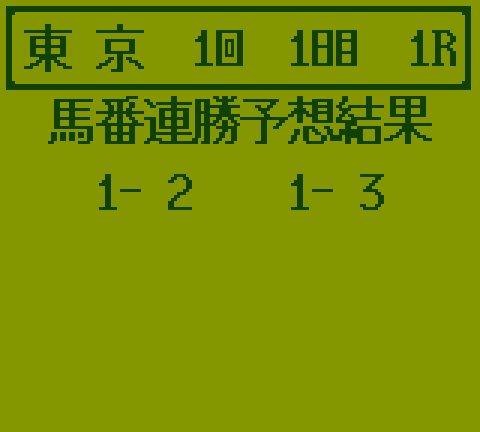
This is the second Game Boy game alphabetically. That is the most interesting thing about it, because this is yet another horse racing predictor. It consists of entering a bunch of info about the race you’re about to watch and then getting random results spit back at you. This one does at least have you enter the odds for each horse, so it has a little more basis in reality than the others. There’s even some pretty decent music.
Rating: 1. Nobody needs a horse racing predictor from 1992.

Aretha III (Japan Art Media/Yanoman) (October 16th)
The third and final of Yanoman’s JRPGs for Game Boy. The series would continue on SNES for a few more games and then disappear for almost thirty years, finally resurfacing with a remaster collection for Switch. It has the slowest walking speed I have ever seen in a game and the presentation value has really declined from previous games. Almost all dialogue takes place in full-screen text boxes, although the protagonist does at least get an animated sprite for dialogue. I don’t think we’ve seen lip movement during speech in the series before. Beyond that, all I can really say is that the music is pretty good in the first town. I did not have the patience to walk far enough to find enemies.
The few pages that exist for this game in English are almost comically useless. Japanese pages are honestly not much better. Wikipedia has a good summary, but no reviews. Atwiki does not have a rating post, and even Gamesoft spends half of their short post (like me) talking about what happened to the series afterward. Gesato provided the only useful review, which gave the game credit for having expanded tactical options thanks to a bigger party and more skill effects, but criticized some overpowered skills that trivialize the game and numerous story points that either felt abrupt or were inconsistent with previous games. MobyGames indicates that Hardcore Gaming 101 had a review in English at one point, but at the time of writing it is offline.
Rating: 1

Battle Dodge Ball (Banpresto) (October 16th)
A dodgeball game from Banpresto’s series that mashes up characters from a number of sentai franchises. It’s basically identical to the Kunio-kun dodgeball game we saw a few months ago, although that was from a different developer. The music and graphics are pretty good. I imagine this would have been decently fun if you wanted a dodgeball game back in the day, but there’s not a lot of reason to go back to it now.
That said, Famitsu and Family Computer were not particularly impressed. They gave it 19/40 and 19.7/30, respectively. Atwiki considers it both a kusoge and a game that has aged poorly, although their justification seems to be mainly that it’s lacking replay value and is imbalanced. That seems pretty harsh next to what generally gets the kusoge label, so I think it’s really driven by how poorly this compares to the SNES game it reimplements, which had launched a year earlier and was quite popular.
Rating: 2


Leave a Reply