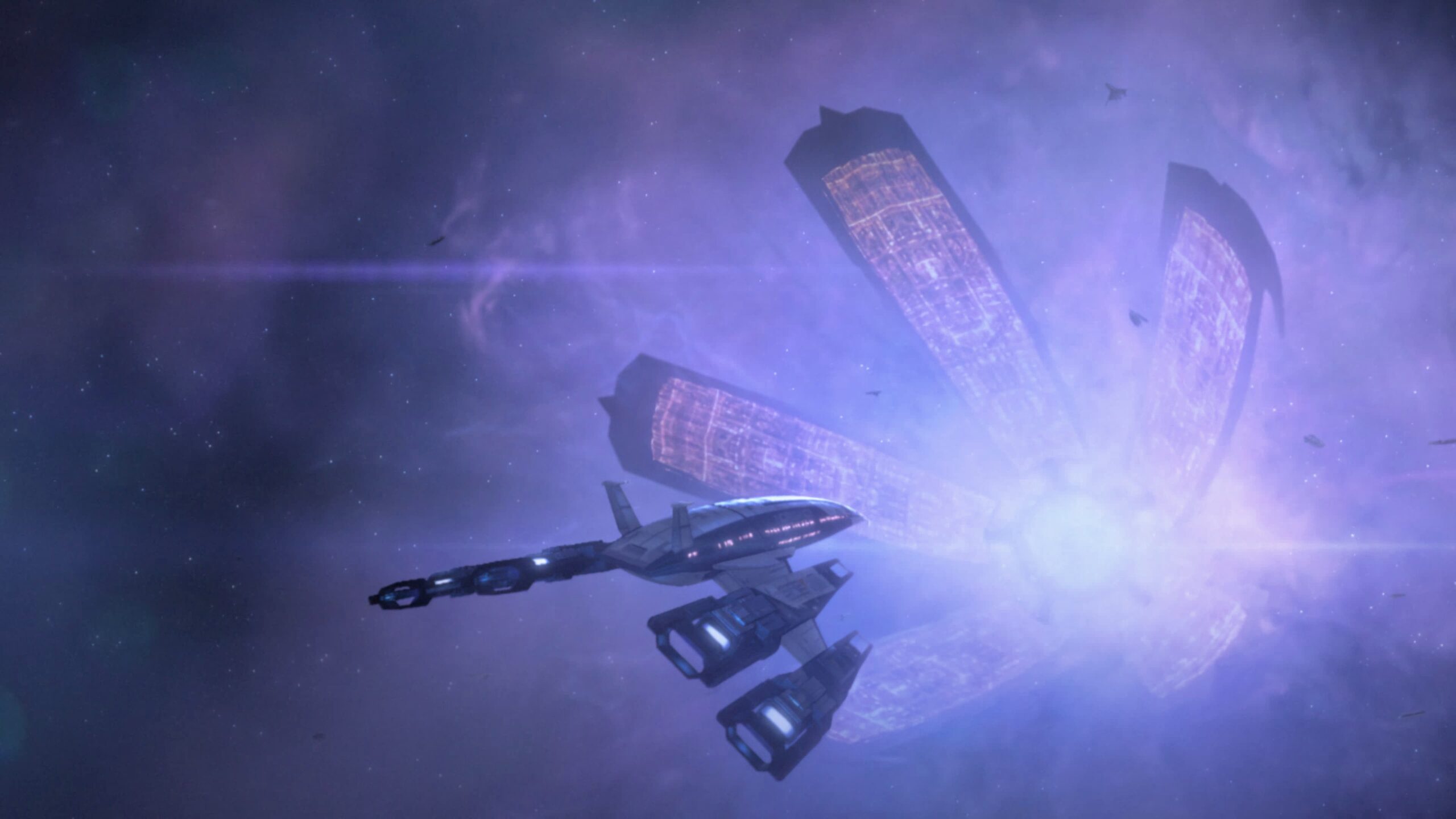

Mass Effect 2 is one of the most influential games ever made, both in terms of its impact on the industry and on me personally. You can see at least a bit of it in almost every RPG since, whether it’s the companion loyalty quests, consequences remembered from previous games, or an analogue to the Suicide Mission. Anyone who was around for it in 2010-2013 will still remember the almost unmatched hype and speculation it inspired both before release and in the buildup to Mass Effect 3. It was mind-blowing enough to have minor choices from an entirely separate game be remembered at the time, but ME2 added so many new major choices – nearly every notable character can die – that seeing how they’d play out in a third game was almost more tantalizing than the plot itself.

I’ve played through ME2 four or five times prior to completing it again as part of the Legendary Edition. The first and third games both place extremely high in my top 100, and ME2 was right there with them until my last playthrough in 2018. It definitely lost a little from familiarity, but my main issue back then was how much of the game felt like it was justified only by the “rule of cool” rather than being a coherent piece of the first game’s universe. ME1 has a cast of misfits going up against villains who are mostly used sparingly and often take their time to build mystery before revealing their true abilities. ME2, by contrast, often feels like it was written with a mandate that it needed a trailer-ready moment every 15 minutes. The new characters largely have no connection to the plot other than being Star Wars prequel-style badasses, which is probably why none of them return as party members in 3, most situations are now resolved with one-liners rather than dialogue trees, and villains have the subtlety of a runaway freight train.
Some contrasts to illustrate the point: In ME1, your party members are either original crew members or, like Garrus, Tali, and Wrex, have direct personal motivations to fight Saren and working with you is mutually beneficial. In ME2, that description just about holds for the returning and starting characters, but many others are recruited in scenes that show them being badass enough to not need you only for them to join anyway because the mission sounds like fun. ME1 has scenes like the final confrontation with Saren or Wrex’s conflict on Virmire that can lead to radically different outcomes depending on how you respond throughout a conversation. ME2 almost always provides one-liner buttons you have to click to get the best outcome by saying something cool, with the only alternative being to say something lame and get a bad outcome. Lastly, where ME1 had scenes like Sovreign’s hologram reveal or the slow introduction of the Thorian, ME2 introduces its villains with cutscenes in which they threaten you with one-liners and probably blow something up. The tone is, in short, very different.

Gameplay is similarly both of its time and different from ME1. 2010 was the age of waist-high-wall cover shooters, and so levels in ME2 are usually just a procession of such walls. You do at least get most of the same powers from ME1 to supplement the shooting, so it’s not a straight clone of the era’s military shooters, but this genre died off for a reason. As much as Andromeda is generally a worse game, the plodding combat and bullet sponge enemies of ME2 compare very poorly to the jetpack-powered chaos it offered. Still, it’s at least a largely competent implementation of a dated concept. Most of the guns feel good to use if you can ignore the inconsistent damage. Enemy variety is also pretty great – even though any one mission generally only has enemies from one group, it’s great about making sure there are at least a few variants and that the next mission will have something else to fight.

Lastly, my previous playthrough made me realize that the side quests are very lacking for an RPG. Most of them are either just returning lost items you find during main missions or can be found during planet scanning. The former missions aren’t worth talking about at all, and the latter are largely only a little better. Most of them are just combat sequences with minimal story context and against enemies you’ve already seen elsewhere. A few at least create quest chains or make some effort to provide a plot, but you’re not going to find anything like the Cerberus Rachni experiments or wild Thresher Maws of ME1.

It was for all those reasons that only played an hour of ME2 in 2021 after finishing my previous writeup. After being disappointed last time (although, to be clear – this was a change from “one of the very best ever” to “still excellent”), I wasn’t ready to give it another go after only three years. I finally did play all the way through after five more years, and going in expecting everything I didn’t like before helped me get a new perspective. If you’re able to look past all the attempts to be cool, there’s still a lot of the core Mass Effect experience to love here.
Let’s start with the lack of exploration. I think it’s pretty much undeniable that there is nothing close to the uncharted worlds of ME1, but planet scanning actually does a much better job of filling the gap than it gets credit for. Every planet displays a codex box when you visit it, nearly all of which have an interesting story to tell. Some, like the Anjea screenshot above, hint at a mystery on the planet. Others tell the story of a local conflict across multiple planets. Still others imagine strange lifeforms on extreme planets or the miserable ends of colonists who tried to settle somewhere foolish. It’s all text-based and sometimes contradicts how the planet looks if there’s an anomaly to visit, but many of them are interesting enough that I’d want to play a separate game based on them. A handful of planets help bring back ME1’s sense of awe of the Reapers by showing traces of civilizations who fought and lost in the impossibly distant past. It’s excellent stuff that never got enough credit.

A couple of main story missions also stand out as successfully escaping rule-of-cool. Two levels have you visit allegedly dormant ships, a Collector vessel and a Reaper killed by a blast you can find traces of on a nearby planet. Both eventually turn into more bombastic shooting missions, but they do a great job of building the tension before that and present suitably alien architecture. In a game that is determined to undermine Harbinger’s menace with “ASSUMING DIRECT CONTROL” memes, these two missions stand out for lending credence to Sovreign’s claim to be beyond your comprehension.

The Reaper mission is also where you encounter Legion, which sets up what I now consider the best part of the game. ME1 presents the Geth as a rogue AI swarm with no interest in communication, let alone understanding, and that happily allied with the Reapers. You’re told that they had a classic unprovoked robot rebellion against the Quarians and that they’re inherently hostile to all organic life. Mass Effect 2 then presents you with a damaged Geth who helps you in combat against Reaper minions and which has grafted a piece of human armor onto itself. You’re given a choice after the missions: trust the Geth enough to wake it, or sell it to Cerberus? If you choose to trust your eyes over what you’ve been told, you learn that the Geth you’d met before are Heretics infected with a Reaper virus, and that the core Geth population have never been hostile. Your conversations with Legion, the name this Geth adopts, re-contextualize huge parts of both games up to that point. Rather than a relentlessly destructive force, the Geth become a unique species with their own culture and goals. This exploration of how a swarm intelligence could build a civilization is easily the game’s most imaginative writing, and it sets up the final resolution of the Geth/Qurian conflict in ME3 to be that much more impactful. If you chose to reject Legion, you’ll see a war between two irreconcilable sides that can both only survive by destroying the other. If you chose to trust, you’ll see centuries of needless brought on by a refusal to seek understanding. Most games would force the choice in order to deliver a hamfisted message, but ME2 leaving it to the player to actively chose diplomacy against the prevailing ‘wisdom’ is genuinely brilliant.

Mass Effect 2 is probably best remembered for its final level, known as The Suicide Mission. In a decision that would have been brave for any game, let alone one that planned to continue its story, the danger in this mission is very real. Every single character, including you, can potentially die depending on the choices you make, and the game is intentionally obscure about exactly what the right choices are at each point. Choosing the wrong person for any task, failing to complete companion loyalty missions, and skipping particular ship upgrades all result in guaranteed or likely deaths, but even the most prepared run can end with casualties if certain fragile characters are left to hold the line off screen. It’s a roller coaster even when you know exactly how it all works, and it’s like nothing before or since the first time you play it.
That said, the effects of it ripple throughout the rest of the game’s design. There’s no doubt that it is one of the very best gameplay sequences ever made, but it is also the justification for many of the game’s worst parts. Why do we have so many companions? One death out of a cast of six would have been devastating. Why are so many of the companions barely attached to the plot? Less to resolve in ME3 if they’re dead. It also likely explains why many of the companions have minimal roles in that game. Why bother developing them more if there’s a good chance they died in the last game anyway? None of it is enough to take away the mission in the moment, but in a post-Baldur’s Gate 3 world, you can definitely see the seams of how Mass Effect 2 handles character death.

I also noticed that a lot of missions play almost like there was a directive that they all had to fit within a certain time limit. It’s nice to know that you can sit down and complete any given segment in 45 minutes to an hour, but several really suffer for their brevity. Jacob’s loyalty mission sets up a horrific shipwreck aftermath that could have been something special if given time, but basically goes right from the tense introduction to the conclusion. Even Tali’s, which is otherwise about as good as the game gets, felt like it was due a courtroom sequence that was twenty minutes longer.
Finally, some notes I couldn’t find a place for anywhere else: The upgraded graphics for LE largely look fantastic, but the HDR can sometimes be too dark and the basic facial animation really stands out when everything else has been improved. Kasumi’s DLC, which I was playing for the first time, is similarly mostly excellent, but I really wish they’d given her proper conversations on the Normandy instead of just random brief interactions. Lair of the Shadowbroker feels like a poor fit for Liara’s character and while it does have a couple of amazing setpieces, it is the extreme end of ME2 trying too hard to be cool. I intended to do the Overlord DLC again, but it was bugged and just triggered an infinite loading screen, which frustrated me enough that I didn’t end up bothering with Arrival or Zaeed either, but I’d played all of those before. Firewalker still sucks. Also, BroShep has some really stiff deliveries. It feels like it was the direction more than bad acting, but I wouldn’t mind a recasting if they ever remake these again.

Mass Effect 2 is a game with plenty to criticize, but this playthrough did bring my opinion closer to where it used to be. Is it going to be joining the other two in or near my all-time top 10? No. But I do think pushing it all the way back to 90th overdid it on how much the rule-of-cool hurts the setting and undersold the game’s positive aspects. This is not a perfect game. It is unmistakably from 2010. And yet, every stumble is ultimately in service of one of its wildly ambitious ideas that still stand out 16 years later. It’s rather fitting that this space game ends up as a demonstration of the old adage about shooting for the moon: this is one heck of a journey to the stars.
I plan to get to ME3 and finish this series a whole lot faster than five years. Let’s see if I succeed.