Nobody’s 2025 Top 100 Games: 100-91
Nobody’s 2025 Top 100 Games: 90-81
Nobody’s 2025 Top 100 Games: 80-71
Nobody’s 2025 Top 100 Games: 70-61
Nobody’s 2025 Top 100 Games: 60-51
Nobody’s 2025 Top 100 Games: 50-41
Nobody’s 2025 Top 100 Games: 40-31
Nobody’s 2025 Top 100 Games: 30-21
Nobody’s 2025 Top 100 Games: 20-11
Nobody’s 2025 Top 100 Games: 10-1
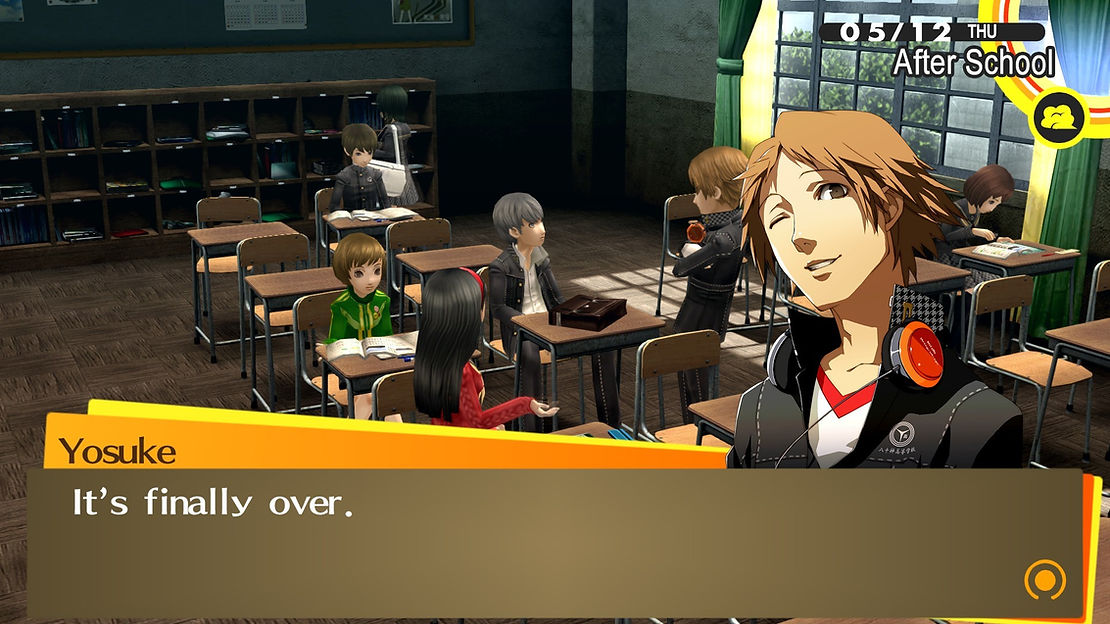
10: Persona 4 Golden

There’s very little separating any of these games now that we’re into the top 0.9%, but there’s particularly little between P3P and P4G. No other games of comparable length get anywhere near the two of them for the amount of times I’ve played, and they’ve both got casts and soundtracks that are among the best available anywhere. I went back and forth a lot when it was just original P4 against Portable, but Golden pushed P4 slightly ahead. Even though it makes a long game longer, the extra content is solid throughout and provides some of the most memorable scenes and fights in the whole game.
Previously: 15. I played it another time.
9: Persona 5 Royal

Royal actually bucks the pattern here a bit because I don’t think the extra dungeon is particularly well done and a lot of the new content focuses on a character who deserved as little time as he got in the original. It’s Royal that makes the list anyway, though, because freeing up the night periods and a few other smaller changes are good enough to cancel out whatever other missteps there were. And looking beyond what’s unique to Royal, P5 is just the best this series has ever been. Music? Characters? Gameplay? Everything stepped up from what was clearly already top 10 material. I haven’t had the time to finish P5 as many times as 3 or 4 yet, but since it’s a much longer game, the three playthroughs I have done account for nearly as many hours. I regret nothing.
Previously: 9
8: Mass Effect

I can see where people are coming from when they say that Mass Effect has a rough combat system or that the planet exploration is janky. I don’t mind either of them, but I can see why the inaccurate guns and bouncy Mako tank could get annoying. Even if I did mind them, though, they wouldn’t get in the way of what makes this game truly special. BioWare truly outdid themselves with this one, creating a universe that is understandable at a glance, but that’s also self-consistent if you dig into its backstories and cultures. Too much worldbuilding amounts to setting a bunch of events 10,000 years ago that don’t matter, but ME’s back history is full of events that either come up in this game as points of conflict in this game or set up threads that would only be resolved by the next two entries. It has a cast of some of the most memorable characters in RPGs, along with Kaiden and Ashley, an ending sequence that is no less exhilarating for having seen it five times, and it was the starting point for a trilogy of save game imports. Others, including BioWare themselves, have tried to match what ME accomplished by having decisions echo across three games. No one has come close to matching them even nearly twenty years later.
Previously: 10
7: Sid Meier’s Civilization VI

Civilization VI has been a great entry since the release of Gathering Storm, but the wave of post-pandemic content it received from both Firaxis and modders really took it to the next level. The number of different civs you can play as is absolutely stupid now, and they still manage to feel different. If that’s not enough, you can turn on Heroes and Legends or Corporations mode to radically shake up how core systems of the game work. Got through all that? Modders have expanded on nearly every part of this game to create an experience as deep or complicated as you could ever want. Enter hundreds of new units, extra options for how to build out every district, and even entirely new eras and progression systems. I have nearly 800 hours in it and will add many more.
Previously: 8
6: Until Then

Somewhere around June of last year, I saw the Steam page for an upcoming game called Until Then. It appeared to be some kind of magical realist high school story set in the Philippines. That’ll be a fun follow up to A Space for the Unbound, I thought. Surely a dev who had never made another full game from a country that has hardly made any full games wouldn’t make much more than a fun echo of a different game I liked, right?
They did. And much more than that, honestly. Although there are other games higher on this list, I truly don’t think any of them, or any other game not on this list, can match Until Then for how technically well written it is. Every character has genuine depth and gets the time to shine at some point in the story, but none of it is bloat. And it does that all while presenting its story with a remarkably effective art style that keeps the charm of 2D sprite work while also allowing them to make clever use of animations and camera angles to deliver characterization non-verbally.
I could say far too much about it, but much of it will be better without knowing what you’re getting into. Instead, I’ll just say this: If the game had simply ended at the end of chapter 1, I’d still have given it a 10/10, it’d still be on this list, and I’d still be telling you that the ending was absolutely perfect. But it doesn’t end at the end of chapter 1. It has barely even introduced half of the core cast by then. It only gets better from there.
Previously: Unreleased
5: Slay the Spire

This is where I’ll emphasize again that the relative rankings are almost completely meaningless at this point. Spire makes it as high as it does for being an unbelievably deep design. It only has four characters and three main chapters, and although each chapter has three different possible bosses, you’re likely to see most of the other content at some point in each run. Many other roguelites fall flat after a dozen or so runs because of that kind of repetition, yet StS is still going strong for me after hundreds of hours and perhaps a thousand runs. Instead of relying on simply have more options to create depth, it works by having loads of interlocking strategies and combos that you’ll have to dynamically shift between as the cards you’re after do or don’t appear. Even if you’ve seen every individual component of a run before, you probably haven’t seen them combined in that exact way, and those small differences can have massive effects on how you actually fight in each encounter. It’s also wonderful at having hidden utility throughout. I’m still finding cards that I wrote off as useless that can actually be incredibly powerful in the right circumstances, or combinations of more obviously useful items that become even more fun when used in a specific way. And, although this doesn’t factor into the list, there’s even a boardgame version now if you want to play co-op.
Previously: 7. I played even more Spire in the last 4 years than I did before making the last list.
4: Mass Effect 3

Sticking the landing for a series like Mass Effect was always going to be hard, and I will be the first to admit that ME3 didn’t do it. The ending sucks. But there’s some good news: You don’t have to play the ending. The more time passes, the easier it is to recognize that this series was always about the friends you made along the way and not the conflict with the Reapers. Yeah, the conclusion to the story about the alien death gods is pretty underwhelming. But, on its way to that, it delivers perfect conclusions to every other major plot thread you built up across three games. The characters you’ve come to love over three games, and also Kaiden and some guy named James, get the moments they deserve. I don’t blame anyone for hating the game because the ending just isn’t there, but I prefer to look at the 95% of the game that is exactly what it needs to be and ignore the parts that aren’t up to snuff. And now that’s even easier now that the Citadel DLC exists, that’s even easier. Forget the Reapers, we all actually just wanted a farewell party for this crew. N7 forever.
Previously: 5
3: The Witcher 3: Wild Hunt

Number 2 ruined a lot of what I could say here. I’d love to tell you that it has the most impressive web of choices I’ve ever seen in an RPG and the worlds most densely packed with interesting content, but that’s no longer quite true. But that really doesn’t diminish what is here: the second best versions of those things. TW3 defied basically everything about open world games when it came out. Turns out that you can tell an excellent story while being open world, that you can have sidequests which offer meaningful choices and impact the main plot, and that you can do all that while still leaving plenty of room to just explore. And then once you’re done with the 60+ hour main campaign, there’s another 30+ to get out of the two DLCs, which keep up the same level of quality while telling new and interesting side stories.
Previously: 3
2: Baldur’s Gate 3

I somehow still haven’t finished BG3, but no matter. It’s clear long before the end credits that Larian accomplished something pretty incredible here. I effectively already said what I think about this in the previous entry, but to expand on it, the choices available in just the first act of BG3 put nearly any other game to shame both in quantity and quality. It doesn’t quite reach the impossible standard of being as freeform as an in-person TRPG, but it gets as close as you could ever hope for from a game, and does it while still having those decisions echo throughout the rest of the game. You’ll have a different experience later in the game for resolving a quest any number of different ways, but also for not resolving it or for letting a core NPC die in an unfortunate side effect of combat. Some choices have such drastic ramifications that you almost might as well be playing a different game once you’ve made them, while others are hidden in corners of the map that are almost impossible to find without deliberately thorough exploration. That same freedom extends into almost every part of the experience: your character can be whatever you want and be built however you want, but you could also just play one of the defined party members and experience their party in a more personal way. Fights can often be avoided with the right dialogue choices or actions beforehand, but they can also be picked unnecessarily. Most games with a character as obnoxious as Astarion would make you suffer has presence throughout the entire story, but not this one: you can solve that problem with a quick shove into the ocean. And it has full co-op! And mods! And people are creating full conversions now! It’s hard to imagine how RPGs can ever top this, but at the same time, I won’t be surprised if Larian or CDPR has managed it by the time the 2030 list comes around. For now, BG3 is the squid king.
Previously: Unreleased
1: Zero Escape: Virtue’s Last Reward

Anyone who has ready anything like this from me before knew what was coming. VLR has been my number 1 game for over a decade, and while replays may have reduced the standing of its two sister games to some extent, the shine hasn’t come off this one at all after three plays. Its success is really down to just two things: the first 80% of the game is a relentless stream of new mysteries and variously subtle hints about the solutions to them. At any given moment you’re likely tracking six different big questions about the plot along with loads of smaller ones. Then the final 20% comes along and unravels those mysteries at an equally blistering pace. You’ll have figured a lot of them out if you were paying enough attention, but certainly not all of them, and the execution is so good that it’s a thrilling ride regardless. It also finds for an epilogue that, while throwaway in terms of plot, offers a really beautiful outlook on how the game’s events would feel to characters who have lives beyond participating in death games.
All of which could still be true of a game that does not stand up to replays, but VLR foreshadows and hints at its many mysteries in so many ways that there seem to always be new things to catch on another experience. You’ll go in thinking there was one way to solve a question in advance but end up discovering that there were three more, or you’ll find a strange scene that only makes sense with the context you now have.
And with that, there’s nothing else to say. This was the list’s last reward.
Nobody’s 2025 Top 100 Games: 100-91
Nobody’s 2025 Top 100 Games: 90-81
Nobody’s 2025 Top 100 Games: 80-71
Nobody’s 2025 Top 100 Games: 70-61
Nobody’s 2025 Top 100 Games: 60-51
Nobody’s 2025 Top 100 Games: 50-41
Nobody’s 2025 Top 100 Games: 40-31
Nobody’s 2025 Top 100 Games: 30-21


