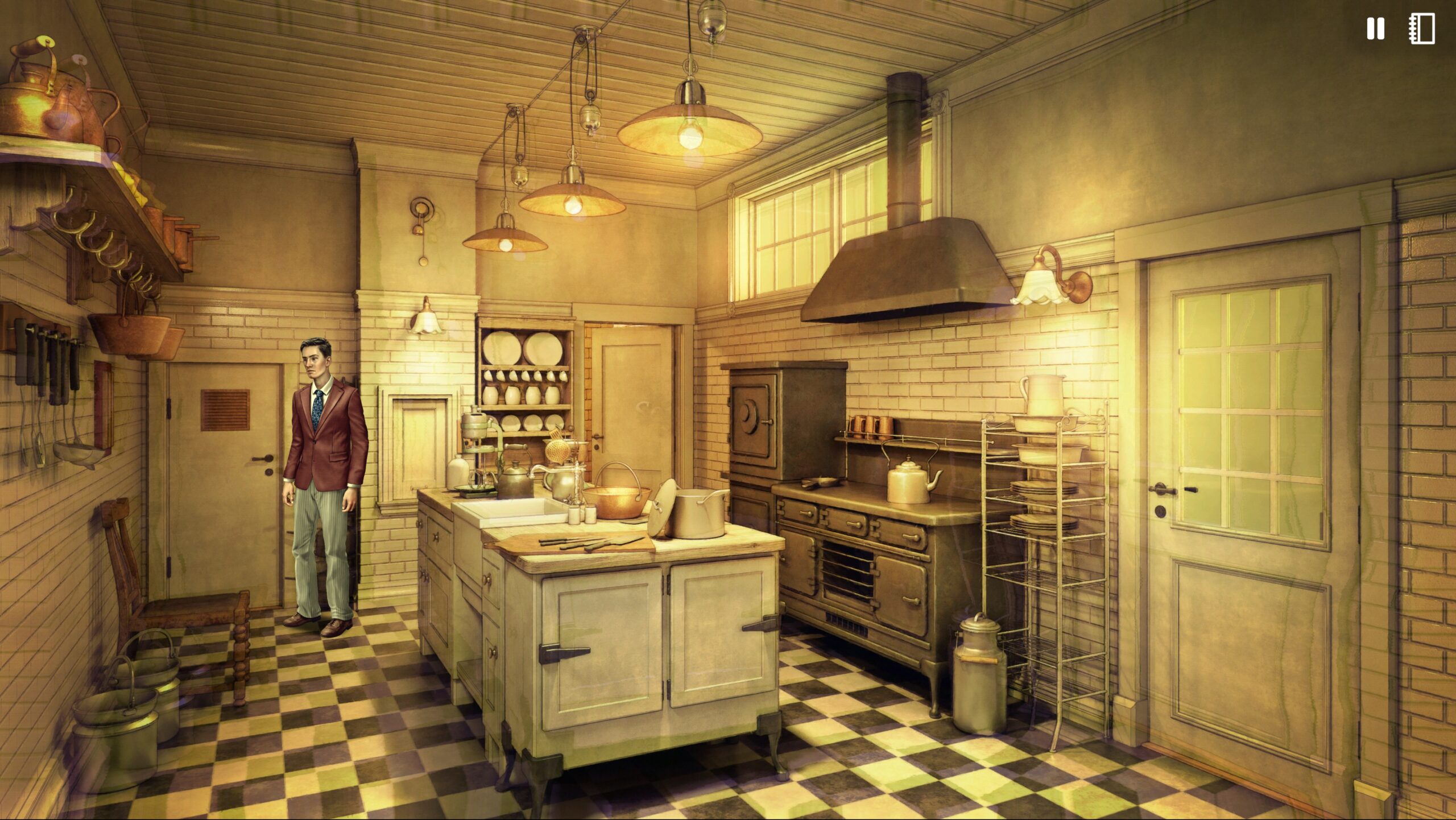

The Incident at Galley House is a deductive mystery game that has more in common with something like Unheard or Return of the Obra Dinn than Evil Trout’s other Steam game, The Roottrees are Dead. Both are essentially remasters of existing games, but where Roottrees was a sprawling mystery covering decades and an ever-expanding cast, Galley House introduces its entire cast almost immediately and then tasks you with putting together what happened to them over approximately 24 hours. It’s similar to Unheard and Obra Dinn in that you’re primarily working by listening to snippets of scenes and using the info you get to unlock more snippets. That said, this is much easier than Obra Dinn. I didn’t need the notes tool.
The story of The Incident at Galley House is best experienced blind, but the premise is revealed either on the Steam page or within a couple minutes of starting the game. Twelve people died under mysterious circumstances at Galley House in 1936. Eleven of them were never identified, and the twelfth had no reason to be there. Most had no obvious cause of death. You are an investigator working seventy years later with a seance machine that can replay the scenes from any room in the house provided you’re able to identify who was there at a particular timestamp. Given that premise, it’s fairly obvious that the story will be an And Then There Was One-style sequence of deaths, but your job is to figure out how and why.

Well, sort of. Your actual job is just to find enough scenes that you eventually trigger the one that rolls credits. Ideally you do that by deducing what’s going on, but you’re never actually required to demonstrate that you’ve figured anything out. Gameplay ultimately comes entirely down to inputting sequences like 05-LI-1-2-3 to indicate that you believe characters 1, 2, and 3 were in the Living Room at timestamp 5. If you’re right, a scene plays. If you’re not, an animation long enough to discourage brute forcing plays. Revealed scenes will have little numbers on them to indicate how many other scenes you can still find using clues from them, so you’re supposed to keep re-reading those to figure out the links you haven’t spotted yet.
This all works great for about the first two thirds of The Incident at Galley House. By that point, you’ll have seen quite a few deaths and will have largely figured out what’s going on. I can say that confidently because the game is not even remotely subtle about it after a certain point. That’s largely fine, because what’s going on is cool, but it does make the last part of that story arc drag since you already know what’s going to happen. Opportunities for deduction also start to vanish even earlier than that. There’s a lot to figure out at first when all the characters are still alive and you don’t know all the rooms in the house, but once it’s down to six or so, you’re usually only identifying 2-3 scenes per timestamp and everyone has basically announced where they’re going to be. It doesn’t feel like an accomplishment to figure out that A is talking to B in the Dining Room when you were explicitly told that B would be there and A is going to see them.

The original The Incident at Galley House apparently ended when you had completed the story of that night in 1936, but this version unfortunately decides to add a bonus chapter to complete afterward. The good news is that this extra chapter does have a couple of really cool ideas and is well-integrated into the story. The bad news is that it’s basically the same thing again but with fewer characters and only using a handful of rooms, so if you were already getting sick of easy deduction, the extra chapter is just another hour or two of it. It also takes a plot that just about works as it was written and expands the scale in a way that work as presented, but doesn’t really make a ton of sense when you think about what would have had to happen off camera.
Still, the game is fantastic for 4 hours and remains mostly solid for the remaining 2-3. I don’t think the bonus chapter is worth buying this edition for if you’ve already played the original, but I do think the new art and voice acting are enough to justify the price. Every scene looks and sounds great.
Conclusion
I was expecting to have to decide if The Incident at Galley House was new enough to make my annual top 10 for most of my time with it. The underwhelming final hours have made that a moot point, but it’s still a good time. Give it a go as long as you’re okay with the pacing falling apart at the end. If nothing else, there are definitely a few scenes that will stick with you.
Rating: 80%
Time to beat: 7.5 hours to find all the scenes
Price: $20
Feel free to leave a question or comment below!
For more reviews, see my Steam curator page: https://store.steampowered.com/curator/43219041
For a similar game, see Schrödinger’s Call Review – Coming Through Clearly


Leave a Reply