The Game Boy games of August 9-23, 1991, were a bunch of crap plus another great game from Konami.

BattleCity (NovaGames) (August 9th)
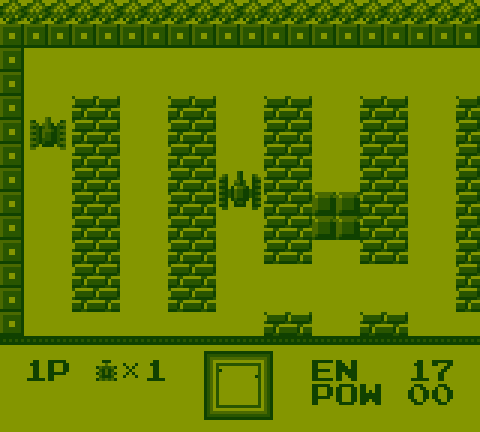
A port of a 1985 Namco arcade game. Wikipedia claims that no version of this ever left Japan despite it getting ports there as late as the Wii U, but MobyGames has the original arcade release also reaching the US. Either way, it’s a fairly simple tank game that has a respectable 3.6/5 from 77 MobyGames users, nearly all of whom reviewed the Famicom version. Stages consist of driving around a maze and blowing up enemies until the EN counter reaches zero, but it does innovate a little by making the maze destructible. Playing this with the sound on is banned by the Geneva Convention.
Unsurprisingly for a simple game that only had Japanese releases, there don’t seem to be any reviews from Western critics. It earned a 24/40 from Famitsu and 18.1/30 from Family Computer readers in Japan. There’s plenty about it on the Japanese internet, but as with MobyGames, the interest is chiefly in the Famicom version. This port is largely forgotten.
Rating: 1.

Elevator Action (Taito) (August 9th)
Another port, but this time of a game I already know I hate. It has a 58% average from 7 critics on MobyGames, although weirdly that’s largely driven by the 4 German reviews all being terrible. It got a 25/40 from Famitsu and 18.8/30 from Family Computer in Japan. I have nothing else to say about it. I only played long enough to get a screenshot.
Rating: 1.


Gradius: The Interstellar Assault (Konami) (August 9th)
The Game Boy in this era really was just Konami and everyone else. They one-upped themselves on graphics and sound yet again with this game, producing a shmup that really looks and sounds incomparably better than almost everything else available at this time. Just consider that this released on the same day as BattleCity above. That said, the difficulty is a bit inconsistent and some parts certainly require memorization, so it does not reach the same heights as Parodius for me.
Critic and user reviews were and remain high, with the contemporary score being an 83% on MobyGames and user averages tending to be similar. There’s plenty of positive coverage out there in many languages in Let’s Plays and blogs, but unfortunately, nobody seems to have saved what Japanese critics gave it. It’s probably safe to assume it was positive.
MobyGames has it as the 11th best game on Game Boy, and once you factor in that Pokemon Red and Blue shouldn’t really be separate entries, that means Konami released three of the system’s top 10 games within six months of each other.
Rating: 4

Higashio Osamu Kanshū: Pro Yakyū Stadium ’91 (Nihon Linguist/Tokuma Shoten) (August 9th)
A baseball game using the name of Japanese superstar Osamu Higashio. It only released in Japan and is essentially unknown everywhere else. The game looks and sounds fine, but pitches are far too fast for how precisely you need to hit them, so batting is a nightmare. I couldn’t find any contemporary reviews, but atwiki considers it a kusoge. They justify that rating with complaints about the excessive bunting ability of the CPU and strange behavior while fielding.
They gave it another go in 1992, so we’ll see this game again.
Rating: 1.

Megalit (ASCII/Asmik) (August 9th)
This was obviously supposed to be “Megalith”, but ended up sounding like someone trying really hard to invent hip new slang. It’s a very boring puzzle game where you push and pull blocks around to try to make them all touch the ground. The music is fine, but the graphics are pretty awful. It received poor reviews all around.
Rating: 1.

Blaster Master Boy (Aicom/Sunsoft) (August 23rd)
A sequel to the 1988 NES game. It’s sort of like Bomberman and has you navigating a maze full of enemies while detonating bombs that explode in a cross pattern, but you also have a gun. It has great music, but relatively mediocre graphics. Critics felt it was too basic and averaged out to a 74%. It got a poor 21/40 from Famitsu, but Family Computer readers were a little more positive with a 19.2/30.
Rating: 2. It can have a point for the music.
Leave a Reply