December 7th, 1990, was a day that would live in famy for Game Boy games. With 8(!!) Japanese debuts, it was by far the biggest release day so far. There were also three North American releases without a specific day, and while I’d normally cover them in the first post for the month, this one is already too big.

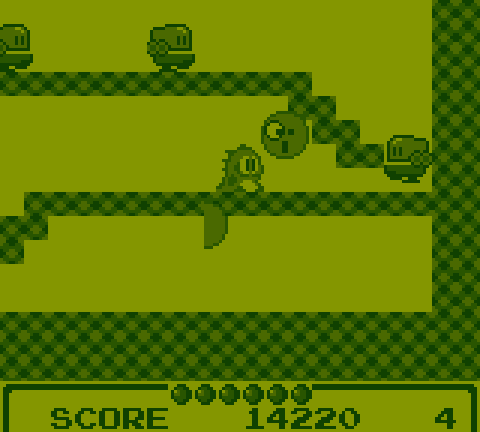
Bubble Bobble (Taito)
English Wikipedia and MobyGames lump this in with the arcade original, but it’s actually a distinct game. It’s basically the classic Bubble Bobble gameplay but without colors and with more scrolling in the puzzles. There’s a new story, but it’s as basic as you’d expect, and the music ported over perfectly. A lot of ports butcher their music, but the classic theme sounds as great as ever here.
Japanese Wikipedia points out that this version was entirely written in English in all versions and that Japanese text wasn’t available until the Taito Memorial Bubble Bobble remake released years later for GBC. The game received mostly average reviews in the West, a 23/40 from Famitsu, and a 20.77/30 from Family Computer. The last one is pretty high for them.
Rating: 2. Not the best way to play Bubble Bobble, but it’s pretty good.

Chibi Maruko-Chan: Ookozukai Daisakusen (KID/Takara)
Another missing MobyGames entry. This one is the first of many adaptations made of the Chibi Maruko-Chan manga, with the most recent listed coming 26 years later in 2016. It’s extremely obscure in the West, but clearly inspired assorted strong memories in the Japanese players who experienced it. Despite getting a 22/40 from Famitsu, Wikipedia gives it by far the biggest entry of any game in this series on the manga’s page, nearly all of which is a massive quote from an IGN Japan writer who wrote a long post about finally clearing the game decades after playing it as a kid. That author still enjoyed it, but calls out that the internet is full of decidedly less positive takes. And so it is. An atwiki writeup for it labels it a Kusoge and not only has the longest section to flaws I’ve seen for a game on that site so far, it actually has a second flaws section that lists even more. This game did things to that author.
The divisiveness is down to this being a pure RNG gambling game. Maruko wants to buy a bunch of crap from the mall, and the only way she can do that is challenging random townsfolk to games like rock, paper, scissors in order to win pocket money – the title is “the great pocket money operation”, after all. Any game so dependent on RNG would always be divisive, but this one apparently takes it further with random events that can screw you over and just generally punching you in the face every time you lose. It’s certainly not what you’d expect from a glance at the game.
Rating: 1.


Double Dragon II (Technos)
Anyone very familiar with the GB library may be about to object that Double Dragon II released in 1991, which is true. However, it’s actually a major reskin of the 1990 Nekketsu Kouha Kunio-Kun: Bangai Rantouhen, part of a series typically localized as River City outside of Japan. For whatever reason, Acclaim decided to pretend it was a Double Dragon game and change basically everything in a release a year later. All that remains of the original in the Western release is most of the GUI elements and the general feel of the controls.
MobyGames classifies these as two separate games, and I agree that they’re so different that it feels a little silly to group them as one. However, I’m using English Wikipedia’s list as my source of truth for the Game Boy list, and it merges them together, so here we are.
Western reviews were mostly pretty good at the time. The average tracked on MobyGames is hurt by a 20% review from 2008. Famitsu came in at a 24/40, and Family Computer settled on a 21.85. It is notable for being the first game I’ve seen to offer save games for multiplayer.
Rating: 2. It just looks a bit off in the Double Dragon version and the music is an abomination in the original, so you can’t really win here.

Kaisen Game: Navy Blue 90 (Use Corp)
For those keeping track, this is already the third version of Battleship on Game Boy. It’s a sequel to 1989’s Kaisen Game, and retains most of the graphics along with the idea that each ship has its own special weapons it can use. This one adds a campaign and deepens the fleet customization with multiple variations of each ship.
It received two poor reviews in the West. I can’t find the Famitsu/Family Computer reviews if there ever were any, but there’s quite a lot about it in various Youtube videos and atwiki posts still today. Opinions are mixed, but it obviously struck a bit of a chord to still be getting talked about.
Rating: 2.

Koro Dice (A-Wave/King Records)
“Korokoro” is the Japanese onomatopoeia for rolling dice, so it’s unsurprising that this is a game about rolling a die around. It’s a bunch of boards with various obstacles and the goal is to get your die to the marked space with the one pip facing up. It’s pretty boring, but did have a versus mode.
I found a few writeups about it that didn’t offer an opinion.
Rating: 1.

Painter Momopie (Sigma Enterprises)
A game about cleaning impossibly dirty floors in maze-like rooms. You’re a witch and have access to some spells that can help, but there are also enemies to avoid or kill during your cleaning. Some spaces can only be fully cleaned by approaching from particular angles, but there are no restrictions on your movement, so I wouldn’t call it a puzzle game. It earned a 47% from the German Power Play magazine, a 21/40 from Famitsu, and a 18.04/30 from Family Computer. Those are all low.
I found hardly anything about it other than resale sites in Japanese, but it does get a Wikipedia page. The few non-resale links are mostly Youtube videos, which include a few in English claiming that it’s one of the best Japan-exclusive GB games. That’s an opinion and can’t exactly be wrong, but it already feels hard to justify after just two years of the GB’s library.
Rating: 1.

Head On (Graphic Research/Tecmo)
This was Power Racer in the West, and Wikipedia credits the 1979 arcade original with being the first game about eating dots in a maze. Pac-Man edged it out on arrival to the Game Boy, though, and there’s really no competition at all between them. This feels horribly stiff and slow in comparison, plus it’s graphically dull. The only thing going for it is the music.
Critic reviews at the time were quite poor. MobyGames has a 38% average, and modern user reviews are not much better.
Rating: 1

Scotland Yard (Shoei System/Toei Animation)
Despite being a Japan-exclusive, this is a port of the classic German board game. I don’t actually know how to play the game, though, and this seemed like a pretty awful way to learn. None of the buttons seemed to do anything on this screen.
I didn’t find much about the game. It doesn’t help that ‘GB’ is the most common abbreviation for Game Boy in both English and Japanese and that the actual Scotland Yard is in Great Britain, nor that “Game Boy” and “board game” contain the “game” word in both languages as well. Basically every search result is a resale site, about the original game, or about the London police. What I could find suggested it was probably a decent time in multiplayer.
Rating: 1. Not the way to play this today.
Previous: Revisiting Every Game Boy Game: Part 31: November 30th, 1990 | Hub: Revisiting Every Game Boy Game | Next: Revisiting Every Game Boy Game: Part 33: December 11-13, 1990


