August 1-8 1990 was not a good week for Game Boy games.

Ishido (Nexoft/ASCII) (August 2nd)
A puzzle game in which you place tiles on a board, but each tile has to be placed adjacent to others that match it either in shape or in the pattern filling each shape. It had quite a few different ways to play, including a tournament mode, but this seems like a pretty awful way to play compared to the console/PC versions with a bigger screen and colors. Contemporary reviews were, to say the least, divisive on all systems. MobyGames tracks reviews all the way from a 92% on Amiga to a 10% on Genesis. The Game Boy version was near the middle of the pack and, oddly, got a review from Entertainment Weekly.
Rating: 1. It’s probably good if you really want a difficult solitaire game, but this is an awful way to play it.

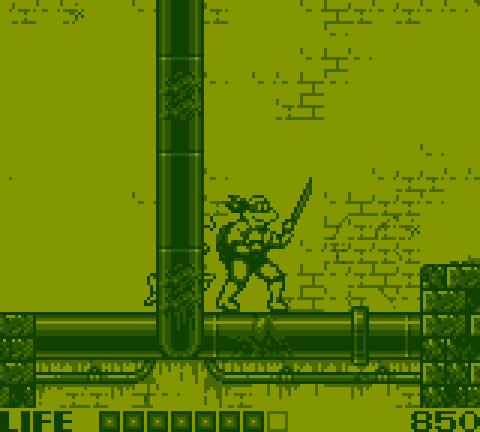
TMNT: Fall of the Foot Clan (Konami) (August 3rd)
This released on August 3rd in Japan and an unspecified date in August in the US, so it was at least close to a simultaneous release. It’s a scrolling beat-em-up featuring the Ninja Turtles. Reviews at the time were largely very positive, including a few perfect scores, but I’ve got to agree with the handful of critics who thought it was a bit crap. Gameplay pretty much consists of slowly moving right and mashing attack until enemies walk into your attacks and immediately die. It tried to have parallax, but something about the way it works when you jump just results in a GB game somehow inducing motion sickness. It doesn’t have much going for it other than relatively good graphics.
Rating: 2.

Sakigake Otoko Juku (Yutaka) (August 4th)
The full title is Sakigake Otoko Juku: Meikoushima Kessen and it’s a fighting game based on the anime of the same name. I will say that it has decent music and a proper story mode, which is more than the other fighting games so far could say, but the gameplay is absolutely dire. All you can do is attack, crouch attack, or jump. The AI seems to know that mashing attack is a basically unstoppable strategy, so it counters by endlessly jumping far beyond the top edge of the screen and sometimes trying to hit you on the way down. It’s very easy to time its jumps and get a hit, so you can still deal damage, but it takes forever. It’s almost like if Divekick required 15 hits to win and you could jump to twice the height of the screen.
I can’t find any professional reviews, but a few Japanese blogs writing about it in retrospect agree that it’s garbage. One suggested it might be more fun to play against a human, but also noted that it doesn’t lend itself to finding another person to play it.
Rating: 1.

Osawagase Penguin Boy (Natsume) (August 8th)
Later released as Amazing Penguin Boy overseas, this is the third penguin game on Game Boy. This penguin needs to press A on the black orbs and B on the white orbs to fill in the board. Touching the enemies or running out of time costs a life, but you can temporarily remove the enemies by kicking a black orb into them or by removing all orbs from a tile they are adjacent to. Both the player and the enemies can only move on the lines.
Wikipedia has a stunningly-high 21/25 score from GamePro, but most other contemporary reviews seem to have been pretty poor.
Rating: 2.
Previous: Revisiting Every Game Boy Game: Part 18 – July 27-31 1990 | Hub: Revisiting Every Game Boy Game | Revisiting Every Game Boy Game: Part 20 – August 10-12 1990