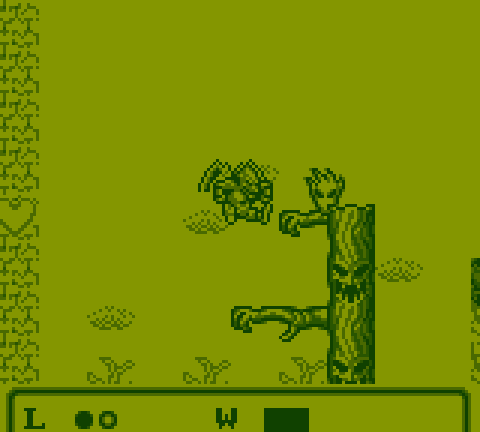
May 1990’s Game Boy games consisted of just five titles, quite a step down from the 13 released in April. All debuted in Japan, and two of them never released anywhere else.

Gargoyle’s Quest (Capcom)
Released on May 2nd, this is a spin-off of Ghosts n’ Goblins where you play as one of the standard enemy types rather than the usual hero. It opens with a really comical scene in which three different people walk up to you, deliver a partial message, and then immediately die. The first level is fairly standard gameplay for the series, albeit with the character’s trademark flying and wall-jumping abilities instead of the hero’s standard moveset. Later levels apparently include more RPG-like gameplay.
It was one of the most critically acclaimed Game Boy games in the West, but it broke the cliches about critic scores in a few ways. For one, Nintendo Power’s 3.5/5 was one of the lowest scores it received outside of Japan, and more significantly, Famitsu and Family Computer gave it a 25/40 and 21.88/30 respectively. It’s pretty unusual for Famitsu to come in that much lower on a domestic game.
Modern opinion on it seems to have converged a bit, however. The 3DS version scored notably worse than GB with critics, and user scores for both the 3DS and NSO versions are lower as well.
Rating: 3. It’s another one that gets points for being important and unique, but the slow gameplay and unforgiving blind jumps don’t hold up very well.

Lock ‘n Chase (Data East)
This port of a 1981 arcade game released on May 11th. It looks like a straightforward Pac-Man clone, but it’s a little bit more than that thanks to having multiple kinds of power ups and not using the same map on every stage. The only contemporary reviews I could find were from Japanese Wikipedia and are in the 50-70% range. That said, the user reviews on GameFAQs are quite positive, so it has some modern fans.
Rating: 3. The music is fun and it’s nice to see a game in this style that tries something at least a bit different.

Heavyweight Championship Boxing (TOSE/Tonkin House)
This released on May 18th as just Boxing in Japan. It’s a very graphically impressive boxing game that features both a full-ring view like the original Punch-Out and a first person view similar to the much later Wii Sports boxing mode. Alas, the gameplay does not live up to the graphics. The first person mode expects you to time your punches to match when the power bars have filled up in order to do any real damage, but your opponent dances around so much that you really just have to swing when you can and usually end up punching him in the face to no effect. Worse, players can strafe indefinitely and move at the same speed, so the AI mostly just moves left endlessly once it starts winning and there’s not much you can do except move in the other direction to revert to ring view and try again.
The critic and user reviews I can find are mostly low. Its average is dragged up a good bit by the ever-positive How to Win At Game Boy Games awarding an 83%.
Rating: 1. This sucks.

Ayakishi no Shiro (SETA)
May 25th brought this dungeon crawler set in a Japanese castle. It’s very much based on Wizardry, which was tremendously influential in 1980s Japan, and is another game that never released anywhere else. I believe this is the first Game Boy game to be fully first person. Beyond that bit of trivia, it’s pretty standard stuff for the genre. The contemporary reviews I can find gave it quite low scores, although I’m beginning to get the impression that Famitsu and Family Computer just hated Game Boy games around this time.
Interestingly, while this game is unsurprisingly very obscure in the West, it seems to have become a bit of a cult classic at some point in Japan. There is a lot out there about it compared to similar games from the time. Modern players mostly note being impressed by the similarities to Wizardry, liking the change in setting, and being frustrated by the difficulty of the final boss.
Rating: 2. You’re going to need to know a lot of archaic castle terminology for this one, but it’s cool that they got it working. MobyGames suggests there is a fan translation out there somewhere.

Ultraman Club: Teki Kaiju o Hakken Seyo! (TOSE/Bandai)
Finally, we had “Ultraman Club: Find the Enemy Kaiju!”, released on May 26th. It’s something like a fusion of Advance Wars and a JRPG-lite battle system. You chose whether to play on a city, space, or country side map, place a crapton of units, and then put down your base. Your goal is to find the enemy base before they smash yours, and everyone alternates taking turns. It included a Link Cable versus mode, but would have required a lot of patience to finish a multiplayer game. Getting anything done takes forever when you only get one move before having to wait for your opponent.
It seems to have attracted very little attention from anyone. It doesn’t have a Wikipedia article in Japanese or English, MobyGames tracks no reviews from anyone, and I could only find a couple of Japanese bloggers who tried it out decades later. That said, both of them came away feeling positive about it.
Rating: 1. It’s promising that those bloggers liked it, but it’s just so slow that I can’t imagine playing it over newer games. The gameplay is also basically incomprehensible without the manual to explain what’s happening.
Previous: Revisiting Every Game Boy Game: Part 13 – April 27-28, 1990 | Hub: Revisiting Every Game Boy Game | Next: Revisiting Every Game Boy Game: Part 15 – June 1-15 1990