Nobody’s 2025 Top 100 Games: 100-91
Nobody’s 2025 Top 100 Games: 90-81
Nobody’s 2025 Top 100 Games: 80-71
Nobody’s 2025 Top 100 Games: 70-61
Nobody’s 2025 Top 100 Games: 60-51
Nobody’s 2025 Top 100 Games: 50-41
Nobody’s 2025 Top 100 Games: 40-31
Nobody’s 2025 Top 100 Games: 30-21
Nobody’s 2025 Top 100 Games: 20-11
Nobody’s 2025 Top 100 Games: 10-1
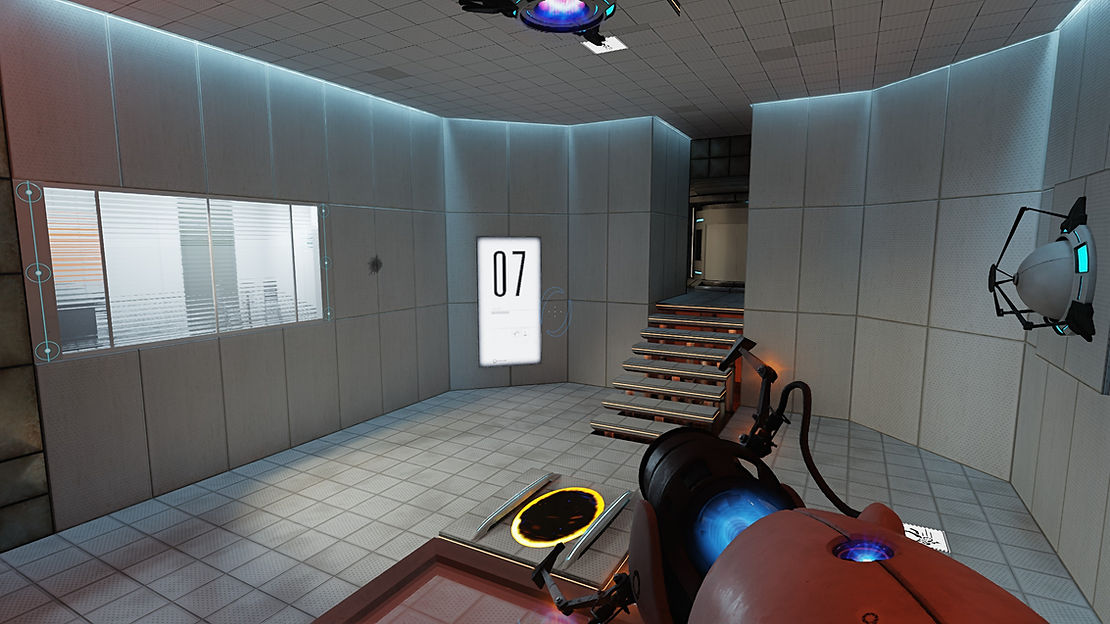
40: Portal

Look, everyone knows Portal. It’s one of the most famous games and most meme’d games ever made. It was tremendously influential on gaming in general and puzzle games in particular. Sometimes I think it shouldn’t be this high because it’s so short and because Portal 2 is so much better, but at the end of the day, there’s just no getting around what an incredible achievement this game is. It was a dinky little bonus game in The Orange Box, and yet it’s responsible for “Still Alive” and some jokes that are genuinely iconic. You can finish it in an hour or two even if you’ve never played before, but it’ll still be fun and funny after another five playthroughs. Portal is the embodiment of the design adage that perfection is achieved when there is nothing left to take away. It is a small game, but it is exactly what it needs to be.
Previously: 49
39: Sumire

Sumire is about Sumire, a young girl who is having a bad time. Her grandmother just died, her parents are headed for divorce, her best friend is moving away, and so on. Enter the magic space flower, who has promised her the opportunity to see her grandmother again if only she can have One Perfect Day. And to do that, she’ll have to face all of her problems head on.
Sumire is only two hours long, and yet it somehow finds time to treat a huge number of heavy themes with depth and respect. It isn’t a “friendship is magic” story, either – you have the freedom of choice to resolve Sumire’s problems like a jerk. Nor can all of your problems actually be solved in a way that anyone really likes. It’s a game about doing what you can while you can and knowing that, whatever happens, you tried. Other games have had these themes, but few can claim to do them so well or so efficiently.
Previously: Unreleased
38: Hollow Knight

I don’t particularly like Metroidvanias and I’ve never finished a Souls game, so Hollow Knight is a game I should have bounced off of. And I did. My first attempt at it only lasted a few hours, and it wasn’t until coming back to it a few years later that I realized how special of an experience this is. It does have the flaws that usually turn me off both genres: there’s a lot of backtracking, and there are frustrating segments that you’re forced to play repeatedly because of checkpoint placement. And yet it works anyway, because somehow the strengths of both genres do an excellent job of cancelling out what I don’t like about the other. Repeating segments is less maddening because movement is fast and fluid, and backtracking is less frustrating because combat is engaging. It also helps that the game is absolutely full of weird and wonderful environments that can change dramatically as you progress through the story. There’s always some mysterious corner of the map that you’re eager to discover or a ledge that’s barely out of reach that promises the possibility of an exciting new region. Almost everything you do in Hollow Knight feels rewarding.
Previously: 11. Another strange entry in the 10-20 block from last time, although this one at least had the excuse of recency bias.
37: Final Fantasy X

My second favorite Final Fantasy is a great all-rounder. It has my favorite leveling system in the series, via the Sphere Grid, and uses that system to have some of the best combat. The soundtrack has some of Uematsu’s best work, the unique art style makes for tons of memorable locales, and I even love Blitzball. It’s just a thoroughly fun experience that, with a few brief exceptions, is free of the filler periods that bog down the middle of most JRPGs. There’s almost nothing I don’t like about it, but it only comes in at number 37 because the story and cast just aren’t quite as strong as other games. Although it has a few great moments and a couple of excellent characters, that part of it is never quite as strong as everything else. Still, 37th out of 1100+ is an extremely good showing.
Previously: 66. Not actually sure why it went up so much
36: Total War: Shogun 2

Shogun 2 is a game I feel like I could play forever. Partly because the core strategy mechanics are so solid, but mostly because there’s such an absurd amount of meaningfully different content built into this game. Despite the fact that it takes place during a brief historical window in a small country whose geography forces a fairly linear approach to campaigning, the major factions have such different starting situations and unique abilities that you can play any two of them back to back and get a different experience. But that’s peanuts next to how different it’ll be if your second campaign was in Rise or Fall of the Samurai instead. The two DLC expansions instead having you fighting wars in the 1100s and 1800s, with all the technological and societal changes you’d expect relative to a game originally set in the 1500s. And of course those expansions have their own set of unique factions. It is hard to think of any flaws other than that I don’t have infinite time to play it and that, even if I did, there’s actually one more TW game later on the list.
Previously: 28
35: Dishonored 2

I was a bit surprised to see Dishonored 2 here ahead of Shadow Tactics since I’ve said the latter is my favorite stealth game for years, but in the end the ranking averages were not particularly close. Both games are nearly perfect, and while I tended to prefer the more intricate Shadow Tactics levels at the time, I think Dishonored won this year because of its creative setting and the really unique gameplay that comes from playing with no powers. D2 still takes place in the same light-magical Industrial Revolution setting as the first game, but it’s now in a more colorful Mediterranean-inspired country and has some really bonkers levels. The levels don’t inherently demand the same level of planning and precision as ST, but if you chose to reject powers early on, they get pretty close. It’s really something special to work you way through a level intended for a magic assassin despite being stuck with the abilities of a regular human.
Previously: 39
34: Mirror’s Edge

I praised Double Dash earlier because of the way levels flow once you get into the game. Mirror’s Edge is like that, but to an even greater extent. It does take multiple playthroughs to get there, but once you’re at the point where an entire level is basically one continuous motion, it feels incredible to play. It also has a remarkably distinctive look considering it’s a ‘realistic’ game and gave us an awesome credits song despite it only being the second best video game credits song called ‘Still Alive’ of 2007. Most people don’t like this game because the story sucks and the combat is even worse. They’re absolutely right, but you can skip the story and you should skip the combat. This is a game about going fast, and combat is slow and unreliable. If you’re stuck fighting, you’ve usually done something wrong already. Is it a niche pick? Absolutely. But, well, so is basically everything else on this list.
Previously: 51. Fun fact: The last three games tied with an average ranking of 38.667, which was the only three way tie in my list. ME won the tie thanks to having a best placement of 29 against 31 and 37 for the other two.
33: Pokemon Quetzal

We’ve finally reached the end of Pokemon, and it’s another Gen 3 romhack. What does this one add? Just the entire Pokedex along with modern movesets, mega evolutions, loads of QoL improvements, visible Pokemon in the overworld, and a whole new type of shiny. Oh, and full co-op. You can play every single battle in the entire game as a doubles match with another player in couch co-op, which is an obviously amazing idea that has somehow still not occurred to GameFreak. It’s even better because of higher difficulty modes, which give your opponents properly built teams that are a genuine challenge to beat and require you and your co-op partner to really plan together in order to have a team that can win. Hopefully GameFreak will eventually make an official game like this someday, but until and if that is done well, this is the best Pokemon experience you can have.
Previously: Unreleased
32: Total War: Three Kingdoms

It didn’t take very long to get to the next, and last, Total War game on this list. Three Kingdoms has the same core mechaics as Shogun 2, but the two games play very differently. China is a massive setting for this kind of game, and unlike Japan or Europe, the geography does very little to limit how you expand. Going to war is nerve wracking because there are potential enemies on every side, but if you’re not aggressive, you’ll fall so far behind the size of the leading empires that you’ll have no chance of catching up. That tension is present throughout the campaign and to an extent that other TW games really struggle to match. Three Kingdoms also goes even further with faction diversity, with my favorite being the bandit leaders who suffer massive diplomatic penalties with everyone else and can only survive by picking fights intelligently. Lastly, if you’re playing in Romance mode, the game embraces the way leaders from this period have become legendary folk heroes by making your generals semi-invincible forces of nature with unique powers that can turn a battle if used properly.
Previously: 12
31: Roller Coaster Tycoon 2

I described Parkitect as basically being RCT2 earlier on the list, and it was the only one of the two games to make the 2021 version. What’s up with RCT2 suddenly being so high? A lot of it is because I finally beat this and regular RCT (they are essentially the same game) last year using the excellent OpenRCT launcher. It updates the game engine for modern systems while also adding tons of QoL fixes that clean up the experience without taking anything away from the design. Parkitect has most of those fixes as well, though, and it has a deeper management system. What gives RCT the edge is, to use a cliche, its character. Parkitect is an excellent game with very generic graphics. RCT is an arguably slightly less excellent game that’s full of memorable music, designs, and parks. It’s the one you’re going to remember a year after playing, and it’s the one that started it all. That’s good enough to win the comparison.
Previously: Unranked, which is entirely because I was almost exclusively ranking games that I’d finished
Nobody’s 2025 Top 100 Games: 100-91
Nobody’s 2025 Top 100 Games: 90-81
Nobody’s 2025 Top 100 Games: 80-71
Nobody’s 2025 Top 100 Games: 70-61
Nobody’s 2025 Top 100 Games: 60-51
Nobody’s 2025 Top 100 Games: 50-41
Nobody’s 2025 Top 100 Games: 40-31
Nobody’s 2025 Top 100 Games: 30-21