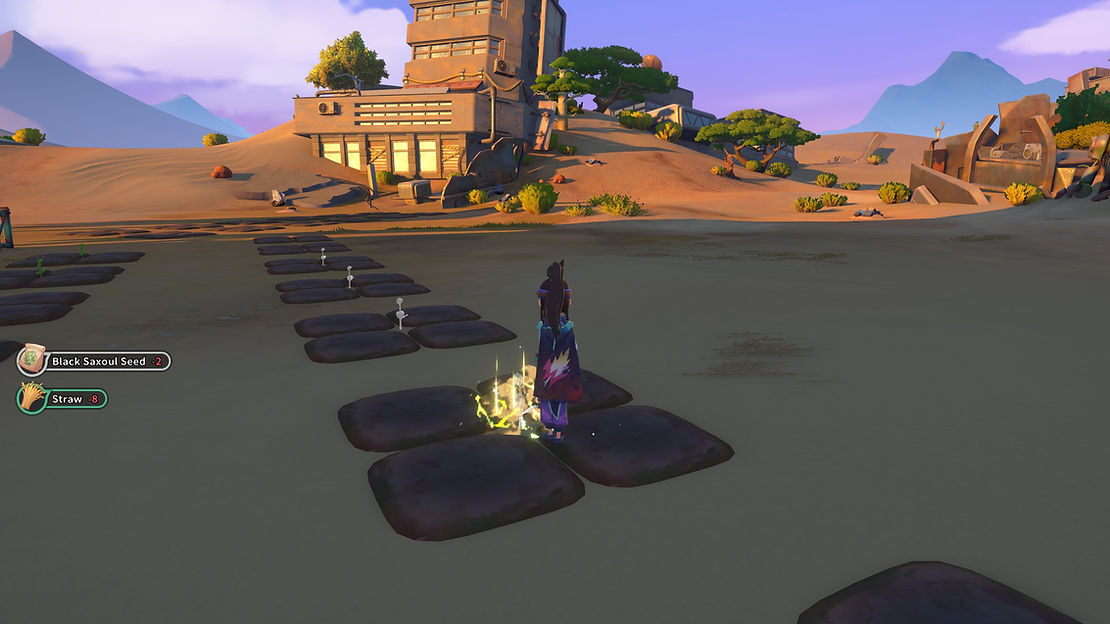
My Time at Sandrock looks like a farming simulator at first glance, but in reality it’s more of a town building simulator. You start out with an empty workshop in the almost equally empty town of Sandrock. Your goal is to complete requests and commissions you get from the townsfolk, which begin as small items and eventually escalate to buildings and massive pieces of infrastructure. Gathering the materials for those requires you to build more and better machines in your workshop. It isn’t as complex as Factorio since you can’t automate production chains, but you could easily end up with a cluster of machines that looks like something out of that game.

Since My Time at Sandrock isn’t a farming game, most of the base materials you need are found scattered around the game world. The more advanced types are usually further away and need upgraded tools to harvest, but you can build fast travel stations and other quality of life improvements to make it easier to reach them. Some ores can only be found within caves that require you to dig your way down to each new level in gameplay that’s very reminiscent of the old Red Faction terrain shaping system. Still other materials are obtained from monsters, which you’ll need to defeat using the game’s surprisingly robust combat. This isn’t Dark Souls or anything, but you do get a reasonably deep upgrade tree, combat perks, multiple melee and ranged weapon types, and even a stamina and dodge system. Compared to the typical combat in Stardew Valley or Rune Factory-likes, this is a huge step up. And on top of all those other ways of gathering resources, it does a great job of preventing one gameplay type from ever getting stale.

All of that resource gathering is in service of what is without a doubt the game’s killer feature: the urban planner. This is a big tree of major crafting jobs that each make significant changes to the town and what you can do in it. Some unlock new areas, others add minigames you can play, and the most exciting projects bring new NPCs and stores to Sandrock. You don’t get control over the appearance or placement of the new buildings, so it’s not as customizable as something like Animal Crossing, but it’s still a very fun way of really making you feel like you’re fulfilling your role as the town builder. That said, the endgame balance needs some work. Each level of the planner unlocks as your workshop gains reputation, but the curve breaks down for the last few levels and you’ll end up needing to grind boring activities for several in-game days in order to unlock each of the last 2-3 tiers. The devs have been adding more quests that alleviate this issue, so it’s possible that the problem will be fully resolved after another few patches. For now, it’s a significant drag on the last 10 or so hours of the game.

My Time at Sandrock‘s other notable weak point is its characters, at least in the multiplayer version. You get a little bit of characterization if you interact with them enough to become better friends, and then a little bit more if you chose to romance that character, but none of it is really that deep and you have to go through a lot of repeated dialogue to get to any of it. It’s all so much effort that you’re not going to befriend more than a couple of the characters unless that’s all you focus on, and even then a few characters are introduced so late that you’d have to drag out the whole experience by a fair amount to see much of them. It’s my understanding that they do a lot more with the characters in the single player version, so it’s a shame that they weren’t able to find a way to make more of that content multiplayer. The town is constantly changing thanks to all your urban planner work, so it’s fair to say that Sandrock itself feels more alive than anyone in it. And, in case you missed it elsewhere, this is a good opportunity to mention that both the story and a handful of systems like having kids are fully absent in the multiplayer game.
Conclusion
All in all, My Time at Sandrock is a solid game with some notable flaws. It does the town building/farming sim crossover better than anything else on the market, and it has one of the most enjoyable co-op modes of any similar games. At the same time, you have to sacrifice access to a lot of the game’s content in order to play mutliplayer at all, and even after that you’ve got to suffer through a poorly balanced endgame that requires a few hours of very dull grinding to complete. Maybe those problems will be fixed someday. I’d probably be giving this a 9 or higher without them. As it is, it’s impossible to play mutliplayer My Time at Sandrock without feeling like you’re playing an incomplete version that didn’t quite get all the attention it really deserved. That makes it harder to recommend than it should be.
Rating: 80%
Time to beat: About 60 hours in two player co-op. I’m not sure if it would be faster with a full group.
Price: $40
For a similar game, see Sun Haven Review – Laboring The Point
Feel free to leave a question or comment below!
For more reviews, see my Steam curator page: https://store.steampowered.com/curator/43219041


