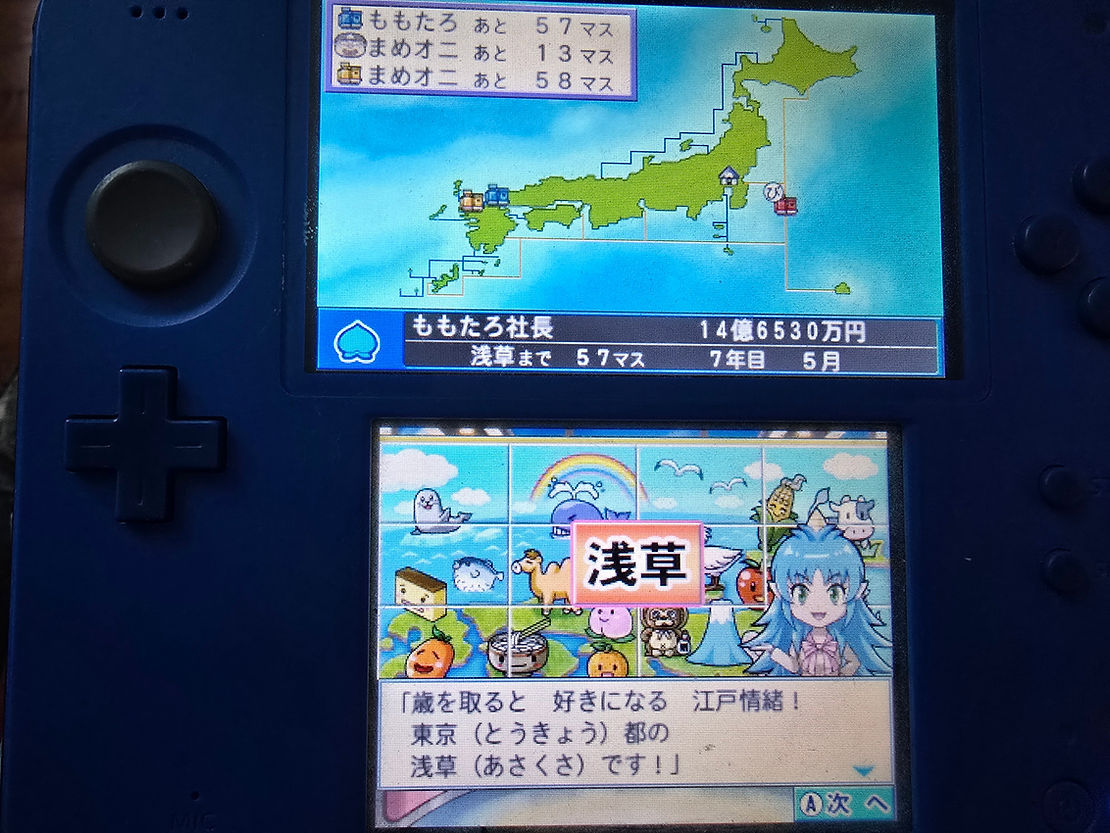
Momotaro Dentetsu 2017, or 桃太郎電鉄2017たちあがれ日本 if you want to find this page by the original title, is a Japanese-only 3DS entry in the long-running series of Japanese-only Momotaro games. This is the first one I’ve played, but all of them are essentially board games where you are racing other players to specific cities around Japan and buying up properties along the way in order to have the most assets at the end. It’s a simple concept that often gets summarized as Japanese Monopoly, but outside of being a roll-and-move game with property purchases, I don’t think the two games actually have much in common.
I’m not sure who the audience is for an English review of a nine year old Japanese 3DS game that’s part of a series with newer and more accessible games (probably no one), but there’s almost nothing else on the internet in English about Momotaro Dentetsu 2017, so I’ll start with the basics and won’t assume anything about why anyone was interested enough to read this. Each turn in this game represents one month of a year. You can either roll one die right away to move that number of spaces in any direction or you can play a card that will either let you roll more dice or otherwise provide an effect that ends your turn without rolling. Your main goal is to roll the right values to make it to a specific station on the map, which results in earning large amount of prize money and the objective moving to a new city. Along the way, you can stop at other cities to buy properties that pay out profits every April, land on blue spaces that give you free money, red spaces that take money, yellow spaces that give you a free random card, or rare shop spaces that let you buy specific cards. This loop continues for between 1 and 100 years depending on your game settings and whoever has the most assets, meaning property value plus cash on hand, wins at the end. It’s that simple.

At face value, anyway. There are actually quite a few catches. The biggest one is that, while you might think that you can win without paying any attention to the race because so many cheap properties have annual returns of 50% or more, this is a trap. Whoever is furthest from the objective when any player reaches it becomes cursed with the God of Poverty, who will impose absolutely brutal fines that can make continuing to play effectively pointless in a short game. Because those fines are so punishing, it’s critical to either not be last or to be close enough to another player that you can move past them and pass the curse off. If you let yourself get isolated and don’t have a card to remove the curse, your only hope is to quickly win the next race before the curse starts activating. None of this is explained in-game, probably because Japanese players would likely know it all already, so I had to learn it from trial and error.
I think it’s pretty hard to argue that the curses are particularly good game design. Even relatively short games will take an hour or two, and the full century mode can be up to 30 hours according to the game, so having something that can wipe out everything you own and drop you massively in debt as a result of a few unlucky rolls is only going to appeal to the most dedicated fans of take-that design. The good news, at least if you’re not playing with a full set of human players, is that the AI is a moron and at least one of them will reliably be absolutely nowhere near the goal at any time, so avoiding the curse in single player is very easy once you know how it works. There are some other AI characters who may play more intelligently, and I think the ideal way to play is probably to have one moron AI to effectively negate the existence of the curse and then the rest of the slots filled with humans or better characters, if they exist, to make Momotaro Dentetsu at all competitive.

Of course, even if you do have that setup, it’s still a very random experience at its core. Roll-and-move games are fundamentally like that, but Momotaro Dentetsu takes it further since some cities are incomparably better to land on than others depending on your financial situation. Some cities have nothing you can buy without amounts of cash that are impossible to obtain except in very long games, but the other extreme is a small number of cities that consist only of very cheap properties with good returns. You can inspect any city on the board at any time to see what’s there, and the map has enough branches that any given roll almost always gives you a handful of choices about where to go, so planning can mitigate the luck a little bit, but it’s always going to have a big influence. And that’s before you start to consider cards – even the most basic ones that let you roll more dice can be the difference in a close race, but the most powerful cards can launch other players across the map, steal everyone’s cash on hand, or even teleport you from anywhere to within a few spaces of the goal. And that’s before you consider the random events that can trigger based on the properties you own or pure luck that grant large amounts of money, powerful cards, or screw you over instead. In short, RNG is going to have a major impact no matter what you do. This is a strange sort of design that rewards good planning and investment but is also perfectly happy to punch you in the face for no reason.
Lastly, I did think it was really cool how local Momotaro Dentetsu is. It’s almost certainly the reason why it was never translated to any other language, but every single city on the map has unique properties that are relevant to the real world city or town it represents, and many of them can trigger events based on historical figures or cultural references from that place. It’s neat to see when you do get the references or at least see an item you recognize and learn something about the location it’s associated with, but most of these are so specific and for towns that are so small that I’d imagine even a lot of Japanese players don’t have much of a connection.

Conclusion
Overall, it’s a very strange game that’s hard to recommend. I wrote this mostly because information about it in English is otherwise limited to a surface-level Nintendo wiki article, but at the same time, you’re only going to enjoy Momotaro Dentetsu if you can read Japanese anyway or just absolutely love long and very random games. One of those groups doesn’t really need this review, and the other one probably isn’t very many people. For everyone else, you could play this with a screen translator and miss a lot of references, I guess. The gameplay is flawed for all the reasons I’ve mentioned, but it’s unique and buying up spots all over the map is compelling for a while as long as you have a moron bot to eat the curse. There are worse ways you could spend your time.
Rating: 70%
Time to beat: Roughly 20 minutes per year, so one hour for three years or three hours for 10. There is a speed mode that gives you loads of starting cash and can only be played for three years, but the curse effects are so debilitating in that mode that it’s hard to recommend. You can lose 30x your total assets if you’re hit by the first curse, which makes the rest of the game essentially pointless unless you immediately have exactly the right cards to recover.
Price: You can get it used for about $10, but note that the 3DS is region locked and playing it requires either a Japanese 3DS or mods.
Feel free to leave a question or comment below!
For another tycoon game, see Roller Coaster Tycoon Review – Revisiting a Classic
For more reviews, see my Steam curator page: https://store.steampowered.com/curator/43219041


