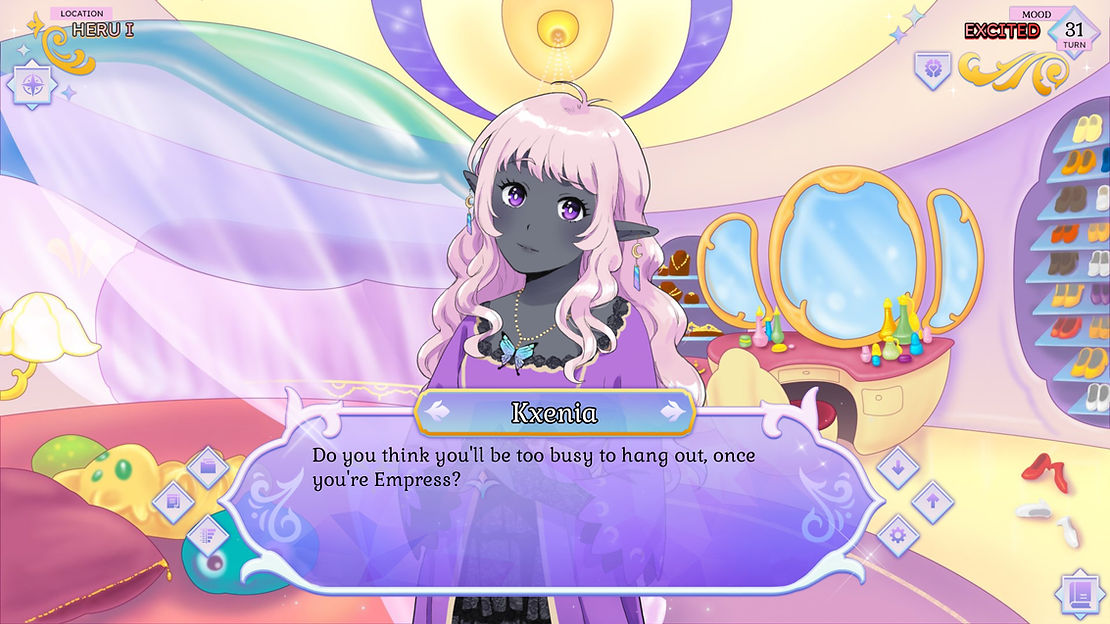
Galaxy Princess Zorana is a follow-up to the classic Long Live the Queen, which had you playing as a princess who faced an absolute gauntlet of fatal skill checks before her eventual coronation. If you played and enjoyed that game, or any other Princess Maker-likes, you should drop everything and play this immediately. LLTQ was previously the pinnacle of this genre, but Zorana is even better. If none of that meant anything to you, I’d highly recommend checking out LLTQ as well, but this is also a fine place to start.
Gameplay
Galaxy Princess Zorana and basically all games like it revolve around a simple turn structure where you pick a few skills to increase and then go through a bit of life and some skill checks before starting the loop again with another round of stat raising. Part of the fun is just watching all the meters go up, but the meat of these experiences is in all the branching scenarios that your improved stats lock or unlock. Failing a skill check in LLTQ frequently meant you were headed towards an assassination, but passing one could lead to uncovering a plot or opening up an entirely new option for the ending. No two playthroughs would ever be quite alike because there are so many choices to make between which stats to raise and what to do in the visual novel segments, and the order of operations could make a big difference if it swung the results of particular stat checks.
The cliche would be to say that Galaxy Princess Zorana takes that to 11, but it really takes it to more like 100. LLTQ was almost a puzzle game where certain events were more or less guaranteed to happen every time and the difficulty was figuring out what decisions you could make to survive to that point with the right stats to do something new. Zorana is firmly an RPG where every problem has numerous solutions and a decision that seemed correct on turn 5 can come back to bite you on turn 25. Instead of progressing through events determined by the game like in LLTQ, you’re now able to freely pilot your palace around the galaxy in order to visit different systems and try to convince the electors there to vote for you as the next Emperor. You need at least 17 votes to win, but how you get there is entirely up to you.
A typical turn plays out like this: First, you choose two stats to raise. Stat progression may be boosted, penalized, or completely blocked in each class based on your mood, which was determined by your decisions in the last turn. You could also choose to progress knowledge skills, which are boosted based on whether or not you’ve found skilled ministers for their respective domains. After you’ve taken classes, you have the choice of either keeping the palace where it is to receive a bonus social action, or you can move it to a connected sector to meet different electors. Then you might some events based on where you are and what you’ve done, which in turn could trigger lots of skill checks and choices that impact the story. Finally, you can interact with the electors at that location or members of your entourage. After you spend your social actions, you bump your mood to one of the adjacent spots on the mood wheel and play the next turn. Even that last decision is actually quite meaningful since moods impact skill progression and it may be unwise to, say, train with the guards to become Bold if you’ve angered the military faction.

Political Sim
It’s interacting with the electors that provides the deepest part of Galaxy Princess Zorana, though. Each elector is a member of certain factions and has a list of friends and enemies, which you can learn if you have a good intrigue stat and which play into how they feel about you. Hostile electors are usually a lost cause and may start plots against you, but negative and positive electors can be convinced to commit their votes to you in various ways. Some like you enough that negotiating with them will lead to a free vote, but most will give you a quest that you can complete in numerous ways to sway them to your cause. You could also take the easy way out and award them a ministry in exchange for their vote, but some electors are incompetent and others have no interest in playing politics. Still other electors might be swayed with a bit of blackmail or by turning on the charm, which could even lead to a political marriage. It’s a remarkably complex system, and that’s before you consider that all of this is duplicated across almost 30 electors with their own goals and alignments. As a social and political simulator, it’s hard to think of another game that can hold a candle to what’s on offer here.
If all of that sounds overwhelming, it could be, but the key is to view a lot of the complexity as simply being the fog of war in the election. A lot of games like this lose their immersion when you know the systems well enough to say “I shouldn’t talk to A on turn 5 because it’ll trigger an event on turn 7 that makes B hate me”, but Galaxy Princess Zorana’s massively overlapping systems support the illusion of these all being real characters. It might be unwise to offer your chief minister position to someone who doesn’t like you, but who can say if the assassination attempt that happened on the next turn was caused by them or by another hostile elector? For that matter, is that elector hostile because they were simply never going to vote for you, or did you anger them by helping their enemies too much? Some choices have more obvious impacts, but lead to such different scenarios that going back and doing something different leads to a whole new experience.
Death and Difficulty
Although this is much less of a death simulator than LLTQ, you’re still pretty much guaranteed to end your first run by dying in one way or another. There are so many stats with so many different uses that it’s hard to know what’s important until you’ve seen some of what’s in the game, and failing an important check somewhere along the line is almost inevitable. You’re allowed to rewind to the start of the turn once before the game kicks you back to the main menu, so you get a chance to change a couple of decisions and try again, but you’re also given dozens and dozens of save slots, so you can always reload from slightly further back. Doing that usually wasn’t super helpful in LLTQ since it was so much of a route planning game and you might need to rework your stat decisions entirely to survive, but Zorana has so much freedom that there’s usually a way to survive even then grimmest scenarios if you replay a few turns. You might need to carefully bump your mood around to avoid having the wrong one at a critical moment, steer the palace away from a particular sector, or just quickly raise a few stats, but clever use of all the game’s systems will usually get you there.
Of course, the other catch to Galaxy Princess Zorana is that simply surviving isn’t enough. Surviving to the election will still result in a loss if you haven’t collected 17 votes, and doing that while also surviving will require convincing a lot of people to vote for you in the easiest way possible. Even winning the election isn’t truly the end, because there are numerous ways to make it that far and quite a few mysteries that you may not even have scratched the surface of in your campaign. I ignored several branches entirely in my winning run, so it’s possible that those branch out in a way that makes the game even bigger than I think it is.
Conclusion
Zorana is a fantastic game. A lot of people will probably write it off because the title sounds like a Barbie game and some screenshots make it look like a lazy Princess Maker clone, but it’s really a sci-fi political adventure and roleplaying game with incredible depth. There are still things it could do better – some skills are largely useless, some systems could use more thorough explanations, and some characters aren’t tremendously interesting – but those are relatively minor flaws in what is otherwise a blast from start to finish. Don’t sleep on this one.
Rating: 90%
Time to beat: I won a run in 6 hours with a lot of reloading saves. Doing it without reloading would take much longer, and seeing everything will take much longer no matter how you do it.
Price: $25
For a similar game, see Volcano Princess Review – Volcano Maker
Feel free to leave a question or comment below!
For more reviews, see my Steam curator page: https://store.steampowered.com/curator/43219041


