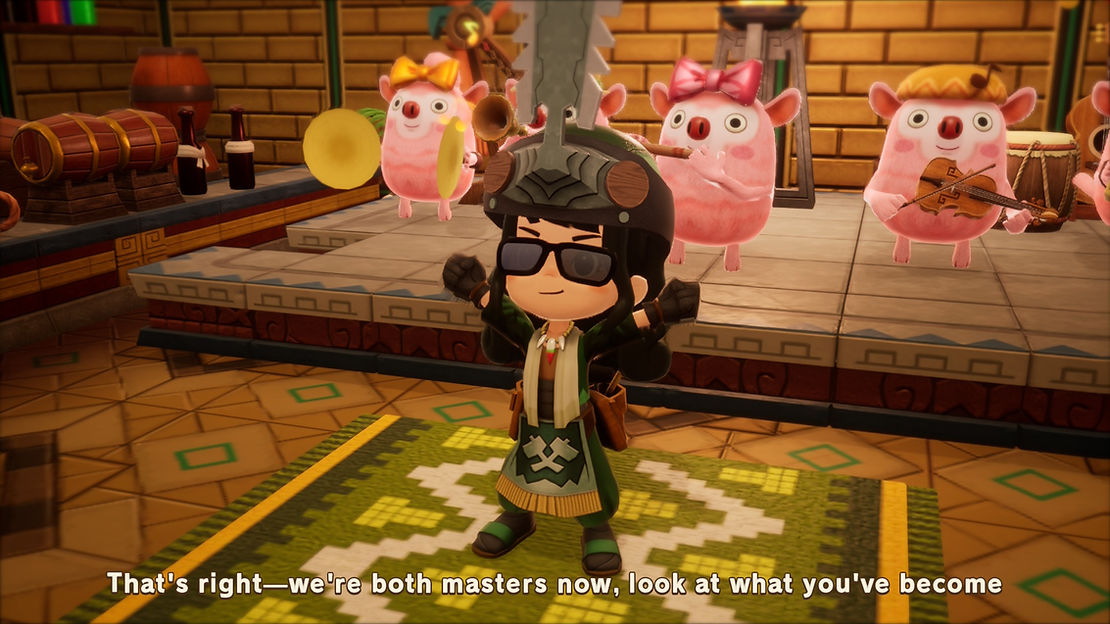

Fantasy Life i is a sequel to a largely forgotten 3DS game that combined a lite version of the Rune Factory farming/adventuring gameplay with a job system. The original game was held back by overly simple gameplay and dull combat, but now Level-5 took a second shot at the idea with a bigger budget and more powerful hardware. The result is still a simple enough game that almost anyone could play it, but now with robust adventuring and progression systems that keep you constantly excited to explore one more room or level up one more time.
The game revolves around the 14 “lives” that make up its job system. These are really different ways of accomplishing three tasks: combat, gathering, and crafting. You’ll eventually need to start all of the 10 gathering and crafting lives, which allow you collect resources from the world in order to later turn them into equipment so that you can get more powerful, collect better resources, and start the loop again.
Gathering lives all use minor variations on the same minigame where you need to find the sweet spot on the tree/rock/fish/plant you’re trying to collect and punch it with actions and skills so that its HP runs out before your stamina depletes. If you succeed, you get resources, but if you overkill the HP bar with a powerful skill at the last second, you get an Excellent! and receive bonuses. There are even boss resources that have massive health bars and move the sweet spot around during the fight. It’s just enough to keep gathering interesting throughout Fantasy Life i, and it’s always satisfying to take down a resource node that should have been beyond your level.

Just like gathering lives, crafting lives also all revolve around slightly different versions of the same minigame. In this case, you’re presented with three different actions on a table and need to input them as quickly as possible. Sometimes you need to hold or mash actions, and you’re rewarded with a bit of progression towards the recipe for every sequence you complete. If you reach 100% before you run out of actions, you get a recipe, but completing the sequences quickly and working with a high skill level can result in getting one a good/great/top quality item with significantly boosted performance. Crafting skill trees give you special abilities to input actions for free, extend the timers, speed up your inputs, and more. Just like the gathering lives, these are exactly as deep as they needed to be in order to stay engaging while also being easy to pick up and play.
Four combat lives round out the list, but you’ll probably only take one of them yourself. They’re basically your standard tank/DPS/ranged DPS/support archetypes, so you can pick however you prefer to play and leave the other roles to NPCs. Combat features standard attacks with no stamina cost, strong attacks with a small cost, special versions of both with high costs, and free dodging. It’s pretty standard stuff with an action RPG, but it works well and it’s fun to unlock new skills as you progress through the tree.
All 14 lives also have a Life Master who assigns you progression quests and gives you a rank up whenever you complete enough of them. This is probably the game’s best idea – the quests serve as both a guide to what you should be doing next and a satisfying skill check to serve as a gate to the next batch of content. Rank ups also reward you with powerful new equipment and unique armor sets for each life, so even a master angler can look the part with sweet shark-themed armor. There are even skills on the tree that are locked behind certain ranks, including ultimate skills for combat and gathering lives that deal massive damage and define your approach to bosses.

Fantasy Life i‘s last two great ideas are the Ginormosia and Treasure Grove systems. Ginormosia is a completely optional continent that rewards you with bonus characters and powerful gear if you’re able to complete its challenge shrines and caves. It’s divided into areas that can each be ranked up by playing in them, which leads to stronger enemies and better resources spawning in them. Treasure Groves, meanwhile, are randomized dungeons that task you with charting a path through a bunch of challenge floors to reach a boss challenge and unlock the next difficulty level. They’re undeniably repetitive, but they’re also treasure troves of rare resources and provide the most challenging content for the endgame. Both Ginormosia and Treasure Groves can be played in mutliplayer, which really helps extend the game’s value as you team up to take on what are effectively raid bosses.
Lives and the dungeons are the core of the Fantasy Life i experience, but everything else is at least serviceable. The story is decently entertaining and is very family friendly if you’re playing with kids. It’s got a distinctive chibi look that grew on me the more I played. The soundtrack is honestly pretty great. These are all just bonsues, though, because it’s the kind of game that lives or dies entirely based on how much you enjoy that core loop. If you don’t like it, none of the other systems will redeem the game for you, and if you do like it, you’ll probably be able to look past any issues you have with everything else.
Conclusion
I wasn’t sure what to expect going in to Fantasy Life i, especially since I bounced off the first game in under an hour, but it ended up being one of the best surprises of the year. It’s a joy to explore the world and level up your character in a half dozen different ways while doing so. It still has some occasional hiccups with poor enemy AI and I could do with more variety in the Treasure Grove objectives, but those are minor flaws in an excellent RPG. It’s even better if you’re able to play co-op, but make sure that everyone has their own game – the local co-op is an entirely different experience that relegates player 2 to a minor assistant role.
PS: If you are playing on Switch 2, get the Switch 2 version. It’s only $3 more and makes a huge difference to load times and graphical fidelity.
Rating: 90%
Time to beat: 45 hours to master a handful of lives and finish the main story. There is still a huge amount of game left from that point.
Price: $60
Feel free to leave a question or comment below!
For more reviews, see my Steam curator page: https://store.steampowered.com/curator/43219041


