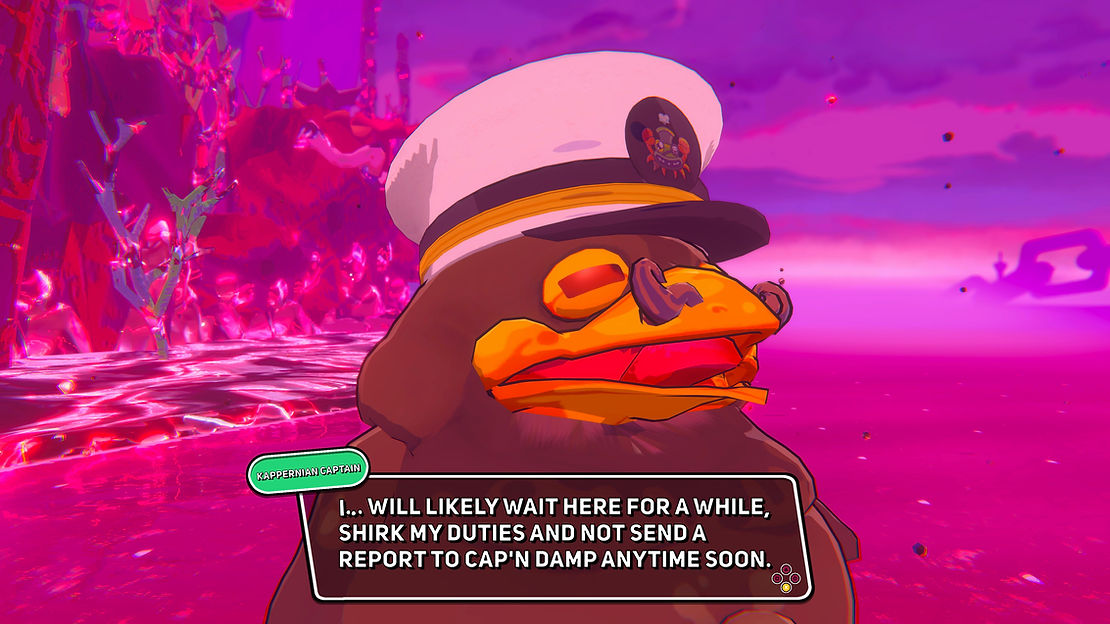
Demon Tides is a sequel to Demon Turf, a 2021 collectathon platformer that I liked a lot. Turf had a fairly unique aesthetic where almost all the characters in the game where 2D sprites that rotated towards the camera like the trees in Super Mario 64, and it was a hub-based game where each world had a distinct style. Tides ditches both of those features to become a fully 3D open world (or at least mostly open) where you journey between dozens of islands that each have their own bite-sized platforming challenges. It’s a bit of an odd blend of Wind Waker‘s ocean with Super Mario Odyssey‘s approach to collectibles. It’s a good idea.
Positives
I don’t want to come off too negative on a game that is largely well-made, so let’s start with what it does well. It really deserves a lot of praise for its approach to cosmetics, which are plentiful and entirely earned with in-game currency and progression. They didn’t even make a $10 upgrade with one extra costume, and that’s enough of a rarity in 2026 to be worth calling out. I’m also a big fan of the graffiti system, which combines the notes for other players from Dark Souls with a sticker system. The stickers other people have added really give a lot of areas extra character, and many of them also provide helpful tips about where to look for secrets. Demon Tides also brings back the unique checkpoint system from Turf, which gives you the freedom to place respawn points basically wherever you want, but also means there are almost none in the game world. You can play completely without checkpoints if you really want a challenge, but you can also place one after every jump if you value your time more. It’s great.
Open World
Demon Tides is divided into three ocean areas, and I really expected this to earn a high spot on my end of the year list through the first area. I’m a sucker for good exploration in games, and not many platformers offer as big of a world to explore as this one. The first islands you visit will likely to a great job of presenting new platforming gimmicks and challenge types to make you think the game will keep getting bigger and bigger, but it doesn’t. It’s tons and tons of islands with minor variations on the same few challenges and a couple of extra gimmicks. As much as exploring the ocean could have been genuinely fun, it’s let down by the feeling that whatever island you find next is probably going to play largely the same as the last one.
Mundanity
The elephant in the room, though, is that Demon Tides just doesn’t have any setpieces. The best platformers have moments like New Donk City in the aforementioned Odyssey, the murder mystery in A Hat in Time, or Astro Bot‘s parody bonus levels where the gameplay changes radically to surprise you and make it feel like anything could come next. I think the Gearserker and boss fights are supposed to fill this role in Demon Tides, but the simplistic combat makes all of these feel too similar for them to really count as surprises. For as much as this game revels in its wacky characters and silly environments, the gameplay just plays it straight the entire time. It’s a real missed opportunity.
Conclusion
That said, the platforming mechanics here are largely solid and if you just want a big list of small levels to do speedrun challenges on, Demon Tides is going to be well worth your money. There are a huge variety of collectible passive abilities and routes to optimize, so for someone interested in the leaderboards, I can easily imagine matching the 12 hours I spent with the game on a single one of the larger islands. For everyone else, though, it’s hard to recommend at $25. As much as it is a good game at its core, it just doesn’t have much other than those leaderboards to motivate you to keep playing.
Rating: 60%
Time to beat: I had 26 of the 35 gears needed to win after 12 hours, but had been exploring every island. You could probably beat a rushed playthrough in the same amount of time.
Price: $25


