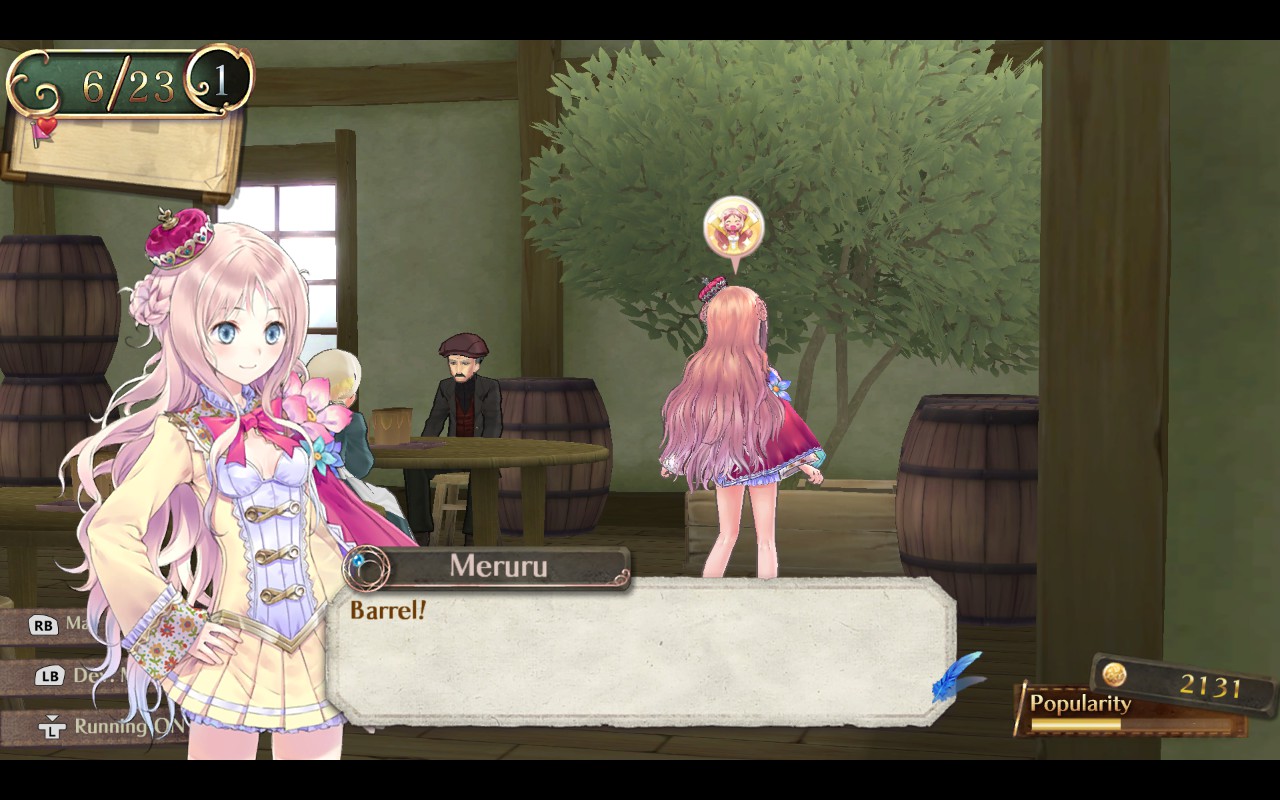
Atelier Meruru is the final game of the Arland trilogy. The plot follows Meruru, princess of the kingdom of Arls, who has decided to become an alchemist rather than do anything princess-y. Her father agrees to this as long as she uses alchemy to advance the kingdom, which is how Gust justified this being a very light city building game. Every task you complete awards development points and population, and development points can be spent to build facilities that give passive bonuses and more population. Your goal is to hit certain population milestones at the end of each year.
Just like with Rorona, the time limits in Atelier Meruru are so forgiving that you can basically just ignore them if you’re not going for 100%. If you are trying to get the best endings, the time limits are so punishing that reaching most of them is generally considered unrealistic until New Game+. This time around, there are no deadlines at all except for the easily reachable yearly population goals. Every task can otherwise be completed whenever. The vast majority of these require you to make a certain number of items and deliver them to a place, and any item with a particular specified trait counts twice. Other tasks require you to beat a particular enemy or just reward you for doing some action a ton of times. Many tasks that take place in a particular location cause visual and functional changes in that place after completion, which is very cool.

The city building you can do from completing tasks is fun at first, but ends up being pretty shallow. It’s presented as building facilities, but all you’re really doing is buying a bonus that gets delivered after some number of days. There’s no synergy between buildings and you can’t see the unlock chains in advance, so you usually can’t strategize any more than skimming the handful of options you have and picking the one with the most immediately useful bonus. It’s also disappointing that the developments never actually show up anywhere other than the world map, at least as far as I could tell. A couple of them do kick off some event chains, but you don’t get to see your shiny new facilities pop up in town. They’re just sprites in the center of the map.

Outside of those systems, there’s not much new about Atelier Meruru. Crafting and combat are almost entirely unchanged from Rorona and both still very rarely require any strategy. There are still far too many characters with too little personality, and you’re still constantly interrupted by boring events for those characters every time you try to move around town. Luckily, the fast forward options for text and battles have less lag than in Rorona, so you can at least speed through the boring bits.
Conclusion
Despite all that, Atelier Meruru is actually a significant step up in quality from the other two Arland games. It’s really all down to the tasks being more interesting. Yes, the writing is still awful and combat is mostly mindless, but it’s just so satisfying to see the different parts of the game world evolve as you progress. Some areas change completely from wild areas into farms or towns, and others receive structures that change the layout of the map or make new areas reachable. There are even projects that change the world map itself and create shortcuts to save travel time. Meruru is proof that doing one thing really well can make up for a lot of other poor design. As long as you’re willing to spend a lot of time in fast forward mode, there’s a fun game here.
Rating: 80%
Time to beat: 22 hours for one playthrough. There is an ending you can get at the end of year 3 by not having enough population, and that probably only takes 12-15 hours to reach.
Price: $30, but you can get the whole trilogy for that price during a sale
Feel free to leave a question or comment below!
For more reviews, see my Steam curator page: https://store.steampowered.com/curator/43219041