Today’s Game Boy games include a couple of sequels and what is probably the most famous Japan-exclusive game for the system. That latter game may explain why this was a relatively quiet month overall.
The usual reminder: Scores are out of 5 and reflect only how worth playing a game is today. Most games get 1s. Exceptionally bad games get 0s.

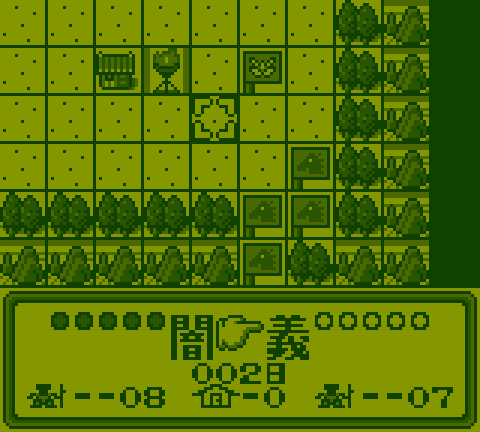
SD Sengokuden 3: Chijou Saikyou Hen (Bandai) (September 4th)
The third and final entry in Bandai’s Sengoku-era Gundam spinoff. Like the other two, it’s a tactics game with really basic overhead graphics. It continues to not show your movement range when you’ve selected a unit. It does show a counter for how many moves you have left, but you can’t undo a partial move once you’ve taken it, you seem generally unable to move in anything other than straight lines, and there are confusing rules that prevent movement even when you have points left. Presumably the manual would have explained all this. It’s hard to imagine there’s a good enough game here to deal with overcoming the bad UX.
Gamesoft felt that the story was poorly explained and that it was the kind of game where you needed to be familiar with the series to be able to enjoy it. Weirdly, despite being a Gundam game, I couldn’t find any other written opinions or scores. The game is certainly not forgotten, but nearly all coverage of it is in the form of Youtube videos. Seems like it at least has a small number of fans today.
Rating: 1.

The Sword of Hope II (Kemco) (September 4th)
Kemco’s second attempt at an adventure game on Game Boy did not fare much better than the first. It still features a distinctive UI and some nice character graphics, everything moves at a glacial pace and the battle system is basically just mashing attack. It’s the kind of game that is probably best experienced with a turbo fast forward on. You wouldn’t be able to hear the music, which is otherwise probably the best part, but it would be much closer to playable at 10x speed. It’s available on NSO.
Contemporary Western critics averaged 66%, although it’s worth noting that it was very delayed and didn’t arrive overseas until 1996. Oddly, EGM felt it was too ambitious for the Game Boy while GamePro felt it was basically unchanged from the first game. Neither scored it well. In Japan, it received a 22/40 from Famitsu and an 18.2/30 from Family Computer readers. Atwiki classifies it as a poorly balanced game, although I’m surprised they didn’t go with kusoge considering how long their negatives section is. It includes some pretty important things, like some magic spells not working and the damage from attacks being essentially random.
Rating: 1

Kinniku Man: The Dream Match (Yutaka) (September 12th)
Today’s crappy manga license is from a series that translates as “Muscle Man”. It’s a fighting game, and given the track record of manga licenses and fighting games on this system, you probably don’t need me to say that this is awful. It does have decent background graphics and good music, but the positives end there. The enemy AI constantly runs away unless you’re aggressively following them. Animation quality is wildly inconsistent. Worst of all, the controls feel like they don’t even do anything half the time. There is no animation canceling and almost any movement seems to lock out half the buttons for a random amount of time, so you’re left to just mash buttons and hope attacks happen. It’s one thing when rotoscoped games have this issue, but I can’t imagine why a sprite-based game controls this badly. It should be thankful that Pit-Fighter exists to stop it from being the worst fighting game on the system.
Famitsu awarded one of their lowest scores so far with a 17/40. Family Computer readers felt it was a more pedestrian level of bad and went with an 18.2/30. User opinion on it has certainly worsened since then. Atwiki labels it as both a “game disliked by series fans” and a kusoge, with criticisms mostly matching mine. They further call out some unfair stun locks, ineffective special moves, a small roster, and lazy character endings.
Rating: 0. There’s plenty of room to beat Pit-Fighter and still be a 0.

Kaeru no Tame ni Kane wa Naru (Intelligent Systems/Nintendo) (September 17th)
Undoubtedly the most famous Game Boy game never to leave Japan, this feels years ahead of its time. There have been a couple of other games to put more effort into their writing so far, like Jungle Wars or Seiken Densetsu, but even those can’t really compete with the presentation here. It has far more text than almost any other game so far and uses it to set up characters and humor in a way that its contemporaries just didn’t do. It also features graphics and music that, aside from the lack of color, would not feel out of place in a much later GBC game. Add in plenty of innovative gameplay ideas and it’s not hard to see why this is considered a classic. I had to mash through a lot of the text without translating for time reasons today, but it’s a game I will definitely be coming back to.
Famitsu awarded a 30/40, which makes it one of only a handful of Game Boy games to break into the 30s. Family Computer readers gave a slightly less impressive 22.2/30, but HiPPN Super! went with a 9/10. Japanese Wikipedia cites a long list of various websites, books, and TV shows that have given it awards and high scores. Atwiki unsurprisingly gives it the good game marker and lists very few negatives.
Rating: 5


Leave a Reply