March 27th, 1992, was one of the busiest days of the Game Boy’s life so far, with six new games released. I assume it has something to do with the start of the Japanese school year, but March wasn’t a particularly busy month in either 1990 or 1991.

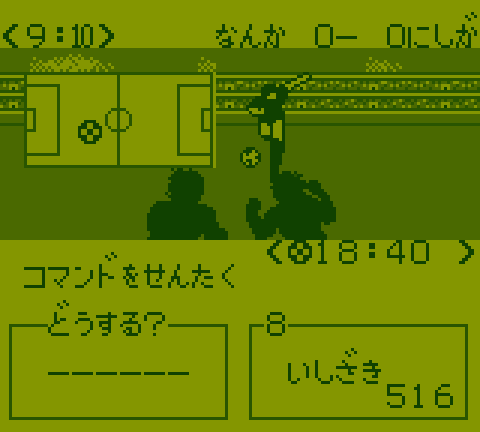
Captain Tsubasa VS (Graphic Research/Tecmo)
My knowledge of Captain Tsubasa begin and ended with the two games it got in the last few years. I assumed it was a recent anime based on that, but it is apparently actually pretty old, having run originally from 1981-1988. This first of two GB releases builds on Tecmo’s earlier games with the license for Famicom, which presented soccer matches as RPGs. While one of those actually made it to the West without the Tsubasa IP, this stayed in Japan. It’s pretty clear that Inazuma Eleven was inspired by this. The two games play almost identically except that Tsubasa is simpler, doesn’t have the same absurd super moves from what I saw, and limits your view of the field to the minimap in order to ensure that you always have the finest anime cutscene the Game Boy could show on screen. It looks incredible and is very innovative, but it’s not very playable. You also get treated to a horrible strobe light any time you take an action.
Famitsu gave it a 23/40, which was quite a step down from the 32/40 its Famicom big brother got. Despite having individual entries for every microtransaction DLC the later Tsubasa games got, Moby Games doesn’t know about this one, so I don’t have any contemporary Western reviews. It does have a couple of positive written user reviews on GameFAQs as well as some guides. Japanese players seem less enthused. The Atwiki post for it does praise a few things, like the music, but has a long section on divisive points and possibly the longest downsides section I’ve seen so far.
Rating: 2. A point for innovation.


Chibi Maruko Chan 3: Mezase! Taishou Game no Maki (KID/Takara)
They are really pumping out the games for this IP. It is pretty fascinating that despite releasing them so quickly, they are all completely different games. The first one was a gambling sim that involved no skill. The second was a weird adventure platformer. This one is basically the world’s most boring visual novel that makes you play microgames every so often. Your performance in said games does not matter at all, however, so I beat it by the power of turbo mode and mashing A. Words cannot being to convey how much text in there is in this game relative to gameplay, nor how impossibly slow the text moves. You can’t speed it up or skip. Still, it only took about 5 minutes to ‘beat’ in turbo mode, and the only punishment for failing every minigame was that poor Maruko couldn’t afford anything with all the tickets I didn’t win. Alas.
I could look up what the Japanese internet says about it, but I’m sure you we can all guess without looking. It’s low-effort shovelware that blatantly padded an unacceptably short playtime with interminable cutscenes. Certainly one of the worst games I’ve ever played.
Rating: 0

Chiki Chiki Machine Mou Race (Atlus)
I got excited when I saw this was a Wacky Races license made by Atlus. Unfortunately, there is apparently a reason why no one thinks of racing games when they hear that name. I can’t quite call it the worst racing game I’ve ever played because we just saw one a few days ago that was literally impossible to beat and consisted entirely of dice rolling, but this is up there. For starters, there is no animation whatsoever. Cars just slideshow forward with their sprites tearing everywhere on each frame. You accelerate by holding the dpad, and no matter how long you do that, no one ever seems to go any faster than about half the length of their car every second. The track is barely wide enough to pass anyone, and sometimes the other racers just stop. They become immovable objects when this happens. There are items like in Mario Kart, but they’re useless. I spent about a minute trying to play it and never saw any turns in the track, but I did run into some mud that made me move even slower. Everything about this is shockingly bad other than the music.
The game is deservedly forgotten. I didn’t find any coverage except by Gamesoft, who called it a disappointment.
Rating: 0

Janshiro (Sammy)
The mahjong games are going to get pretty common from here on out. I don’t think there’s much point to doing any research on them since they’re all basically the same thing and no one is ever going to recommend getting your mahjong fix from a 30+ year old monochrome Game Boy game. This one has crummier kanji rendering than previous options and the music is boring. Moving on.
Rating: 1.

Little Master 2: Raikou no Kishi (Zener Works/Tokuma Shoten)
Tokuma Shoten’s name made me a bit nervous that this would be another crappy manga license, but I’d forgotten that we’d already seen Little Master on Game Boy and it was one of the earliest SRPGs. This continues in that vein and is easily the most competent entry in its genre so far. The battlefield graphics are clear, combat animations fluid, and all the information you need is readily available. It even has good music. The story barely exists, but considering most competitors on Game Boy have literally not had a story at all, it’s ahead on that front as well. Still, while it’s very impressive for its time and system, it’s pretty basic by modern standards and everything takes forever to happen.
Famitsu gave it a 23/40 and Family Computer readers a 23.9/30. This game is also our introduction to new challenger Game Boy Magazine, who copied Family Computer’s polling system but added more significant figures to everything. Readers of that magazine went with a 24.972/30. Given those high reader scores, it should come as no surprise that it’s still fairly popular in Japan. Atwiki marks it as a good game and doesn’t have much significant to criticize other than some bugs. Gesato’s review didn’t find any bad points at all. Although the game never released outside of Japan, it does have a fan translation patch for anyone interested in giving it a go. Text is pretty limited and simple, so I think you could also get by on either basic Japanese or by just guessing.
Rating: 3. I’m not sure how well it holds up, but it’s clearly an achievement for the time.

Super Kick Off (Enigma Variations/Imagineer)
MobyGames and Wikipedia disagree on whether this released in Europe in 1991 or in June of 1992. Wikipedia is my source of truth for everything on this list, but given that the developer was based in England, I’m inclined to believe that it did not actually debut today. It’s far too late to go back and add it to 1991, though, so here we are. This has an impressive 81% critic average on its MobyGames page thanks to being great on Master System, Game Gear, and Genesis, but those versions came later and the Game Boy version sucks. It tries to present a zoomed-in soccer game where the ball is always in the center of the screen, which would be a successful format on other systems, but here the ball is too fast and you spend almost all of the time watching it roll out of bounds while no one is anywhere near it. If you do manage to get the ball, you run faster with it than without it, so that turns into just running down the field until an opposing player appears out of nowhere from the top of the screen and takes it. You obviously can’t see the goals until you’re basically standing in them and there’s no map indicating where you are on the pitch, so I’m not sure how shooting was intended to work. The buttons are horribly unresponsive anyway.
MobyGames has this at a 56% average from 4 critics, but the 81% review in Portuguese is doing a lot of work for that score. None of them are in English, but I can be pretty confident about what they said anyway. The Japanese version was known as Pro Soccer and added Japan as a playable team, but no one seems to have noticed. I didn’t find any coverage of it except by Gamesoft, who found it hard to play, and a bunch of sites that are no longer accessible.
Rating: 1


Leave a Reply