March 6th of 1992 only brought two new Game Boy games, but there’s a third that I forgot to cover in February.

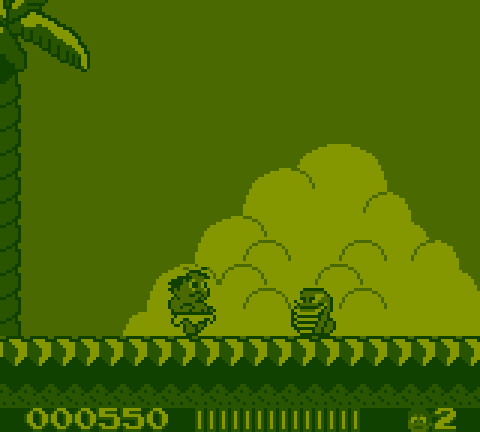
Adventure Island (Hudson)
This confusing game actually released a bit earlier in North American than in Japan despite being from Hudson, and is a remake of the NES game Adventure Island II despite being called Adventure Island. There will later be an Adventure Island II on Game Boy that is in fact Adventure Island III from NES. The game basically consists of slowly walking from left to right and trying not to touch the enemies, who all kill you instantly. Death sends you right back to the start to begin your slow march again. One user review on MobyGames described it as the most boring platformer ever. I agree.
Critics were more positive, averaging about 70% once you remove some modern reviews. None of them really said what they found impressive about it other than suggesting that Wonder Boy fans would enjoy it, which is probably true. I didn’t find any professional Japanese reviews, but Atwiki considered it a good game. The series is known as Takahashi Meijin no Bouken Jima in Japan, or Famous Takahashi’s Adventure Island. In a Final Fantasy-esque twist, the names are synced with the console versions in Japanese, so this game is Takahashi Meijin no Bouken Jima II.
Rating: 1. No idea what everyone else is getting out of this.

Dragon Slayer Gaiden: Nemuri no Oukan (Agenda/Epoch)
Another Dragon Slayer spinoff, but this time with house graphics that remind me a lot of Link’s Awakening. It lets you choose from a handful of classes at the start and then dumps you into what must be the longest cutscene on Game Boy, which is completely non-interactive and can’t be skipped. Once you’ve finished that a week later, you start out with no equipment and in an area that appears to be a dead end. It turns out that you can walk south after all even though the status bar looks like a wall. I bought some equipment in a shop without any indication of what it did and then went out of town. You have an actual attack button now instead of just running into enemies like old Ys games, but they still just run into you. That makes it really hard to tell when they’re attacking, which resulted in me dying without even realizing I’d taken damage.
Atwiki didn’t score the game, but gave it credit for good music (I don’t agree), some good graphics, and for game balance. Confusingly, they also dinged it for the Knight being unbalanced, for the growth systems and controls being hard to use, not being memorable, and having an annoying save system that relies on staying at inns. Gesato similarly gave it credit for being well made and having good music, but disliked that equipment piles up as you keep playing and found it generally inferior to Seiken Densetsu.
Rating: 1. A lot of the positive sentiment for it seems to be down to there not being many options for ARPGs on the sytem. That’s true, but hardly a reason to play today.

Rubble Saver II (A-Wave/King Records)
The first Rubble Saver was notable for its Western publishers having made the impressively sexist decision to reverse the roles of the two main characters and have the sister get kidnapped instead of being the hero. Rubble Saver II avoids any risk of that by starring a boy named Max in the first place, and also by not releasing in North America at all. Infogrames spared purchasers any worry that there might be a girl by naming the game simply Max instead of referencing the prequel.
Gameplay is largely similar to the first game, but you now have a max of two pieces of armor instead of just one and have a hookshot you can fire by pressing up to reach high platforms. It also gives you the choice of seven worlds to play at the start screen like it’s Mega Man. Western critics gave it a 68% from 5 reviews, but 4 of those are German. Some of those scores seem pretty harsh if they’re not using 5-centered scales.
I didn’t find any professional Japanese reviews or even many blog posts. Gamesoft had their usual short blurb that didn’t offer much beyond “some people might find some sections too hard.” Retroboy had a longer post that praised the controls, smooth animations, and sound effects, but criticized the music and the length of the game. They also gave it a 0 on the story scale for not having a story at all, which was funny. That said, that blog reviews games from the perspective of buying them at a used game shop today, and this is quite expensive for a GB game at 3,300 yen, so some of the length complaints are motivated by the modern price.
Rating: 2. The hookshot is worth a point.


Leave a Reply