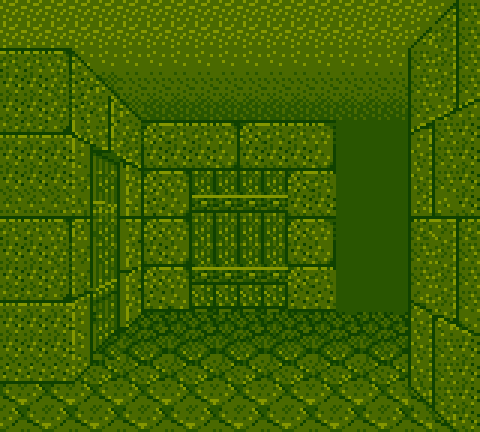
There were only two new Japanese Game Boy games in October of 1991, making it one of the quietest months since the system launched.

Wizardry Gaiden I: Suffering of the Queen (ASCII) (October 1st)
Although originally an American game, Wizardry was far more popular in Japan and has received dozens of exclusive releases there. This is the first of four exclusive games on Game Boy and is apparently based on the port of Wizardry V that ASCII had recently made for SNES. It’s far deeper than similar GB games so far. Your party consists of six custom characters with different classes and species, dungeons have puzzles, and there’s an extensive overworld village that acts as the menu for anything you might need to change. The graphics and sound are also quite good compared to the competition.
I did not find anything about how Famitsu or Family Computer reviewed it back in the day, but there is more modern coverage of this game in Japan than just about anything else I’ve looked at so far. It’s basically universally positive and covers reviews, guides, and Let’s Plays.
Rating: 3. Clearly it’s a very good game if this genre is your thing. The language skills required aren’t too bad, but there’s definitely a learning curve to it and the game expected you to have some familiarity going in. Screen translation is an option, but my test of it performed terribly (うんのつよさ became “strength of poop” somehow instead of “strength of luck”), so you may have more luck with a fan patch.

Xerd no Densetsu (Graphic Research/Vik Tokai) (October 18th)
(I had to use a different setup to launch this one, so enjoy a temporary reprieve from green)
The title of this game would normally be written as “Zard no Densetsu”, but the game’s cover art writes it in Romaji as “Xerd”, so here we are. MobyGames describes it as a parody, but Japanese Wikipedia makes no mention of that and Gamesoft was unclear on whether it was intended to be funny. The music and battle sprites are wonderful. However, the other graphics are pretty basic. Famitsu gave it a 24/40 and Family Computer readers a 19.5/30. It was praised for being relatively easy to play as a portable game, but criticized for being shallow and for enemy damage being too high. I definitely encountered the latter problem and had to go back to the inn after every battle. Luckily, most enemies die in one hit and leveling up is pretty fast, so you can probably solve that issue with a little bit of grinding.
Wikipedia has a dedicated section explaining why some people consider it a stupid game, or bakage. The story was rushed according to that description and features such scenes as the hero and heroine abruptly getting married upon entering a particular church, the heroine abruptly becoming pregnant and giving birth upon entering another area, and the child turning out to be the hero you weren’t told you were looking for. I did not find much coverage of this game outside of Wikipedia, but it got a sequel in 1993 that seems to be pretty controversial.
Rating: 2. As nice as the sprites and music are, it doesn’t seem like there’s much else here.
Leave a Reply