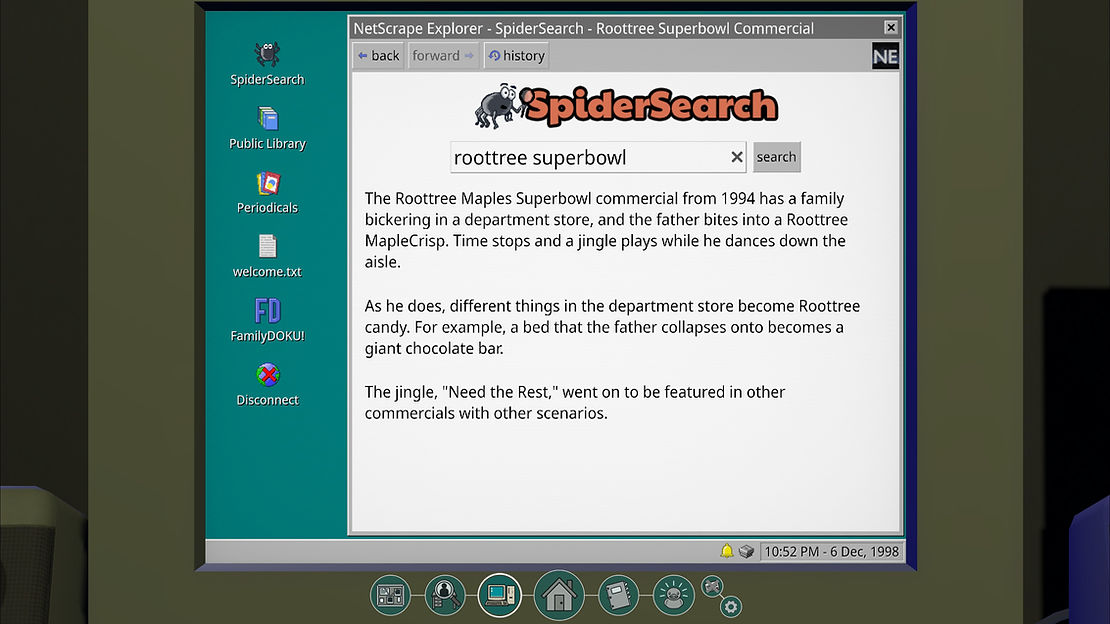
The Roottrees Are Dead is a game about using the raw power of Windows 98 and the late 90’s internet to find the sources you need to fill in 70 years of a family tree. It’s a remaster of a browser game from 2023, although the Steam release also includes a new mystery called Roottreemania that ups the difficulty significantly and has you tracing the possible descendants of affairs that the main game’s cast may have had. The most obvious comparison for both games is Return of the Obra Dinn, since it borrows that game’s “fill in N data points correctly and be rewarded with confirmation and more info” system, but this one is much more about following internet rabbit holes and tying together explicitly stated facts than on inferences. It absolutely captures the satisfaction of being able to add a new branch to your family tree because you found a reference in a local newspaper from fifty years ago or realized that someone went by multiple names, so if you enjoy that puzzle on your own family tree, you should stop reading here and buy the game.
For everyone else, your enjoyment is mostly going to hinge on how much you enjoy the process of searching for sources and finding the important text within a document. Most of the gameplay consists of reading a document to find all the important-sounding terms, searching for those terms online and in your databases, and then repeating the process with whatever you find. The base game has very few red herrings, so almost everything leads to evidence that helps you fill in part of the tree sooner or later, but documents often both contain directly useful facts and references to several deeper rabbit holes, so you need to go over the most important pieces quite a few times in order to get everything from them. You have a magic evidence number in the corner of each document that tells you how many unconfirmed facts or pieces of evidence it can still be linked to, which helps generally with knowing where to focus your attention, but it can also be frustratingly misleading. A few pieces that are tenuously connected to large parts of the tree will still have high numbers attached to them for hours after anything about them is still useful.

Roottrees includes a notebook and a lot of coverage of the game emphasizes that it’s a note-taking experience, although personally I didn’t think that was necessary in the way that it was with something like Obra Dinn or Blue Prince. You might need notes to refresh your memory if you play the game over several sittings, but it’s only a few hours long and most facts are eventually stated directly enough that you can piece everything together from memory and referencing the family tree. Both games end by suddenly asking you to solve a related mystery that would benefit from notes, but you may not have written down anything relevant to them anyway since they weren’t part of your original task. The extra mysteries are optional, fortunately, so if you’re like me and are satisfied with filling in the tree, you can still progress to the credits with no penalty.
I think the best way to approach Roottrees is to essentially treat the initial mystery as an extended tutorial, then come back a few days later and play Roottreemania separately. The games are too long and too similar for most people to want to do them both back-to-back, but Roottreemania is a far more satisfying puzzle and you should absolutely take the time to do it if the base game was enjoyable. Like I said before, Roottrees are Dead does not have many red herrings or dead ends, so you can pretty safely assume that almost anything you find is relevant simply because it exists, and that means the puzzle is just piecing together what goes where. Roottreemania has far more extraneous info, so you have to think about whether something is actually important before just slamming it into the tree. It also makes you separately fill in first and last names from lists that are only populated with names you’ve encountered, so you can’t just infer someone’s existence from their presence in the list like you can in the base game.

All that said, the mysteries are not perfect. My biggest criticism is that several logical leaps you’re required to make are really only supported by the existence or absence of documents about a character. It’s very reasonable to assume that one character is the correct answer if you can trace descendants of them and can’t find anything about another in a fictional world, but that reasoning obviously makes no sense if you’re trying to immerse yourself in a genealogy puzzle. It’s great that character A has generations of descendants I can find, but that’s no proof that the affair wasn’t with character B. Similarly, there are a few places where you’re required to assume that a picture or reference is of a particular character on seemingly no basis other than that there’s no one else you know of that it could be. These puzzles work well enough as pieces of game design, but for immersion’s sake I’d have preferred that the documents gave you a more solid basis for making connections. Like I mentioned earlier, I also didn’t enjoy suddenly having a different puzzle to solve at the very end. That’s more personal preference than a flaw in the game – the extra mysteries are designed well enough, but I didn’t like going right from the “I did it!” feeling of filling in the whole tree to immediately being asked to read over everything again to do one more thing. Your mileage may vary. Roottreemania‘s bonus mystery is much more involved and also more interesting as a story, although it seems to require a lot of bold assumptions and I’m not sure that the science behind a couple of the twists is entirely sound.
Conclusion
At the end of the day, Roottrees is a game that you can probably tell if you’ll like just from looking at it. Do you enjoy genealogy or historical research? Then you’ll almost certainly like this. If you don’t it’s going to be hard to get past that. The core mystery isn’t anywhere near as interesting as simply exploring this family’s history and filling in all of their stories, so a love of mystery stories isn’t going to get you past not enjoying reading all of the documents. A love of 90’s tech might help you a bit, since this does a great job of capturing the sounds and appearances of using the early internet, but even that is more of a bonus. If this looks interesting but you’re on the fence because of the price or because you’re worried about the difficulty, you could check out the shameless clone A Case of Fraud, which has copied everything about the gameplay in a cheaper and much easier box. Roottrees is a far superior game, but that’s an easier introduction to the gameplay if you’re concerned. Lastly, I just want to emphasize again that you really should come back to do Roottreemania at some point if you enjoy the base game. Lots of Steam reviewers say they were satisfied after just the first story, and I felt that way at first as well, but you’re missing out on the best parts if you don’t come back for the second chapter. Since it was released two years after the original game, it’s easy to jump into even if it’s been a while since you played the first story.
Rating: 85%
Time to beat: Roughly 3-4 hours for Roottrees are Dead and roughly 5-6 hours for Roottreemania
Price: $20
For another good mystery game, see No Case Should Remain Unsolved Review – Plaintext Detective
Feel free to leave a question or comment below!
For more reviews, see my Steam curator page: https://store.steampowered.com/curator/43219041


