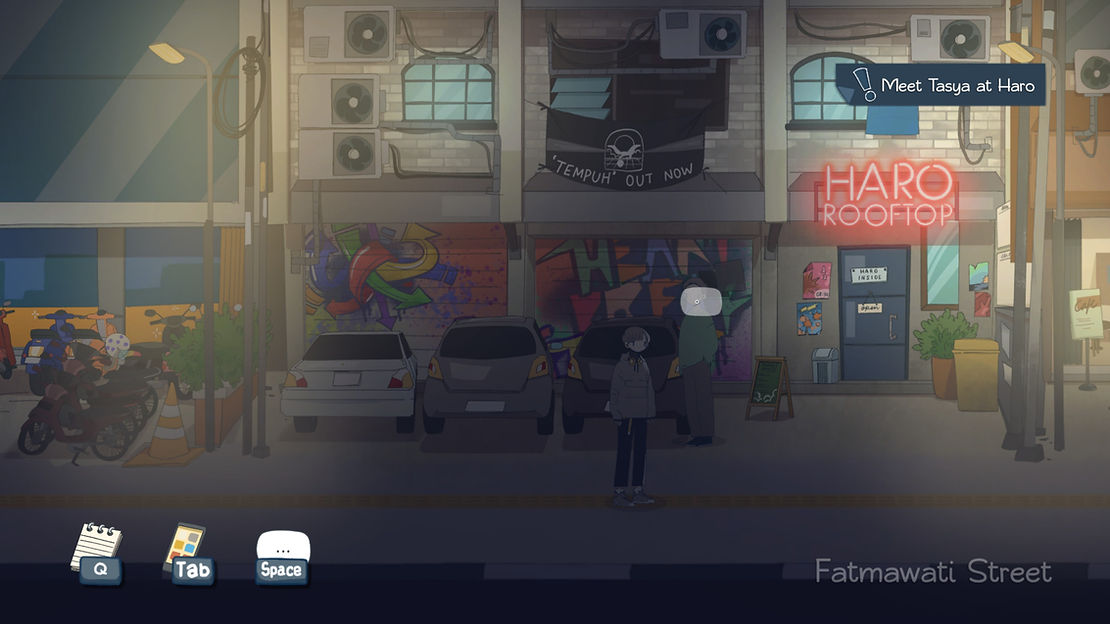
Afterlove EP describes itself as being part dating sim, part narrative adventure, and part rhythm game. The game spends a lot of time on the idea of spreading yourself too thin, and it’s a lesson that it should have taken to heart. None of AEP’s parts a fully fleshed out, and all have flaws that hold the game back in one way or another. It might have been more successful if it had picked one idea and stuck with it.
Start with the part that is both the smallest part of Afterlove EP and the least problematic: the rhythm minigames. You’re in a band and have to play a song once or twice every time you go to practice. This is presented with a weird two track setup with notes coming from the left and right to converge on a single point, but the timing window is so forgiving and the songs so basic that this isn’t likely to give you any trouble if you’ve ever played a rhythm game before. The music is actually pretty good, but I think it would have been more effective if it had fully committed either to being a rhythm game or a music video. As it is, the songs aren’t challenging enough to be interesting, but they also don’t give you enough time to read the lyrics translations at the bottom of the screen.

Next, the narrative adventure. This is both the most important part and the one that’s most responsible for the rest of Afterlove EP not really working. It wants to tell you a story about how Rama is dealing with the metaphorical ghost of his girlfriend Cinta by presenting her as a literal ghost who haunts his thoughts. It’s a neat idea with one critical flaw: ghost Cinta is intensely unlikable. She’s essentially the voice for all of Rama’s negative and self-centered emotions, and while the game goes to great lengths to tell us that she wasn’t like that in life, it does very little to show us that. A major character with this awful of a personality would drag down any experience, but it’s much worse when you’re supposed to be sad about her loss. It’s hard to be moved by any of the memory vignettes when your own experience with Cinta has been so miserable. If all that weren’t enough, the skip text function doesn’t properly worked on Cinta’s voiced lines, so she also slows fast forwarding to a crawl any time she decides to interject.

As for the dating sim part, there are three characters (one male, two female) that you can choose to date, which you’ll do by repeatedly choosing to visit that character Persona-style. Each scene with that character typically gives you a couple of opportunities to pick one of three dialogue options, but as far as I know the scenes generally end the same way regardless of what you pick. The characters are written well enough and there were interesting setups in the route I saw, but it feels like this was added as an afterthought because of how poorly it integrates with the rest of the game. Your dialogue choices do matter to the ending you get, but only in that they aggregate to some invisible score determining if you get the good or bad ending. This produces some wild non-sequiturs where the game ends with everything fine only for you to get the bad ending post credits, but even the “happy” endings are pretty underwhelming. One character’s happy ending is a breakup supposedly justified by mutual enabling that was never shown on screen, and another’s is basically just a minute of talking about how great therapy is.

Finally, all of this is further dragged down by the calendar system they again copied from Persona. You have a day and night period for every day of one month, but not actually much choice about what to do. The good ending for the band requires attending every therapy session and each job while the good ending for your date requires seeing all of their scenes and viewing all 11 Cinta memories. Combined, that leaves you with only a handful of free periods in which you can either talk to one of the other two characters for no reason or engage in equally pointless busking. You’d probably think that a game with so many endings would make it relatively quick to try again and see another, but no. You’ve got to do all of that again from scratch each time and it’s going to take 2-3 hours even if you’re holding skip the whole time. Which would be bad enough for making you watch those 11 memories repeatedly, but since the way the dialogue choices add up to your final character score is so unintuitive, there’s a pretty good chance that you’ll end up with the wrong ending anyway unless you were following someone’s guide.
Conclusion
I really wanted to like this game. It has some individual scenes that are excellent. It’s obvious that the team poured their hearts into it in memory of their founder who really did die to soon. But despite the touching backstory, there’s no getting around that it’s uneven and sometimes tedious as a game. Much like its main character, Afterlove EP spreads itself too thin and doesn’t care enough about the experience of others. You could do a lot worse than playing it, but I still can’t recommend that you do.
Rating: 60%
Time to beat: 5-6 hours to get your first ending and 2-3 for additional endings.
Price: $20
For a similar game, see A Space for the Unbound Review – Perfection in the Imperfections
Feel free to leave a question or comment below!
For more reviews, see my Steam curator page: https://store.steampowered.com/curator/43219041


