
StarVaders is not the first tactical roguelite or even the first tactical deckbuilding roguelite, but it is the first to get much attention. The game’s 88 OpenCritic score is high enough that it’ll almost certainly finish in the year’s top 10 by that metric, and it managed that despite having no marketing at all. Does it live up to that reputation?
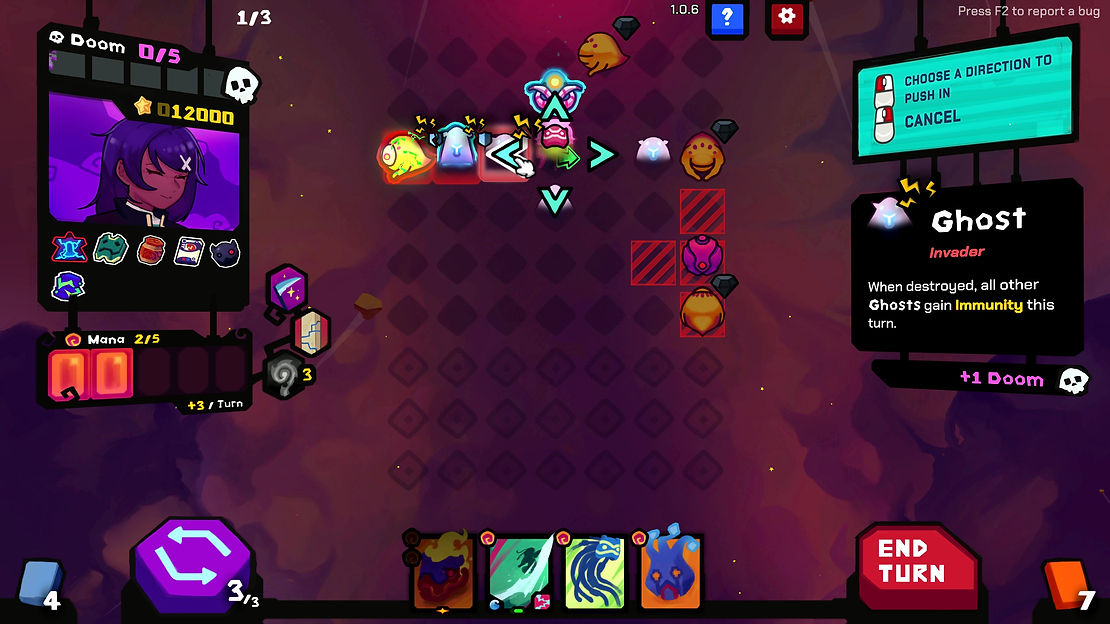
Starting with the positives, StarVaders is easily the most visually appealing of the tactical roguelites and one of the best looking roguelites in general. It’s full of bright colors and clean graphics that both pop and are easy to understand despite minimal on-screen text. It even shows clear simulations of each action you take, allowing you to know exactly how attacks will chain or reflect off of enemies, including how follow-up shots in repeated attacks will behave when they fire.

StarVaders also has a huge variety of small ways to shake up each run. There are 3 playable mechs with their own decks and mechanics, 3 non-secret difficulty levels, 10 pilots who add new cards and passives to the mechs, and about a half-dozen modifiers that can be randomly applied to each fight. None of the changes are radical enough to feel like a new game, but you do need slightly different strategies to beat the same fight with different conditions applied. It further helps that cards can be upgraded with any of a pool of modifiers, which can cause two initially identical cards to eventually fill very different roles in your deck.

Lastly for the positives, StarVaders has some excellent boss designs. The Grandmaster in particular is one of the most unique fights I’ve seen in a roguelite, and nearly all the others have their own fun twists on the formula. Each boss then rewards you with a choice of several artifacts that can allow you to play your deck in a new way – maybe junk cards suddenly have utility or certain card types are buffed at the expense of another. Tactical roguelites have historically not had much variety in bosses, so this is a very welcome change.

As for negatives, there’s really only one. Unfortunately, it’s both a major flaw and one that has plagued this genre: despite all the ways the game tries to add variance, there just isn’t enough to keep runs feeling different. This is primarily because a fairly basic general strategy is universally successful for every character and against every boss: focus on attacks that hit multiple spaces, avoid taking doom and prioritize removing it if you get any, and choose upgrading cards and taking artifacts over gaining new cards. The game has all sorts of cards you can buy or find that might be very useful sometimes, but every pilot also has a few basic cards that can be easily upgraded into being universally powerful and it’s very easy to find artifacts that boost your abilities by more than any new card ever could.
The best roguelites counter strategies like this with specific encounters that force you to have a backup plan. Slay the Spire‘s Act 3 bosses are all hard counters for overly specific strategies, for example. This tries to do something similar by including combat modifiers that make splash damage dangerous, but it’s easy to avoid those fights, and none of the bosses make a convincing attempt to require a different approach. I did lose a few runs using characters that have more unusual core mechanics, but for the most part I got the 12 wins needed unlock Apocalypse difficulty and beat it with every pilot with minimal difficulty. There is a true ending and a higher secret difficulty that would unlock if I kept playing, but I’ve lost interest by this point.
So StarVaders isn’t quite there. It’s a very solid foundation for a game with one of the best UIs in the genre, but it’s far to easy to build basically the same unbeatable deck with every character. The good news is that the 16 hours it took me to win with every pilot feel like a reasonable return on a $25 game. Still, I’d recommend waiting a bit on this one. A few patches or a DLC that add more difficult bosses or more dangerous combat modifiers could be all it takes to make this game into something special. As it is, it’s pretty good without being particularly memorable.
Conclusion
Rating: 80%
Time to beat: 16 hours to beat the third difficulty with every pilot. There’s a higher difficulty that would eventually unlock if I kept winning, but 10 times on the same level is already too much.
Price: $25
Feel free to leave a question or comment below!
For more reviews, see my Steam curator page: https://store.steampowered.com/curator/43219041


