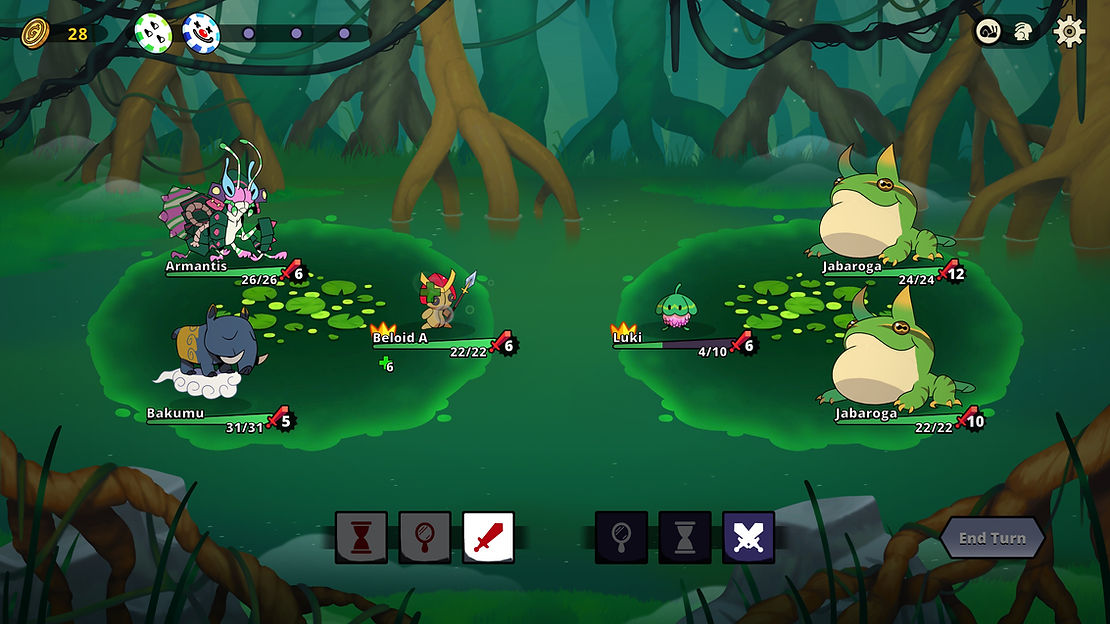
Dicefolk is a rougelite monster battler that takes obvious influence from both Slay the Spire and Pokemon. You fight rotation battles a la Pokemon‘s Generation V/Black and White, but the actions of monsters on both sides are controlled by dice. You click the die you want to activate and may also get to chose who is targeted by it depending on the action. You can always chose not to use some of your own dice, but all of the monster dice have to be used each round, so battles tend to be order of operations puzzles where you need to use the monster powers in the least effective way possible. Almost every monster also has a special ability like getting free attacks under certain circumstances or suffering a penalty to compensate for amazing basic stats, so you’ve got to pay attention to how those interact with the battle as well.

Unlike the climbing maps of Slay the Spire, Dicefolk‘s map lets you freely move between all the nodes available. Each level provides at least two opportunities to swap in new team members. One of those chances comes from the three statues on the map, which will give you an additional choice of monster for each one you activate. You could choose whatever the first one spawns and get a new monster quickly, or you could wait until you’ve activated all three and have a better chance of getting one that really fits with your team. Later statues have better odds of spawning rare or shiny (“incandescent”) monsters with improved abilities, so there’s extra incentive to wait. Your other chance comes from a guaranteed event that lets you spend money to buy a single monster that’s randomly chosen before you make the purchase, so it won’t always be one you’ll want.
Most of the fun of Dicefolk comes from those monster collection events and the other events that help build out your strategy. Each map also has two shops that provide improvements to your dice faces or even additional dice to use each turn as well as single use items and passive equipment. Still other events give you direct stat boosts, ways to increase how much equipment you can use at once, or choices between some or all of the above. You can make some very powerful monsters if you make good use of these events, and healing is easy enough to come by that I found it almost always worthwhile to clear each floor.

Unfortunately, that last sentence also hints at the game’s biggest issue. I found that building out one ridiculously boosted monster and doing every event on each floor was a dominant strategy. That might not be a problem if the ways of making one strong monster were as varied as the ways of making a strong deck in StS, but here it seems like the key is almost always just about getting your leader’s strength as high as possible and finding some ways to get regen. It follows a very similar pattern with StS where you have to reach the final boss door with every character before you’re actually allowed to fight that boss, but unlike StS, I reached the door on my first try with all but one character and then beat the boss on my first try all but one time as well. The lack of difficulty might be a less immediate issue if you’re new to the genre, but the effective strategies are so simple that I think a new player would still find them pretty quickly.
To its credit, Dicefolk does do a few innovative things to try to mitigate that problem as you keep playing. It has an ascension mode like every roguelite, but this one is unique in that both you and the enemies get a buff with each level. This helps runs start to feel unique again since each successive win leads to further modifiers, but since you’ve already won the game many times by the point you’re able to access ascension, it’s almost certainly coming after the fatigue has started to set in. Winning runs also leads to new monsters unlocking and new events, and of course you can change between different characters, but most of these have little real impact on your strategy after the first floor.
Conclusion
All of which makes Dicefolk an odd game to recommend. It’s fun and has a battle system that’s very different from any other roguelite, but it’s too basic to have much longevity. If you’ve already played StS, etc, you’ll probably get bored of this one well before seeing all the content. If you haven’t already played that, it’s hard to suggesting starting here unless the battle system or art is dramatically more appealing to you. I’m happy having gotten about 15 hours out of it before it started to drag, but I know many people are looking for much more time from games in this genre. I’d suggest giving it a chance on sale and refunding if your first run doesn’t grab you, because Dicefolk is never going to be terribly different from what you’ll see in your first run.
Rating: 80%
Time to beat: About an hour per successful run if you do everything
Price: $15
For another Pokemon-style roguelite, see Necromancer for A Week Review – A Good Time, Not a Long Time
For more reviews, see my Steam curator page: https://store.steampowered.com/curator/43219041


