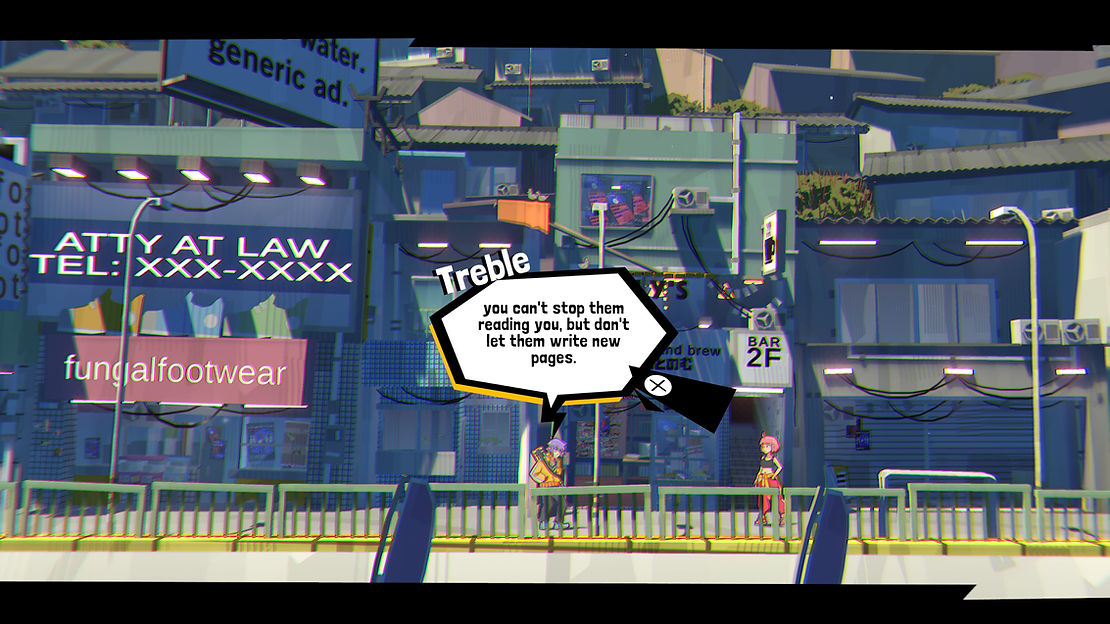
The final credits sequence in UNBEATABLE includes several heartfelt notes from the development team. I start a lot of my reviews by saying “so-and-so game is…”, but one of those notes did a much better job of explaining what this game really is than anything either I or its store page could hope to convey. This dev hoped that, whether you like the game or not, it sticks with you.

That might not sound very informative, but once you play the game you can tell that it’s the philosophy that drove the whole project forward. UNBEATABLE does a lot of things. A lot of them don’t really work. Some people aren’t going to like it because of a pacing issue here or an unbalanced minigame there. If you stick with it, though, you’re going to get an experience that a team of people clearly poured their souls into. You still might not like it for any number of reasons, but it is going to stick with you. That’s the kind of game you’re getting.

I’m not going to go into a ton of detail about the story because, for the most part, I think it’s better experienced the way the game presents it. The important things to know are that it’s chiefly about the complicated emotions and motivations that go into both making art and living life, and that the pacing is all over the place. I nearly refunded the game partway through act 2 when I couldn’t really tell if anything interesting was going to happen. By the end of act 3, I was blown away. Then it slowed down again, only to deliver an absolutely brilliant ending. You will go through as much of a roller coaster as the characters in the game. If you’re going to enjoy your time, you have to be willing to look past some minigames and scenes that probably should have been cut. It is a deeply and undeniably flawed experience, and yet also one that delivers moments few other games can match.

unbeatable, which can apparently be written in all caps or no caps, is also a rhythm game. The core gameplay is sort of like the Taiko no Tatsujin series in that you’re going to be asked to press one of two buttons and sometimes shake it up by pressing or mashing both of them at the same time. The real twist is that you hit notes when they reach the center of the screen and they will shift between coming from the left or the right throughout the song. It takes some getting used to and some story mode maps stretch this idea a bit past the point of being readable, but it’s great when it works. The arcade mode features an incredible number of songs and, if that’s what you’re really interested in, is easily good enough to justify the price of the game even if you never touch the story. I certainly wouldn’t play that way, but it’ll be the best answer for some people.

Of course, the music selection is almost even more important than the gameplay for a rhythm game, and that’s where unbeatable is practically beyond criticism. Whatever flaws the rest of the game may have, the music is truly top-notch throughout. I chose it as my favorite soundtrack of the year when the demo came out a few years ago, and the full game delivers an improved and expanded version of that already exceptional OST. Most reviews have compared this to Jet Set Radio because of some very obvious story similarities, but for me, the game that comes to mind is The World Ends with You. That was a game that felt like had a lost masterpiece of an album for its soundtrack, and so is unbeatable. Plus, you know, they have similar art, enemies based on noise, Japanese settings, and characters named Beat. It’s probably not a coincidence.

A part of me really wants to give this game a 10. I can’t for all the reasons I’ve already mentioned, but the best parts of unbeatable truly are that good. For me, the best games are the ones I come away from feeling their story in my core and knowing that I’ll still be thinking about them in five years. UNBEATABLE is one of those games, but it is also a game whose plot completely lost me for an entire episode before it recovered against all odds. Maybe a game about messy people living messy lives needed to be a little messy itself in order to really work. I don’t know. In the end, this is the game that it is with the flaws that it has. And I love it anyway.
Conclusion
Rating: 95%
Time to beat: About 10 hours for the story, but you could spend dozens or hundreds of hours on the arcade.
Price: $30
Feel free to leave a question or comment below!
For more reviews, see my Steam curator page: https://store.steampowered.com/curator/43219041


