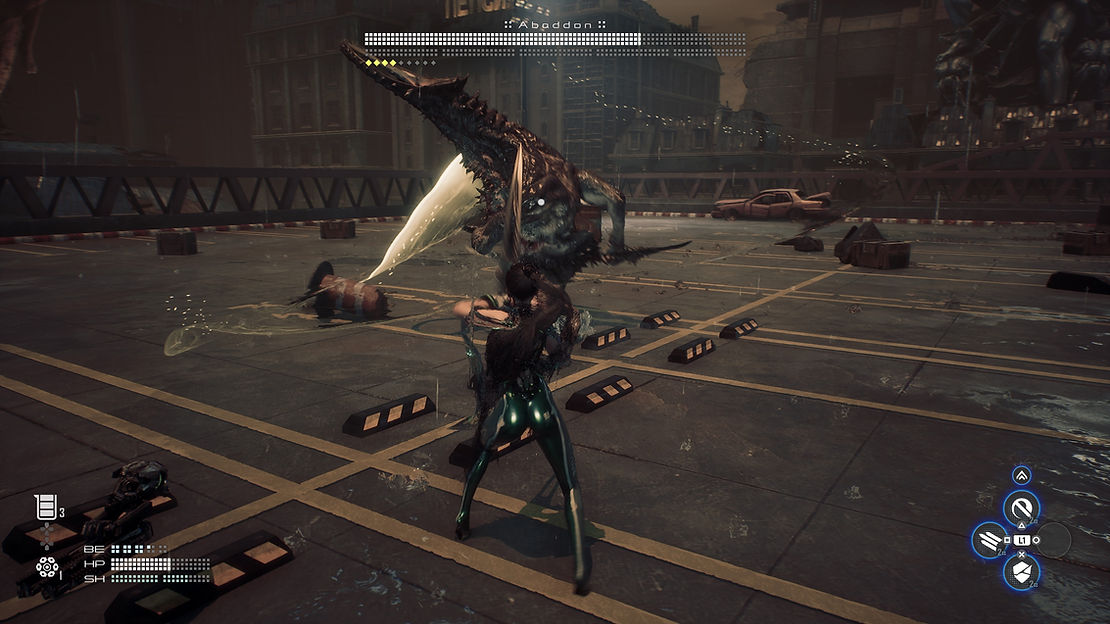
Stellar Blade has a slightly undeserved reputation for being chiefly a fanservice game. The modding scene for it is almost nothing else, but the game itself doesn’t really lean into that beyond having a wide variety of impractical outfits, and there’s much more going on here than just a hot player character. That’s one of about a billion ways that Stellar Blade is similar to NieR: Automata, although it also draws a lot of inspiration from Soulslike games and it isn’t quite safe to say that liking NieR means you’ll have fun with this.
Combat
SB is primarily a melee combat game with a very heavy emphasis on parrying. Dodging is an option, and even required for some attacks, but since parrying has a much shorter cooldown and depletes enemy balance bars, it’s far superior in general. Enemies are great about having varied attack sets that are still reasonably readable, with most of them also mixing in unblockable attacks and grabs that will punish you for trying to spam parry. Just about any action in combat will also boost various special attack meters. Those in turn allow all sorts of different effects depending on your build and situation. Provided that you like parry-heavy combat, it all works brilliantly and the three difficulty levels should keep it fun for most players.

Boss fights are a particular highlight. Every boss plays quite differently, and even the optional repeated fights in sidequests have changes to keep them fresh. While all bosses generally follow the same formula of abruptly gaining strength somewhere around the 50% HP mark, the game is very good at making sure that you don’t fight two bosses in a row that use similar styles. The special attacks you can land against bosses if you manage to deplete their massive balance bars are particularly satisfying thanks to some great animation work. That said, you can run up against unfortunate fight scripting if you’re not careful. Bosses often can’t take damage beyond their strength gain point until they do their “roar!” cutscene, so your big fancy special attack can end up doing basically no damage depending on timing.
Exploration
Like NieR, SB’s campaign alternates between linear areas and open world zones. The former are much stronger than the latter. Linear areas do an excellent job of progressively building up enemy group difficulty and mixing in non-combat sequences to constantly feel fresh. A few of them even take major detours to briefly turn the game into a survival horror or puzzle experience, although it’s never anything as drastically different as Automata‘s shmup sequences. The open world areas are much more uneven. At their best, they provide satisfying optional challenge sequences and a ton of collectibles, but they often feel like big empty fields with far too many of the same mobs dumped in. This might not have been a huge issue if it was easier to avoid combat, but since many enemies are fast and you’re unable to interact with anything if an aggro’d enemy is within a mile of you, you’re going to have to fight dozens of the same enemies if you want to do all of the side content. While the linear areas are good at making each encounter feel a little different, every fight against the same mob in a big field plays essentially identically. I ended up dropping the difficulty just so these unchallenging fights would go faster.

SB’s borrowing from Soulslikes is also at fault for the tedious open world encounters. It copies the system of respawning enemies whenever you use a camp, but it really shouldn’t have. This decision is almost entirely irrelevant in linear levels since there’s usually no reason to backtrack to those enemies, and in open world areas it just means that you end up having fully identical fights against respawns to go with all the nearly identical fights. I assume the reason the game is so “generous” with enemy placement is that it provides enough health and potion upgrades that any given single enemy eventually stops being a threat, but adding even more boring fights wasn’t the right solution to that problem. A mod to reduce enemy frequency in the open world would go a long way to making these areas less tedious.
Graphics and Sound
SB’s graphics and music are well done, if not particularly original. The music alternates between somewhat generic high energy pop or electronic tracks and aping Keiichi Okabe’s work for NieR, but it’s mostly catchy stuff. The visual art includes nightmarish mutants similar to Resident Evil, human-machine hybrids who’d look at home in Cyberpunk, and even some environments that reminded me of Vanquish. And, inevitably, a lot of NieR. Just like the music, you’re probably not going to see anything truly new, but nearly all of it is at least interesting. My only real criticism is that the open world areas go too hard on being wastelands and really could have used more color and fewer repeated decorations.

Story
The writing is the one area in which Stellar Blade truly stumbles. It will not come as a surprise that the plot is basically a slightly modified retelling of NieR‘s story, but it is unfortunately not a very good retelling. The major characters have threadbare motivations and minimal personality, and the minor characters often might as well have just been sign posts. There is a plot twist, but it’s so painfully obvious that you’d most likely see it coming even if you skipped every cutscene. Nearly every sidequest amounts to “Help! My friend disappeared!” and ends with “they died.” Nearly every note you can find in the world is “Oh no, we’re going to die!” On top of all that, the voice acting is often flat, so you’re getting cliche dialogue delivered poorly in a predictable story. The only good news here is that you never need to actually read any of the boring notes and cutscenes are relatively infrequent, so the writing at least stays out of your way most of the time. It would have been a better game with a competent story, but the next best thing is making it easy to ignore. Just don’t go in expecting anything from it.
Conclusion
Stellar Blade tries to synthesize ideas from a lot of other games and mostly succeeds. While almost none of it is remotely original, it’s hard to complain about a well-made Automata copycat when that series has gone almost 10 years without a sequel, and the ideas it borrows from other series at least feel fresh in this setting. The story and uneven open world hold it back from being truly excellent, but if Shift Up can fix those issues in the sequel, they’ve got a real chance of getting there on the second try. As it is, Stellar Blade is an easy recommendation that’s just shy of greatness.
Rating: 85%
Time to beat: 33 hours to do most side content. Finishing everything might have been around 40, but all achievements requires NG+
Price: $60
Feel free to leave a question or comment below!
For more reviews, see my Steam curator page: https://store.steampowered.com/curator/43219041


